


 3 min read
3 Passive Income Strategies With Paxos Global Dollar Stablecoin $USDG




 AI Overview
Paxos’ Global Dollar (USDG) is a fully backed, MAS- and MiCA-compliant stablecoin that redirects ~97% of reserve yield to partners, enabling exchanges and DeFi venues to offer materially higher user returns than USDT/USDC.
- New business model: Paxos’ revenue-sharing forces partners to compete on yield, challenging profit-maximizing issuers and reshaping stablecoin economics.
- Low-risk access: Exchange auto-earn programs (e.g., Kraken, OKX) provide simple, no-lock exposure to USDG yields.
- Higher-return options: Solana lending and stablecoin pools can deliver ~8–14% APY but carry liquidation, counterparty, and smart-contract risk.
Tether’s USDT and Circle’s USDC largely dominate the stablecoin market, but other players are increasingly trying to overshadow these giants in the passive income space.
Tether and Circle keep 100% of their enormous profits. To challenge this business model, Paxos, a leader in tokenized gold, introduced its Global Dollar (USDG) stablecoin. Its idea is to share 97% of its network revenue with partners.
What Is USDG?
USDG is Paxos’ second USD-pegged stablecoin, following Paxos Gold (PAXG) and its earlier Pax Dollar.
It is fully backed by US dollars and Treasuries, regulated under MAS in Singapore and compliant with MiCA in Europe.
Unlike USDT or USDC, USDG does not aim to maximize issuer profit. Instead, Paxos passes almost all reserve yield to partners—exchanges, payment processors, and liquidity venues—who then decide how much to share with users.
This is the core reason USDG can offer higher yields than other regulated stablecoins.
 DON’T GET REKT
Curated drops, testnets and red flag alerts straight to your inbox ✌️
 You’re in. Thanks for joining our newsletter.

Passive Income Strategies with USDG
Retail users do not earn yield directly from Paxos. They earn because:
- Paxos pays reserve income to partners
- Partners compete by passing that income on to users
So USDG yields exist where institutions choose to share them. That creates three practical ways to earn.
Opportunity 1: Auto-Earn on Centralized Exchanges (Lowest Risk)
Exchanges like Kraken and OKX earn revenue from holding and minting USDG. They share part of that revenue with customers through “auto-earn” programs.
You simply hold USDG on the exchange and opt into earnings.
- No locking
- No staking
- No DeFi interaction
For example, OKX currently pays 4.1% APY on USDG balances above $1, paid weekly. That is materially higher than USDT or USDC, which often pay nothing.
This is the simplest and safest way for retail users to earn USDG yield.

Opportunity 2: Lending USDG on Solana (Medium Risk)
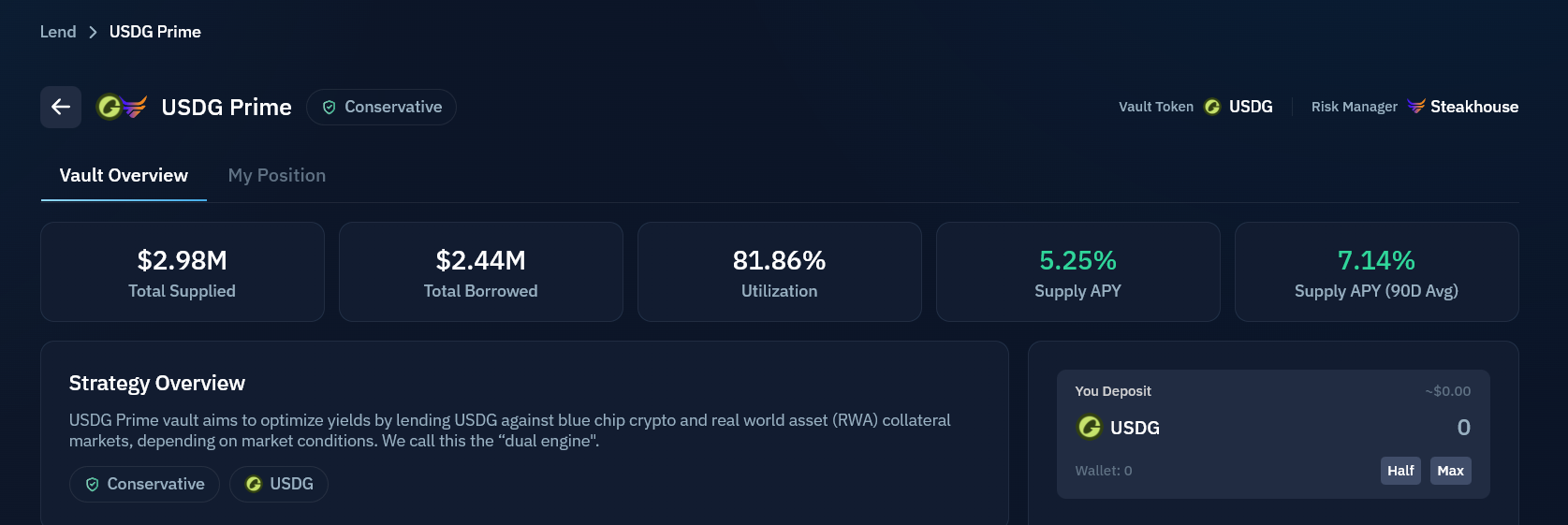
USDG is live on Solana, where DeFi protocols like Kamino allow you to lend it to borrowers.
Solana is faster and cheaper than Ethereum, and offers deep liquidity for those who wish to engage with DeFi. Holding Global Dollar USDG on Solana enables access to lending and borrowing markets such as those offered by Kamino.
By supplying USDG:
- You earn interest from borrowers
- You may also earn points or incentives (e.g., Kamino airdrop seasons)
Advanced users can loop (borrow and re-supply) to increase yield, but this adds liquidation risk. Typical yields can reach 8–12%, depending on market conditions.
Opportunity 3: Liquidity Pools (Higher Risk)
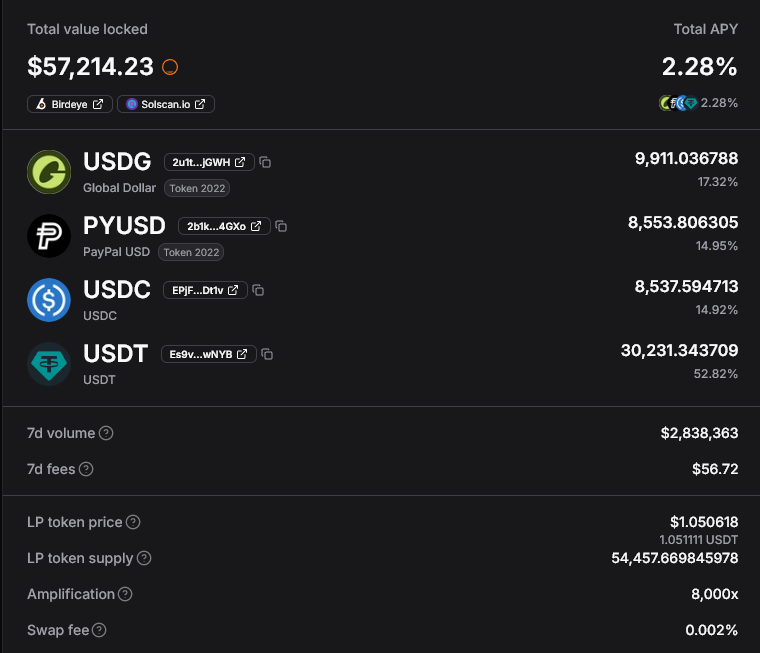
If you’re feeling really brave, you can head to a protocol like Stabble and provide USDG liquidity to a stablecoin pool like the one below to earn an annualized rate of about 14.18% from pool fees.
USDG can be deposited into stablecoin liquidity pools, such as those on Stabble.
These pools pay fees from trading activity. A USDG-USDC-USDT-PYUSD pool recently showed ~14% APY, but this fluctuates and carries smart-contract and pool risk.
This is for experienced DeFi users only.
Bottom Line
USDG is not a retail yield product, but its revenue-sharing model forces exchanges and DeFi platforms to offer better returns for passive income than USDT or USDC.
For conservative users, exchange auto-earn is the cleanest option. For DeFi users, Solana lending and pools offer higher upside.
Overall, USDG will likely become one of the most important yield-bearing regulated stablecoins in 2026.



 Thank you for your feedback! We’re glad you found this article helpful.
 An error occurred while sending the form, please try again.
 We are sorry. You've already sent a message within the last 60 seconds. Please wait before sending another.
 Thank you for letting us know! Our team will review your feedback to help improve our content.
We're sorry you did not find what you were looking for. Please select the reason this article was not helpful.