


 8 min read



 AI Overview
Stablecoins in 2025 function as productive, low‑volatility yield vehicles—linking short-term Treasury returns with on-chain income. The guide compares CeFi and DeFi paths, shows typical APYs, and pinpoints the safest ways to earn steady passive yield while managing custody, contract, and regulatory risks.
- Strategic value: Stablecoins act as digital savings, delivering predictable yield from Treasuries, lending demand, fees, or tokenized RWAs without crypto price exposure.
- Safe allocation: Keep a core in treasury/RWA CeFi (~4–5%), add DeFi lending for ~6–8%, and a small slice to conservative aggregators or hedged products for upside.
- Risk controls: Prioritize audited contracts, transparent reserves, diversification, and avoid opaque double‑digit APYs with no clear revenue source.
Stablecoins have become more than just a way to park funds in crypto. Thanks to key regulatory developments like the GENIUS Act and CLARITY Bill in 2025, stablecoins are becoming a reliable gateway to earning a steady yield without taking on the price volatility of Bitcoin, Ethereum, or other tokens.
For many investors, the question is no longer if they should put their stablecoins to work, but how to do it safely.
This guide breaks down the safest strategies to earn yield on stablecoins today. It separates centralized finance (CeFi) and decentralized finance (DeFi) methods, explains how each works, and highlights the risks to watch out for.

Stablecoin passive income cheat sheet for crypto beginners
Strategy |
What you do (1-liner) | Typical APY (2025) | Earn on $1,000/yr* | How you get paid | Liquidity | Good for | 3-step setup (beginner) |
| Centralized lending (CeFi) | Deposit stablecoins in a custodial interest account | 4%–8% | ≈ $60 | Interest funded by institutional borrowing and low-risk investments | Usually flexible; some fixed terms | Hands-off income, bank-like experience | 1) Create and verify an account 2) Deposit stablecoins 3) Choose flexible or term deposit |
| Treasury-backed / RWA CeFi | Hold a stablecoin or account that passes through T-bill yield | 4%–5% | ≈ $50 | Interest from short-term Treasuries or money-market assets | Usually flexible; sometimes payout cycles | Safety-first baseline yield | 1) Confirm product links to T-bills 2) Deposit stablecoins 3) Opt in to yield accrual |
| DeFi lending (overcollateralized) | Supply stablecoins to on-chain lending pools | 4%–10% | ≈ $70 | Borrowers pay variable interest; protocol distributes it | Usually instant, subject to pool liquidity | On-chain users who want transparency | 1) Fund self-custody wallet 2) Bridge to chain used by the pool 3) Supply stablecoins to lending market |
| Stablecoin liquidity pools (DEX) | Add liquidity to stable-to-stable trading pools | 2%–5% fees (+ up to ~15% with incentives) | ≈ $60 | Your share of swap fees (+ optional token incentives) | Usually instant; depends on pool depth | Earning from trading activity, low price swings | 1) Provide equal values of two stablecoins 2) Deposit into a stable pool 3) Claim/compound fees (and incentives if any) |
| RWA DeFi protocols | Deposit into on-chain vaults that buy tokenized Treasuries or loans | 4%–9% | ≈ $65 | Pass-through interest from real-world assets via tokens | Often flexible; some have notice periods | Real-yield on chain with conservative assets | 1) Complete any KYC if required 2) Mint/subscribe to the RWA token/vault 3) Reinvest payouts |
| Yield aggregators (stablecoin vaults) | Let a vault auto-rotate among safe DeFi/RWA yields | 5%–15% | ≈ $90 | Aggregated interest, fees, and rewards, auto-compounded | Usually flexible; vault queues possible | “Set and forget” with diversification | 1) Choose a conservative stablecoin vault 2) Deposit stablecoins 3) Monitor reported holdings/metrics |
| Delta-neutral / synthetic yield | Use hedged strategies (e.g., staked ETH + short perps) wrapped as a stablecoin or vault | 5%–15% | ≈ $90 | Funding + staking yields while price exposure is hedged | Usually flexible; may rely on perp markets | Higher yield without betting on price | 1) Pick the hedged stablecoin/vault 2) Deposit or mint with stablecoins 3) Track APY and peg stability |
Quick picking guide (for absolute beginners)
- Want the simplest, safest option? Start with treasury-backed/RWA CeFi (~5%) as your core.
- Want transparent, on-chain yield? Add DeFi lending (target ~6–8% when demand is healthy).
- Want a one-stop option? Use a yield aggregator labeled “Conservative” to diversify across lending/RWA.
- Comfortable with some complexity for extra yield? Allocate a small slice to delta-neutral/synthetic products.
Red flags to avoid
- Promised double-digit APY with no clear source (who pays you and why?).
- Uncapped exposure to a single stablecoin or unaudited smart contract.
- Withdrawal hoops you didn’t see upfront (lockups, penalties, or vague “maintenance” delays).
- Platforms that won’t document reserves, audits, or risk parameters.
Here’s why stablecoin yields are the best way to earn passive income
For years, stablecoins sat idle in wallets or on exchanges. That changed when issuers and protocols started channeling them into real-world assets (RWAs) like US Treasuries, and when DeFi protocols refined their lending and liquidity models.
Today, yields on stablecoins largely mirror traditional finance benchmarks. Short-term Treasuries yield around 5%, and stablecoin products linked to them now pass those returns on to users. Meanwhile, DeFi lending and liquidity pools provide organic yield from borrower demand and trading fees.
This has created a new environment where stablecoins act like digital savings accounts, with different strategies catering to different risk levels.
CeFi strategies: Simple but custodial
CeFi refers to centralized providers—exchanges, lenders, or fintechs—that take custody of your stablecoins and generate yield on your behalf. The yields are usually lower than those in DeFi, but the user experience is simpler. The trade-off is that you must trust a company to safeguard your funds.
Centralized lending and interest accounts
The classic CeFi model works like a savings account. You deposit stablecoins, and the provider lends them to institutional borrowers or invests in safe assets. A share of the interest is returned back to you.
- How it works: Borrowers pay interest for using your stablecoins. CeFi platforms also invest in safe debt like Treasuries and pass a portion of the returns on to you.
- Typical yields: 4%–8% APY, with occasional promotional rates up to 10%.
- Risks: Custodial risk (trusting the platform to stay solvent) and credit risk (borrowers defaulting). Transparency and regulation matter here.
Treasury-backed and RWA-linked products
A newer CeFi model ties stablecoins directly to real-world assets like government bonds. Instead of the issuer keeping all the returns, holders now share in the yield.
- How it works: Funds are invested in short-term Treasuries or money market funds. The interest, about 5%, accrues to stablecoin holders.
- Typical yields: 4%–5% APY, depending on Treasury rates.
- Risks: Very low asset risk (since Treasuries are safe), but still custodial and regulatory risk remain. Some jurisdictions restrict stablecoins from paying yield unless they are licensed.
DeFi strategies: On-chain and Transparent
DeFi allows users to earn yield directly through smart contracts without intermediaries. Assets stay in your wallet, and yields come from on-chain activity such as lending, trading, or tokenized RWAs.
DeFi carries smart contract risk—bugs or exploits can cause losses. But for many, the transparency and control make DeFi more attractive.

Overcollateralized Lending
DeFi lending markets let you supply stablecoins to pools that borrowers can draw from by posting more collateral than they borrow.
- How it works: Borrowers pay interest. If their collateral falls, it will be liquidated to repay lenders.
- Typical yields: 4%–10% APY, depending on demand.
- Risks: Smart contract bugs and interest rate volatility. In a market crash, liquidations may lag, but top protocols are designed to withstand shocks.
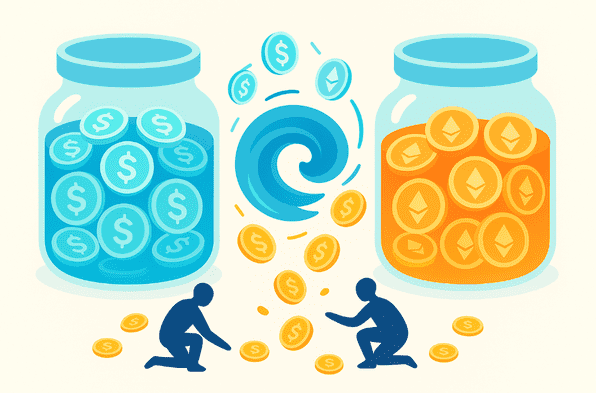
Stablecoin liquidity pools
Automated market makers (AMMs) allow you to provide liquidity for stablecoin trading pairs like USDC/USDT. You earn a share of trading fees and sometimes additional token incentives.
- How it works: Traders swap stablecoins, paying small fees that are distributed to liquidity providers.
- Typical yields: 2%–5% from fees, and potentially 5%–15% when incentives are added.
- Risks: Smart contract issues and the risk of depegging if one stablecoin in the pool loses its $1 value.
Real-world asset protocols
DeFi now includes protocols that connect to traditional finance. Stablecoins deposited are used to purchase tokenized Treasuries, corporate debt, or real estate loans.
- How it works: Yield comes from interest paid by governments, companies, or borrowers. Tokenized claims are managed through smart contracts and legal structures.
- Typical yields: 4%–5% for Treasuries, 6%–9% for higher-risk RWAs and some strategies combine yields to deliver 7%–9% returns.
- Risks: Legal and counterparty risk—someone must actually hold the off-chain assets. Liquidity can also be slower than it is with purely on-chain assets.

Yield aggregators
Yield aggregators are automated vaults that optimize returns by shifting funds across lending pools, liquidity pools, and RWA strategies.
- How it works: Smart contracts move capital to whichever safe yield is currently highest and compound returns.
- Typical yields: 5%–15% APY depending on the mix of strategies.
- Risks: Extra smart contract layer and reliance on the aggregator’s strategy. Best suited for users who want convenience and diversification.
Delta-neutral and synthetic yield strategies
More advanced strategies use derivatives to hedge volatility and capture funding or staking rewards. These often power new synthetic stablecoins.
- How it works: For example, holding staked ETH (+4% yield) while shorting ETH futures (earning funding fees). The price exposure cancels, but the yields remain.
- Typical yields: 5%–15% APY, with ~8%–10% being common in 2025.
- Risks: Execution risk if hedges fail, reliance on derivatives markets, and complex mechanics. These strategies are not beginner-friendly but can be powerful tools for experienced users comfortable with structured products.
Key Considerations for Safety
Before choosing any strategy, think about the type of risk you are most comfortable with:
- Smart contract risk: DeFi yields can vanish if a protocol is hacked. Stick to audited, battle-tested platforms.
- Custodial risk: CeFi yields are only as safe as the company holding your coins. Always ask: do they publish audits, and are they regulated?
- Liquidity risk: Some strategies lock capital or rely on assets that can’t be sold instantly.
- Regulatory risk: Laws around interest-bearing stablecoins are still evolving. CeFi providers in particular must comply with banking-style rules.
- Yield sustainability: If yields are too high without clear justification, they may not last. Organic yields in 2025 mostly cluster around 4%–10%.
Summary table
| Strategy | How it works | Typical yield (APY) | Risks |
| Centralized lending | CeFi lends stablecoins or invests in safe debt | 4%–8% | Custodial, credit |
| Treasury-backed/RWA CeFi | Stablecoins backed by Treasuries or money funds | 4%–5% | Custodial, regulatory |
| DeFi lending | Supply stablecoins to overcollateralized pools | 4%–10% | Smart contract, market |
| Liquidity pools | Provide stablecoin pairs to AMMs, earn fees | 2%–5% (fees), up to 15% with incentives | Smart contract, depeg |
| RWA DeFi protocols | Invest stablecoins in tokenized Treasuries, loans | 4%–9% | Legal, liquidity, counterparty |
| Yield aggregators | Vaults diversify across best yield sources | 5%–15% | Aggregator contract, strategy risk |
| Delta-neutral/synthetic | Use staking + futures hedges to extract yield | 5%–15% | Execution, derivatives market |
Final take
Stablecoins are no longer just idle cash in crypto. By 2025, they have evolved into productive assets offering yields tied to real-world interest rates and organic DeFi activity.
For those with balanced risk tolerance, a practical approach is diversification:
- Keep a core allocation in safe Treasury-backed stablecoins earning ~5%,
- Place some funds in DeFi lending pools for ~8%,
- Consider allocating a smaller portion in advanced or aggregator strategies for ~10%+.
The safest path is to always understand how the yield is generated and to avoid anything opaque. With the right mix, stablecoins can provide steady, transparent returns—effectively becoming the backbone of a new digital savings market.
-
01.
What is the safest way to earn passive income with stablecoins in 2025?
The safest strategies in 2025 are those tied to real-world assets like US Treasuries and overcollateralized DeFi lending pools. These generate organic yields of around 4%–6% annually without relying on unsustainable incentives. They minimize exposure to volatility and are backed by transparent interest payments or government bonds.
-
02.
How much yield can I realistically earn on $1,000 in stablecoins today?
Stablecoin yields in 2025 typically range from 4% to 10% depending on the method. It means $1,000 can potentially earn about $40 to $100 per year as per experts. Safer RWA-backed strategies track Treasury rates around 5%, while DeFi lending and automated yield vaults can push returns closer to 8%–10%.
-
03.
What risks should I know before investing stablecoins for yield?
The main risks are custodial risk in CeFi (trusting a platform to safeguard deposits), smart contract risk in DeFi (bugs or hacks in protocols), and liquidity risk in some RWA products. Regulatory changes may also affect interest-bearing stablecoins. Beginners should diversify strategies and stick to yields backed by real borrowing, transaction fees, or Treasuries.



 Thank you for your feedback! We’re glad you found this article helpful.
 An error occurred while sending the form, please try again.
 We are sorry. You've already sent a message within the last 60 seconds. Please wait before sending another.
 Thank you for letting us know! Our team will review your feedback to help improve our content.
We're sorry you did not find what you were looking for. Please select the reason this article was not helpful.

 You’re in. Thanks for joining our newsletter.
