


 7 min read
Bitcoin Restaking Explained: Earning yield from BTC in 2026



 AI Overview
A 2025 playbook for making idle Bitcoin productive via Lightning routing, wrapped/synthetic BTC in DeFi, conservative centralized yields, and emerging Bitcoin restaking—covering typical returns, custody trade-offs, and practical sizing to manage protocol and liquidity risk.
- Methods: Self‑custodial Lightning, sidechains and restaking for BTC-native alignment, wrapped/synthetic BTC lending/LP, and conservative CeFi or institutional option strategies.
- Trade-offs: Higher yield usually means smart‑contract, bridge, coordination or counterparty risk; choose methods that match your custody and monitoring appetite.
- Actionable allocation: Keep a cold‑storage core, use small capped slices for yield, diversify venues, prefer audited designs, and monitor lockups and penalty models.
Bitcoin doesn’t pay native staking rewards. However, in 2026, you can still make BTC productive—without turning it into a speculative gamble—by using fee-based networks, DeFi, conservative centralized yields, and a new class of Bitcoin “restaking” protocols.
Rather than waiting for a BTC price increase, you can gain through staking protocols and put your idle Bitcoin to use.
This guide explains the main methods, what they pay, how they work, and the risks you need to manage. It stays strategy-focused (not platform-led), beginner-friendly, and global.

What changed in 2026
- Lightning and L2 usage has matured: Running a competent Lightning node can earn routing fees, though results vary widely and require active management.
- Wrapped/synthetic BTC in DeFi is now standard practice: BTC can earn interest or fees on major chains, with well-known trade-offs (bridge and smart-contract risk).
- Bitcoin “restaking” has emerged: New protocols let you time-lock native BTC to secure other networks and earn rewards—often without bridging.
- Centralized yield is now more conservative: After 2022–23 blowups, regulated venues offer lower but clearer rates, with proof-of-reserves and tighter underwriting.
- Institutions have productized yield. Basis trades and covered-call strategies are now available via funds/ETFs in some markets, converting volatility into income.
Layer-2 methods: Lightning fees and sidechains
Lightning routing fees (self-custodial)
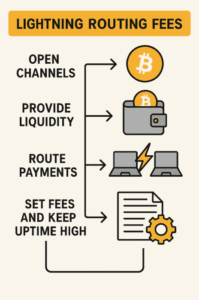
How it works. You open channels, provide liquidity, and route payments. You set fees and keep uptime high. Returns depend on your connectivity, liquidity balancing, and automation.
Typical outcome. Many solo operators see low single-digit annualized returns after costs. Well-run, well-connected nodes can do better, but it’s an operational craft, not a “set-and-forget” yield.
Main risks.
- Channel management errors or being offline when challenged.
- Capital tied in channels; closing them costs on-chain fees.
Good for. Technically inclined users who value self-custody and want modest, organic BTC-denominated income.
Sidechains with Bitcoin-first design (rootstock, stacks concepts)
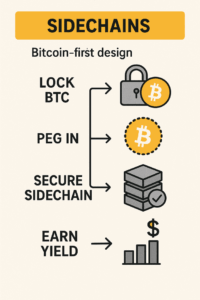
Rootstock-style DeFi. Convert BTC 1:1 to a sidechain representation (e.g., RBTC) and lend or LP in money markets/AMMs to earn interest and fees. Trade-offs include federated peg and smart-contract risk.
Stacks-style “stacking.” You don’t stake BTC itself; you lock the chain’s native token to receive BTC payouts sourced from miners. It’s a BTC-paid yield that is adjacent to Bitcoin, with exposure to the sidechain’s token economics.
Wrapped and synthetic Bitcoin in DeFi
Lending for interest (no leverage)
How it works. Wrap BTC (e.g., WBTC, tBTC) and deposit into established money markets. You earn borrower-paid interest, often 1–5% APY, when demand is healthy.
Risks. Bridge/custodian risk (for wrapped BTC), protocol risk (for the lender), and oracle/liquidity shocks during volatility.
Providing liquidity
How it works. Supply WBTC pairs (e.g., WBTC-ETH or WBTC-stable) in AMMs. You collect trading fees plus potential incentives.
Risks. Impermanent loss, smart-contract exploits, and incentive decay. Choose deep pools with real volume; avoid chasing high APRs with thin liquidity.
Structured / vault strategies
How it works. Vaults automate conservative positioning (e.g., delta-neutral, covered call overlays) on your BTC wrapper to boost net yield.
Risks. Added complexity and hidden path dependencies. If you can’t explain the payoff in plain language, avoid it.
 DON’T GET REKT
Curated drops, testnets and red flag alerts straight to your inbox ✌️
 You’re in. Thanks for joining our newsletter.

Bitcoin restaking: Turning native BTC into productive collateral
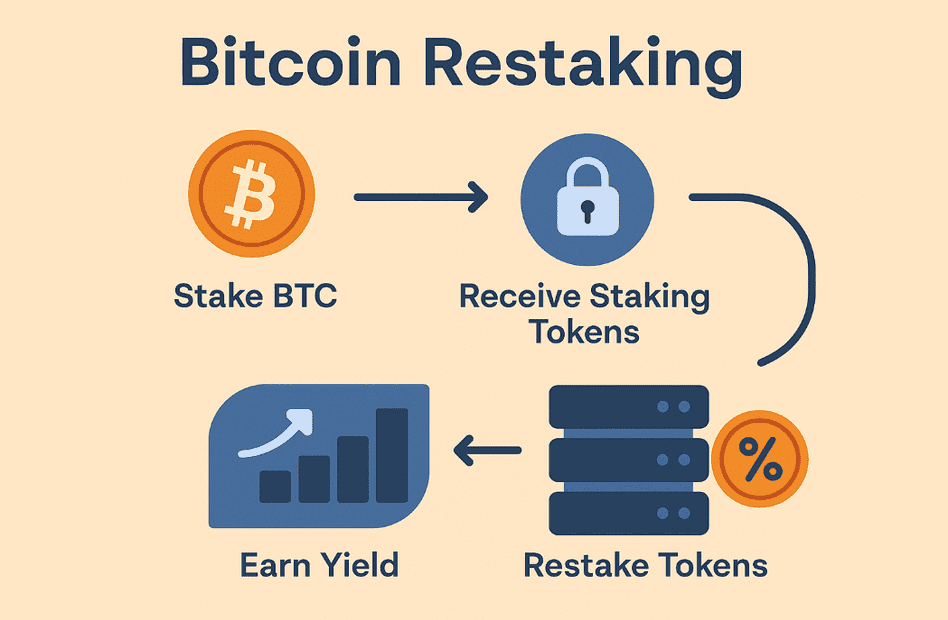
Restaking lets you lock native BTC on the Bitcoin chain (often via time-locks or multisig scripts) and use that economic weight to help secure other networks or services (e.g., rollups, oracles, and data layers).
In return, you earn rewards from those networks—without wrapping or leaving Bitcoin custody in many cases.
Why it matters? It finally provides long-term BTC holders a way to earn on idle coins with Bitcoin-aligned custody assumptions, narrowing the utility gap with ETH staking.
How the rewards flow
- You commit BTC to a time-locked vault on Bitcoin.
- A restaking protocol coordinates how your commitment backs external services.
- Those services pay rewards (their native tokens, fees, or BTC-denominated incentives).
- Some protocols let a single BTC deposit secure multiple services (“multi-staking”) to stack yields.
Key risks and mitigations
- No “on-chain slashing” of BTC, but penalties still exist. Misbehavior can extend the lock-in period or cut rewards. Read each protocol’s penalty model.
- Protocol/cryptography risk. Restaking introduces new coordination and proof systems. Favor audited, widely used designs; diversify positions.
- Liquidity/depeg risk for liquid tokens. Liquid (re)staking tokens for BTC can trade below par under stress. Understand unbonding and secondary-market depth.
- Ecosystem risk. Rewards depend on external networks’ health; if they fail, your yield collapses.
Who does it suit? Long-horizon BTC holders who want yield while preserving Bitcoin-native custody assumptions and who are comfortable with emerging-tech risk with prudently sized positions.
Centralized yield and “yield-bearing custody”
Post-crisis, centralized lenders and exchanges tend to offer low single-digit APY on BTC with clearer disclosures. Institutional custodians may share modest income from fully collateralized lending. Some banks in crypto-friendly jurisdictions are promoting conservative crypto interest accounts.
How to assess risk?
- Custody. If it’s not your keys, you have counterparty risk. The classic rule, “Not your keys, not your crypto”- still applies. Prefer real proof-of-reserves and clear liabilities reporting.
- Regulatory posture. Is the product registered or offered under a recognized regime in your country?
- Source of yield. Borrower demand? Options income? Platform token subsidies? If the answer is vague, pass.
- Rate realism. Outlier high rates signal hidden leverage or unsustainable incentives.
Who does it suit? Users prioritizing simplicity and regulatory clarity over maximum return—and who accept the core trade-off of custodial risk.
Institutional playbook you can learn from
Cash-and-carry (basis) trades
Buy spot BTC, short regulated futures when they trade at a premium, and capture the convergence at expiry. This converts market optimism into a USD-denominated, hedged yield (often mid single-digit annualized in normal conditions). Requires derivative access and margin management.
Covered calls and “dual” income products
Sell call options against held BTC to collect premium, or use exchange “dual investment” products that embed option sales. Income can be attractive when volatility is high, but you cap upside (or agree to sell BTC if price rallies through the strike).
Comparing different Bitcoin yield strategies
| Method | How it works | Typical yield range | Custody model | Main risks | Best suited for |
Lightning routing fees |
Open payment channels, provide BTC liquidity, earn routing fees when payments pass through your node. | <1% up to ~3% APY for well-managed nodes | Self-custodial | Technical setup, low profitability if poorly managed, liquidity lock-up | Technical users comfortable running nodes |
Sidechains (e.g., Rootstock, Stacks) |
Peg BTC into a sidechain, use RBTC or equivalent in DeFi lending or AMMs; some models (Stacks) pay BTC to token holders. | 3–6% APY in lending pools; variable in AMMs | Custody with sidechain federation or protocol | Peg risk, smart contract exploits, liquidity shortages | Users open to moderate risk for higher yields |
Wrapped BTC in DeFi |
Convert BTC to WBTC/tBTC, lend or LP in Ethereum or multi-chain DeFi protocols. | 1–5% APY (lending), 5–10%+ in incentivized farms | Custodial (WBTC) or trust-minimized (tBTC); smart contract custody | Bridge hacks, token depeg, DeFi protocol exploits | Yield seekers already active in DeFi |
Centralized interest accounts |
Deposit BTC with a CeFi lender/exchange; they lend to institutions or use structured strategies. | 1–4% APY in 2025, lower than past years | Full custody surrendered | Platform default, regulatory crackdowns, opaque risk | Simplicity-focused users in permissive jurisdictions |
Institutional strategies (basis trades, covered calls) |
Use BTC in futures/options strategies (hedged arbitrage or selling options). | 4–10%+ depending on market conditions | Usually done via funds/ETFs or prime brokers | Complex risks (margin calls, capped upside), limited retail access | Advanced traders or via regulated ETFs |
Bitcoin restaking |
Lock native BTC in time-locked contracts to secure external networks; earn rewards from those networks, sometimes via liquid staking tokens. | 3–8% APY early, higher if multi-staking or token incentives | Self-custodial time-locks or liquid tokens | Protocol bugs, lockup/penalties, LST liquidity risk | Long-term BTC holders seeking yield without bridging |
Practical ways to earn from your Bitcoin
- Low-touch, conservative. Keep most BTC in cold storage; place a small slice in a reputable, conservative CeFi interest program; optionally run a small Lightning node to learn and earn modest fees.
- DeFi-curious, self-custodial. Wrap a portion of BTC into DeFi to lend on a top-tier market; avoid leverage; diversify across two venues; monitor utilization/oracle health.
- Long-horizon, bitcoin-aligned. Allocate a slice to Bitcoin restaking with strict position caps; prefer designs that keep BTC native and time-locked; avoid overexposure to any liquid restaking token; track audits and network adoption.
- Income-oriented and options-aware. If permitted in your region (and you understand options), sell conservative covered calls on a portion of BTC or use regulated covered-call funds/ETFs. Size positions so you’re comfortable if BTC is called away.
Used thoughtfully, these strategies can help make your BTC productive while respecting your risk tolerance and custody preferences.
The safest portfolio is one that still keeps a core in cold storage —then layers in yield methods that you understand, can monitor, and can exit on your own terms.



 Thank you for your feedback! We’re glad you found this article helpful.
 An error occurred while sending the form, please try again.
 We are sorry. You've already sent a message within the last 60 seconds. Please wait before sending another.
 Thank you for letting us know! Our team will review your feedback to help improve our content.
We're sorry you did not find what you were looking for. Please select the reason this article was not helpful.