


The best staking crypto platforms in 2026 offer high APYs, strong security, and flexible terms. Yet finding the right one can be tricky. In this guide, we’ll break down the best crypto to stake, compare their features side-by-side, and show you exactly how to get started.
At CryptoManiaks, we’ve done the research for you, analyzing dozens of exchanges, reading user feedback, and running tests to identify the most reliable and rewarding staking options available today.
By the end of this article, you’ll know:
- Which platforms offer the highest APY crypto staking in 2026
- How to choose the right exchange for your needs
- Which stable crypto coins and volatile assets offer the best staking potential
- How to start earning passive income in just a few steps
Key Takeaways
- Top staking platforms combine high APYs with robust security
- Always compare APY, lock-up terms, and supported coins
- Rates and rewards change: review regularly
What Are The Top-Rated Crypto Staking Exchanges in 2026?
-
 Coins
Coins



 Deposit Methods
 Avg. Spread The difference between the buy (ask) and sell (bid) price for popular trading pairs. Lower spreads mean better pricing and less slippage for you.
 -
 Coins
Coins
 Deposit Methods

 Avg. Spread The difference between the buy (ask) and sell (bid) price for popular trading pairs. Lower spreads mean better pricing and less slippage for you.
 -
 Coins
Coins

 Deposit Methods
Avg. Spread The difference between the buy (ask) and sell (bid) price for popular trading pairs. Lower spreads mean better pricing and less slippage for you.
Deposit Methods
Avg. Spread The difference between the buy (ask) and sell (bid) price for popular trading pairs. Lower spreads mean better pricing and less slippage for you. -
 PromotionsCoins
Deposit Methods
Avg. Spread The difference between the buy (ask) and sell (bid) price for popular trading pairs. Lower spreads mean better pricing and less slippage for you.
PromotionsCoins
Deposit Methods
Avg. Spread The difference between the buy (ask) and sell (bid) price for popular trading pairs. Lower spreads mean better pricing and less slippage for you. -
 PromotionsCoins


 Deposit Methods
Avg. Spread The difference between the buy (ask) and sell (bid) price for popular trading pairs. Lower spreads mean better pricing and less slippage for you.
Deposit Methods
Avg. Spread The difference between the buy (ask) and sell (bid) price for popular trading pairs. Lower spreads mean better pricing and less slippage for you.
Top-Rated Crypto Staking Exchanges in 2026 Reviewed

Get $10 in Bitcoin when you register through a referral link from an existing member.


Established in 2011, Kraken is a trusted cryptocurrency exchange renowned for its longevity and diverse trading interfaces, catering to a broad user base.
- Supports hundreds of coins
- High liquidity
- Simple and user-friendly interface
- Good customer support options
- Lots of advanced trading features like margin, futures, and indices trading
- No insurance fund for assets on the platform
- Doesn’t offer a crypto credit card
- No personal wallet service for traders
- Supports only a few fiat currencies
Year Founded
- 2011
Headquarters
- United States
Licenses
- United States (IRS)
- Canada (CRA)
- United Kingdom (HMRC)
-
+7
Cryptocurrencies
- Bitcoin
- Ethereum
- Tether
-
+83
Available countries
- Afghanistan
- Albania
- Algeria
-
+240
Languages
- Chinese (Mandarin)
- English
- French
-
+10
Features
- Cryptowatch
- Forks
-
+29
Receive up to $100,000 worth of exclusive gifts for newcomers upon registration.
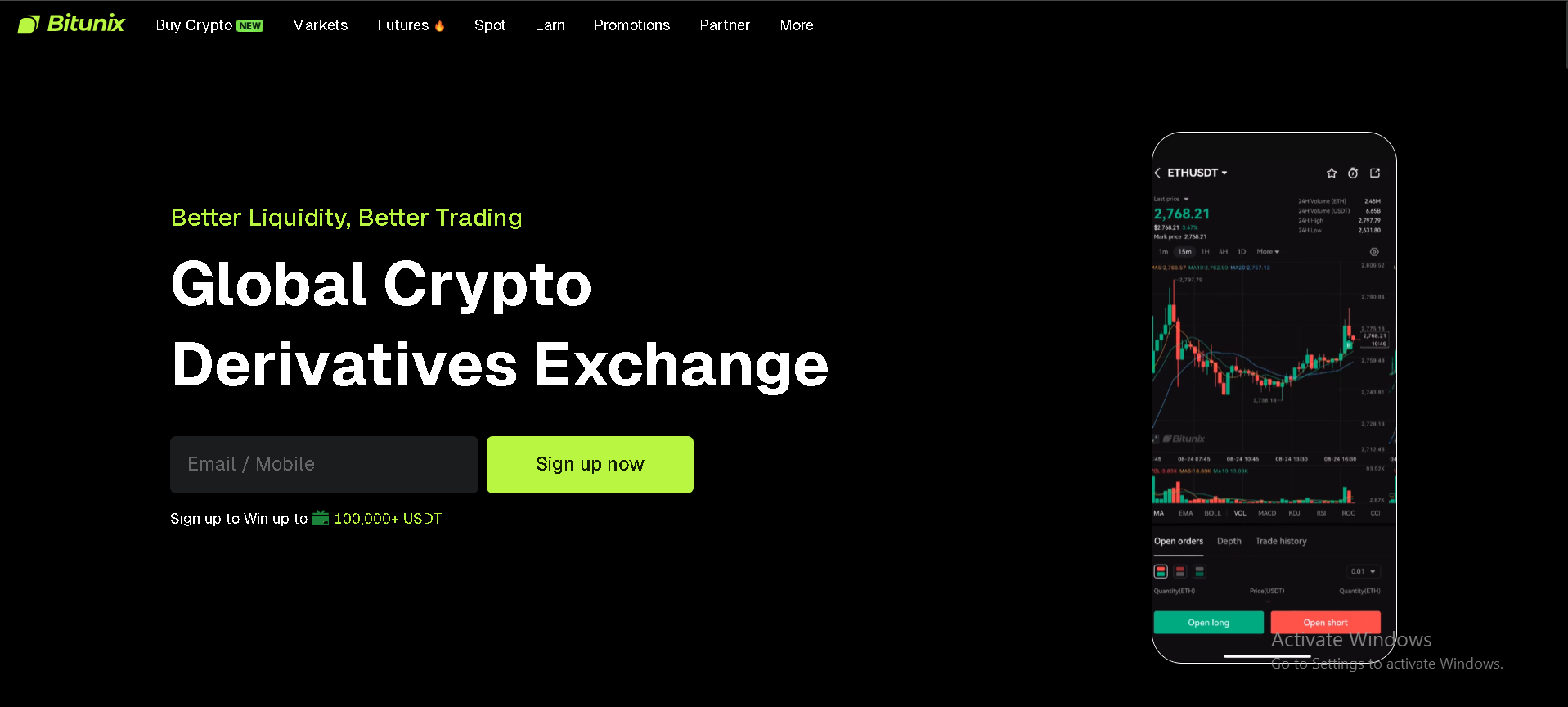

Bitunix was founded in Hong Kong in 2021. It was designed to bring a breadth of crypto features to beginner and intermediate traders.
It supports over 700 cryptocurrency trading pairs in more than 100 countries. It offers spot, P2P, and derivatives trading. With copy trading, new traders can copy the trades of successful users, with them earning a cut.
The exchange offers a myriad of new user bonuses and lotteries, letting new traders jumpstart their experience.
Rewards and tournaments are also available for existing users. Bitunix Splash gives rewards for investing in new tokens, while regular competitions in categories like trading volume or monthly profits carry up to USDT 675,000 in rewards.
Licenses
- United States (IRS)
- Canada (CRA)
- Phillipines
Cryptocurrencies
- Bitcoin
- Ethereum
- Tether
-
+78
Available countries
- Albania
- Algeria
- American Samoa
-
+233
Languages
- English
- Uzbek
- Polish
-
+12

Year Founded
- 2018
Headquarters
- Seychelles
Licenses
- Seychelles
- Estonia
- Switzerland
-
+2
Cryptocurrencies
- Shiba Inu
- Bitcoin
- PAX Gold
-
+72
Available countries
- Afghanistan
- Albania
- Algeria
-
+246
Languages
- English
- Russian
- Turkish
-
+14
Features
- Leveraged ETFs
- Copy Trading
-
+8
Earn $10 in Ethereum (ETH) when you stake $100 in ETH for the first time, up to $30 in rewards


Coinbase, a major player since its inception in 2012, is a user-friendly cryptocurrency exchange offering a secure platform for buying, selling, and managing a variety of digital assets.
- Operating since 2012, listed on Nasdaq, and has a BitLicense from New York State Department of Financial Services.
- Offers a variety of assets
- Fast crypto withdrawals
- Lists smaller assets before other big exchanges
- User-friendly interface with intuitive design
- Coinbase Pro offers much better fees!
- This has been the main complaint against Coinbase, although they have committed to hiring more staff.
- Controls customers' private keys
- Restricted to many countries
- Doesn't offer many advanced services
Year Founded
- 2012
Headquarters
- United States
Licenses
- United States (IRS)
- Canada (CRA)
- United Kingdom (HMRC)
-
+4
Cryptocurrencies
- Bitcoin
- Ethereum
- Tether
-
+68
Available countries
- Canada
- France
- Netherlands
-
+6
Languages
- English
- German
- French
-
+9
Features
- Web3
- Borrow
-
+27


Uphold Crypto Exchange, founded in the United States in 2014, is a global digital money platform that enables users to buy, sell, and trade various cryptocurrencies.
Year Founded
- 2015
Headquarters
- Bahamas
Licenses
- United States (IRS)
- United Kingdom (HMRC)
- Lithuania
Cryptocurrencies
- Tether
- TrueUSD
- USD Coin
-
+144
Available countries
- Australia
- Canada
- France
-
+9
Languages
- English
- Spanish
Features
- Metals
- National Currencies (Forex)
-
+5
Don’t invest unless you’re prepared to lose all the money you invest.

Disclaimer
The information provided on this website is for informational purposes only and should not be considered as financial, investment, or legal advice. Cryptocurrency investments are volatile and high-risk in nature. Consult with a qualified financial advisor and/or tax professional before making any investment decisions. We are not responsible for any loss incurred due to the use of information on this website. Do your own research and exercise caution. Don’t invest unless you’re prepared to lose all the money you invest.
Why Trust CryptoManiaks?
Our staking platform recommendations are based on thorough research, real testing, and transparent evaluation criteria. We analyze APYs, security measures, user feedback, and regulatory compliance, then verify claims through hands-on platform use.
Every review reflects in-depth analysis, ensuring our readers receive accurate, unbiased insights into the best crypto staking opportunities available.
Here’s How to Choose the Best Staking Platform
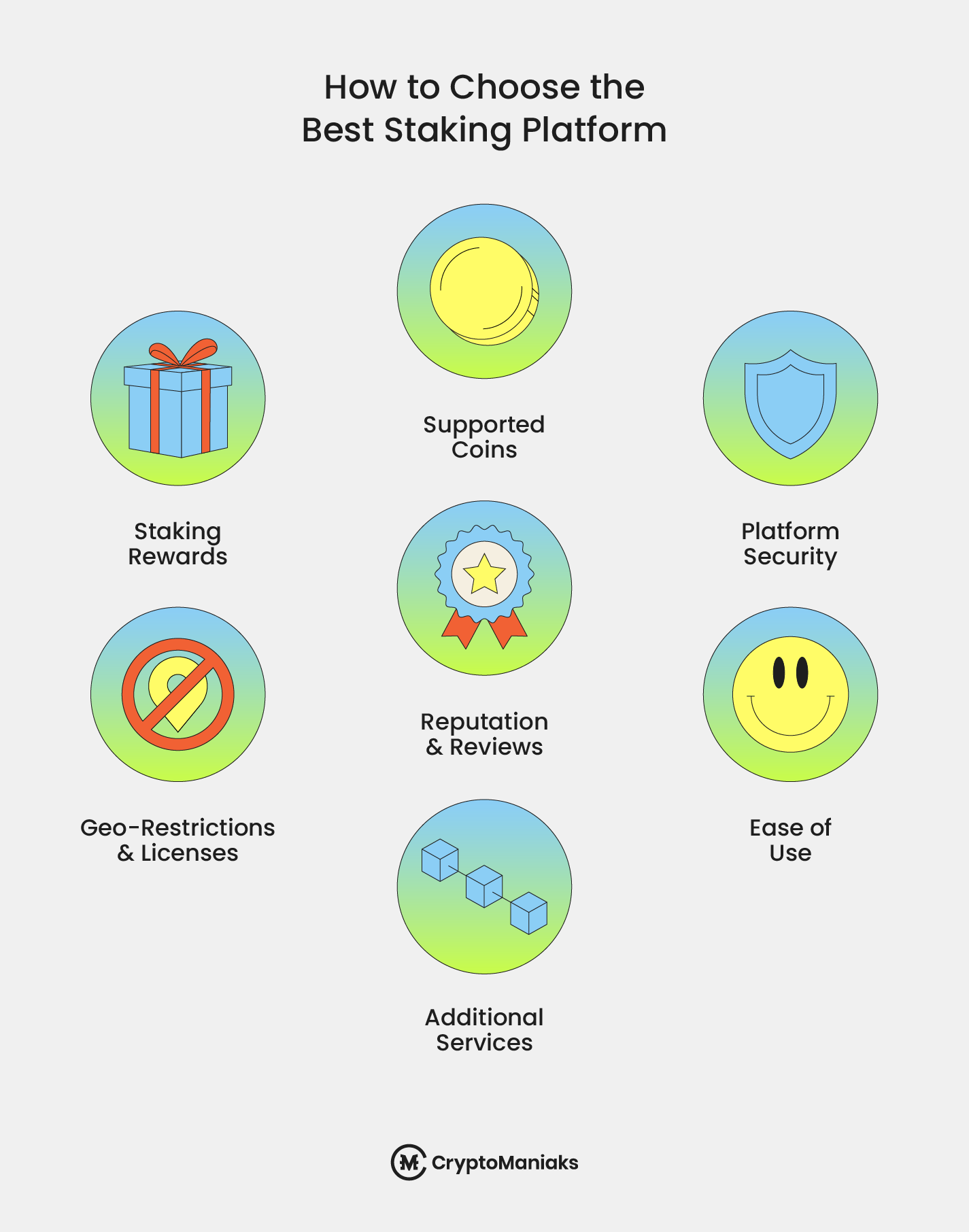
With so many exchanges offering staking, it’s vital to distinguish reliable platforms from risky or underperforming ones.
When evaluating the best crypto staking platforms, we always look at the following:
- Supported Coins
- Staking Rewards (APYs)
- Platform Security
- Reputation & Reviews
- Ease of Use (Mobile & Web)
- Geo-Restrictions & Licenses
- Additional Services (Wallets, Trading, DeFi)
We’ll explore these factors in detail so you can make informed decisions and avoid costly mistakes.
Supported Coins
A great staking platform should offer a wide range of assets — from stable crypto coins to high-yield altcoins. The more supported coins, the more flexibility you have to diversify your staking portfolio and adjust to market shifts without moving assets between multiple platforms.
Staking Rewards (APYs)
APY (Annual Percentage Yield) is the key metric for staking profitability. APY reflects the returns earned over a one year period. It is important to understand that if the token price tanks, your returns could be negative even if the APY is high.
Even small percentage differences can significantly impact long-term earnings. Compare platforms regularly, as APYs change based on market conditions, validator performance, and competition. A higher APY doesn’t always mean better returns; long term sustainability and token stability also matter.
Platform Security
Security is non-negotiable when locking up assets. Look for platforms with robust measures such as cold storage, two-factor authentication, insurance funds, and regular third-party audits. Avoid exchanges with a history of breaches or unresolved security incidents, since compromised safety can instantly wipe out your staking gains.
Reputation & Reviews
User feedback offers valuable insight into reliability, customer service, and payout consistency. Check independent review sites, crypto forums, and social media for recurring complaints or praise. A platform with strong community trust is less likely to engage in shady practices or default on staking rewards as promised.
Ease of Use (Mobile & Web)
A smooth, intuitive interface saves time and prevents mistakes. The best crypto staking platforms offer clear instructions, responsive mobile apps, and dashboard tools for tracking rewards. Beginners benefit from guided staking processes, while experienced users appreciate advanced analytics and customization options for staking strategies.
Geo-Restrictions & Licenses
Some platforms aren’t accessible in certain countries due to licensing and regulatory requirements. Ensure your chosen exchange is legally available in your jurisdiction, ideally with licenses from reputable authorities. Using unlicensed platforms can expose you to legal risks or sudden service shutdowns.
Additional Services (Wallets, Trading, DeFi)
Extra features can make staking more profitable and convenient. Built-in wallets simplify asset storage, while integrated trading lets you react quickly to price movements. Some platforms offer DeFi integrations, lending, and yield farming, giving you multiple ways to earn from your staked crypto.
New to Crypto Staking? Here’s How it Works
The best crypto staking platforms reward you for locking up your coins to help secure blockchain networks, earning passive income in return.
At its core, staking involves participating in a network’s consensus process, usually through Proof-of-Stake, to validate transactions and keep the system running smoothly. Here’s what you need to know:
Proof-of-Stake vs Other Mechanisms
- Proof-of-Stake (PoS) allows validators to secure a network by locking up tokens instead of running energy-intensive mining hardware.
- Compared to Proof-of-Work (PoW), PoS is more eco-friendly, offers lower entry costs, and provides predictable reward schedules.
- Variations like Delegated PoS allow users to stake through trusted validators without running their own node.
Staking Variations in 2026
Staking in 2026 involves a broader ecosystem, and while Proof-of-Stake (PoS) remains foundational, variations include:
- Liquid Staking — retain tradable tokens while earning yields
- Restaking Protocols — earn layered rewards across networks
- AI-Optimized Validators — auto-rebalance to high-performing nodes
Lock-Up Periods and Flexible Options
- Some staking platforms require fixed lock-up periods, meaning you can’t access your coins until the term ends.
- These typically provide higher APYs as a trade-off. Flexible staking allows withdrawals anytime, but usually with slightly lower rewards.
- The right choice depends on your liquidity needs and market outlook.
Understanding Staking APY and ROI
- APY (Annual Percentage Yield) measures your yearly staking return, factoring in compounding.
- ROI (Return on Investment) depends not only on APY, but also on token price changes.
- Even high APYs can result in losses if a coin’s value drops significantly, so consider both yield potential and market stability when staking.
How to Stake Crypto in 5 Simple Steps
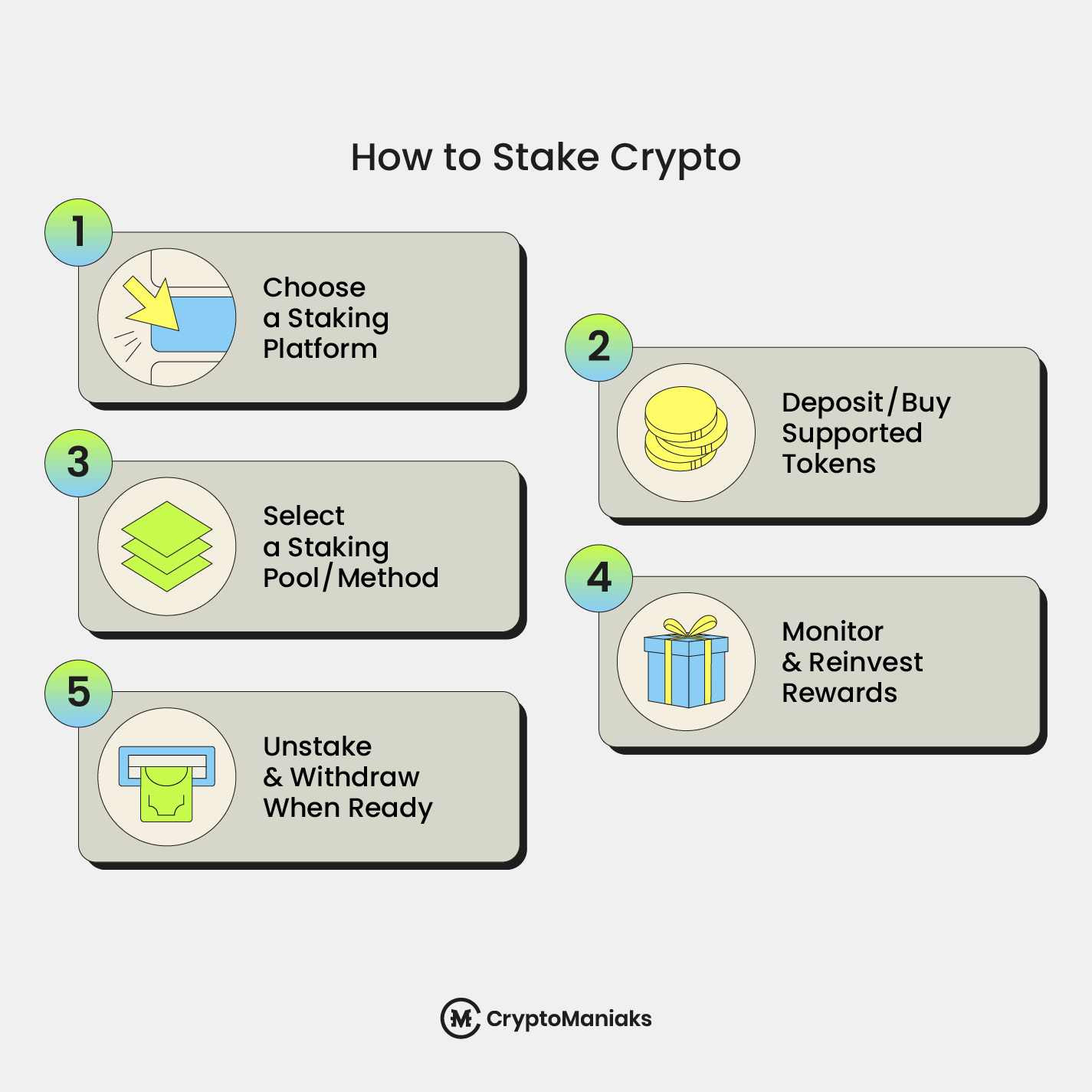
Getting started with the best crypto to stake is straightforward if you follow a clear, step-by-step process from selection to withdrawal.
Step 1 – Choose a Staking Platform
- Select a trusted platform that supports your preferred coins, offers competitive APYs, and has strong security credentials.
- Compare multiple exchanges based on features, fees, and staking options.
- Look for positive user reviews, licensing in your jurisdiction, and a transparent reward distribution process before committing any funds to the platform.
Step 2 – Deposit or Buy Supported Tokens
- If you already own the cryptocurrency you want to stake, transfer it to your chosen platform’s wallet.
- If not, purchase it directly through the exchange.
- Ensure you meet any minimum staking requirements and confirm that the coin is eligible for staking before making the deposit to avoid unnecessary delays.
Step 3 – Select a Staking Pool or Method
- Choose between direct staking, validator delegation, or platform-managed staking pools.
- Direct staking gives you more control but requires technical knowledge.
- Delegation and platform pools are easier but may charge fees.
- Compare lock-up terms, expected APYs, and the reliability of the validator or pool before finalizing your choice.
Step 4 – Monitor and Reinvest Rewards
- Regularly track your staking performance through the platform dashboard or mobile app.
- Consider reinvesting rewards to compound your returns over time, especially if the token has strong long-term potential.
- Stay updated on network changes, validator performance, and APY fluctuations to maximize earnings and reduce the risk of missing rewards.
Step 5 – Unstake and Withdraw When Ready
- When your lock-up period ends, or you decide to stop staking, follow the platform’s unstaking process.
- This may involve a short waiting period before funds are released.
- Once unstaked, you can withdraw to your personal wallet, trade, or reallocate funds to another staking opportunity for continued passive income.
Pros and Cons of Crypto Staking
| Pros | Cons |
|---|---|
| Earn passive income while holding your crypto. | Price volatility can reduce overall gains. |
| Lower entry barriers compared to mining. | Lock-up periods limit liquidity and flexibility. |
| Supports blockchain security and decentralization. | Risk of platform hacks or validator slashing penalties. |
| Flexible options, from short-term to long-term staking. | Rewards may decrease as network participation increases. |
| Potential for compounding rewards over time. | Staked coins remain locked and you cannot use them for DeFi, trading, or lending opportunities. |
Taxes on Crypto Staking Rewards
Staking rewards are generally considered taxable income in many jurisdictions, meaning you may owe taxes when you earn or claim them. Rates and rules vary widely, so always check your country’s regulations and consult a qualified tax professional to ensure compliance with local crypto tax laws.
Staking rewards are taxable in many major markets in 2026.
- Some countries now treat liquid staking derivatives separately
- Reporting tools are emerging for tracking staking income
Always consult a tax professional familiar with crypto rules in your jurisdiction.
Which Crypto Has the Highest APY Right Now?
Below is a table highlighting some of the cryptocurrencies that currently offer the highest staking APYs. Please note that staking rewards vary across platforms and depend on market conditions, so rates can shift rapidly.
| Cryptocurrency | APY Range | Where to Stake? |
|---|---|---|
| Cosmos (ATOM) | Up to 18.5% | Various Platforms |
| Polkadot (DOT) | Up to 11.5% | Multiple Exchanges |
| Tezos (XTZ) | Up to 10.0% | Major staking platforms |
| Avalanche (AVAX) | ~7–8% | Popular exchanges and wallets |
| NEAR Protocol (NEAR) | ~10.6% | Binance, Ledger |
| Algorand (ALGO) | ~7.43% | Ledger, Pera Wallet, Binance |
| Ethereum (ETH) | ~4–6% | Pooled staking platforms |
| USDC (Stablecoin) | Up to 18% | Binance, Trust Wallet |
Note: APYs can fluctuate based on network conditions and platform fees.
Future Trends in Staking
Crypto staking in 2026 is evolving rapidly, with several key trends shaping the landscape. Liquid staking is becoming more popular, allowing users to earn rewards while retaining token liquidity. Cross-chain staking is emerging, enabling rewards from multiple blockchains through a single platform. Institutional adoption is driving demand for regulated, licensed staking services, which improves trust and compliance.
Top trends shaping staking in 2026:
- Liquid staking growth dominates yield strategies
- Cross-chain aggregation boosts rewards efficiency
- AI-driven yield optimization
- Institutional-grade staking services
- Regulated DeFi staking markets
Platforms are also integrating AI-driven yield optimization, automatically reallocating assets to maximize APY. Meanwhile, restaking protocols are gaining traction, allowing stakers to secure multiple networks with the same tokens. Expect more user-friendly tools and lower fees across the best crypto staking platforms as competition grows.
 DON’T GET REKT
Curated drops, testnets and red flag alerts straight to your inbox ✌️
 You’re in. Thanks for joining our newsletter.

CryptoManiaks’ Final Tips: Top Staking Crypto Platforms
Choosing the best crypto staking platform isn’t just about chasing the highest APY; it’s about balancing reward potential, platform security, and flexibility. Always research supported coins, lock-up terms, and the provider’s track record before committing your funds. Diversifying across multiple platforms can reduce risk while maximizing returns.
Smart staking approach prioritizes:
- Risk-adjusted yields, not just the highest APY
- Diversification across chains and platforms
- Periodic strategy reviews tied to your goals
Remember that market conditions and APYs change, so review your staking strategy regularly. By combining smart platform selection with ongoing monitoring, you can make staking a reliable long-term passive income source.
Frequently Asked Questions
-
01.
How much can I earn from staking?
Earnings from staking depend on the cryptocurrency, the platform’s APY, and whether rewards are compounded. For example, a coin with a 10% APY on a $1,000 stake would theoretically earn $100 over a year, assuming the token price remains stable. However, the highest APY crypto staking rates can change based on market demand and validator participation, so always check the current APY before locking in your funds.
-
02.
Can I lose money while staking?
Yes. While staking can be a source of passive income, it’s not risk-free. The main risks are:
- Price volatility: Even if you earn rewards, a drop in token value can erase gains.
- Slashing penalties: In Proof-of-Stake networks, validator misconduct can result in a portion of your stake being lost.
- Platform security breaches: Hacks or insolvency could lead to total loss of funds. Choosing reputable platforms with high security ratings is essential.
-
03.
What is the best staking coin?
The best crypto to stake depends on your investment goals. If you value stability, stable crypto coins like USDC or DAI offer lower but predictable returns. If you want higher potential earnings, tokens like SOL, ADA, or DOT often appear on lists of the best coins to stake because of their competitive APYs. However, higher APY usually means higher volatility risk.
-
04.
Which cryptocurrency offers the best potential staking returns?
While smaller-cap altcoins can deliver huge returns, they also carry extreme risks and can be illiquid. Staking these coins may provide the highest staking rewards, but price crashes can wipe out profits. Focusing on proven projects with sustainable staking models is generally safer for most investors.
-
05.
What’s the difference between liquid staking and fixed staking?
Liquid staking allows you to earn rewards while keeping your funds accessible. When you stake, you receive a liquid staking token (like stETH, rETH, or stSOL) representing your staked assets. You can trade, lend, or use these tokens in DeFi while still earning staking rewards. It offers flexibility, better liquidity, and easier portfolio management.
Fixed staking requires locking your crypto for a set period (for example, 30, 60, 90 days or more). During this time, you generally can’t withdraw or trade the assets. In return, platforms often offer higher and more predictable APYs. However, you sacrifice liquidity, and exiting early (if allowed) may incur penalties or reduced rewards.