


 7 min read
Crypto Passive Income Tips and Strategy For Digital Nomads



 AI Overview
Actionable playbook for digital nomads to earn passive crypto income—staking, lending, liquidity provision and restaking—while prioritising custody, secure banking, and regulatory compliance across Europe, Latin America and Southeast Asia.
- Strategy vs risk: Match strategy to risk appetite — staking and stablecoin lending for steady returns; liquidity provision and restaking for higher yields but greater complexity and smart‑contract risk.
- Secure custody: Use hardware wallets and multisig for long‑term holdings, keep minimal hot‑wallet funds, enable 2FA, back up seeds offline, and use VPNs when transacting on the road.
- Regional finance & tax: Prefer regulated exchanges and dual bank/fintech accounts, choose crypto‑friendly residency if possible, and document rewards to stay compliant with local tax and KYC rules.
Digital nomads rely on flexibility and borderless access to their money. Cryptocurrencies provide that freedom, and they also open opportunities to generate passive income. Instead of actively trading, digital nomads can stake, lend, or restake assets to earn passive and flexible returns. However, security, custody, and local regulations matter just as much as yields.
This guide explains the best strategies for crypto passive income, the top blockchains to focus on, and practical banking and custody advice tailored to Europe, Latin America, and Southeast Asia.

Main crypto passive income strategies for digital nomads
Staking
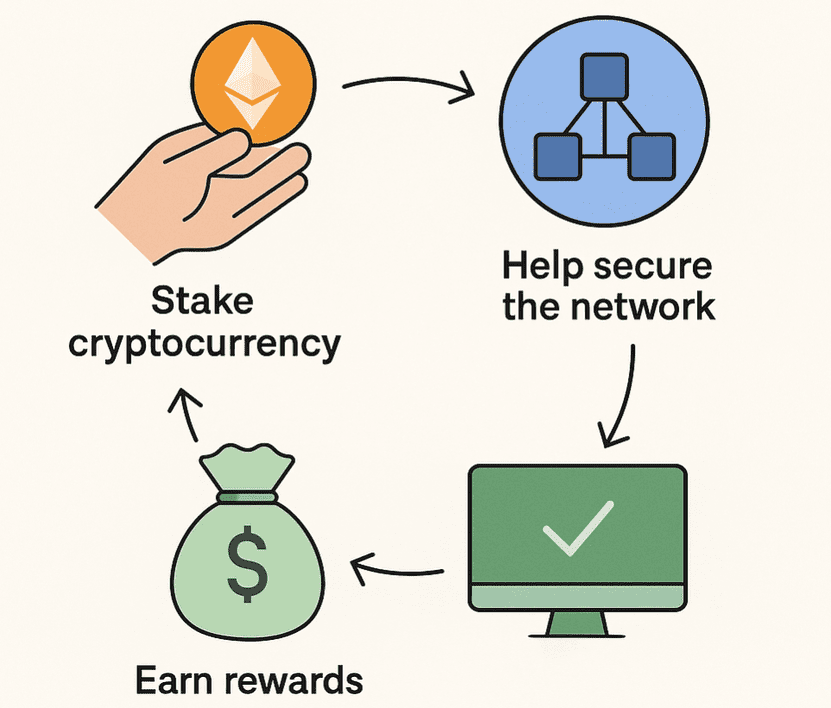
Staking means locking tokens on a proof-of-stake (PoS) blockchain to help validate transactions. In return, you earn rewards.
For example, staking major coins like Ethereum (ETH), Cosmos (ATOM), or Polkadot (DOT) typically yields between 4% and 10% annually. Rewards are predictable, but you need to check lock-up periods and the risks of slashing penalties if validators fail.
For digital nomads, staking is one of the simplest passive income strategies. You can delegate tokens to a validator through a secure wallet and receive rewards without any technical expertise.
Crypto lending
Lending cryptocurrency assets lets you supply tokens—often stablecoins—to a lending market. Borrowers pay interest, which you earn as income.
This strategy is attractive because it provides steady returns without exposure to volatile token prices. However, the main risks are smart contract bugs and borrower defaults. To reduce risks, nomads should diversify across lending pools and stick to well-audited protocols.
Lending is often compared to a savings account: your funds remain accessible, and you earn interest as long as demand exists.

Liquidity Mining
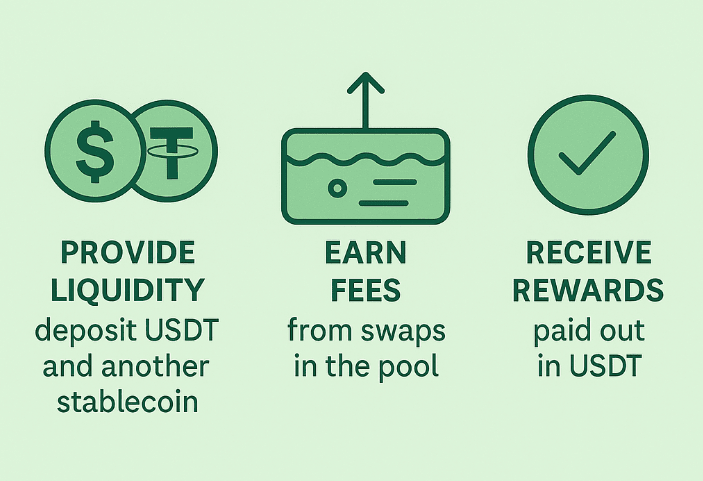
Providing liquidity involves depositing token pairs into a decentralized exchange pool. You earn a share of trading fees and sometimes extra rewards.
This can be profitable if the pool sees high trading activity. However, liquidity providers face impermanent loss—the risk that one token in the pair changes in price relative to the other.
Stablecoin-to-stablecoin pools reduce this risk, while riskier pools may offer higher yields but require careful monitoring.
Restaking
Restaking allows you to reuse staked tokens to secure additional protocols and earn compound rewards.
For example, staked ETH can be restaked into another network to earn extra income on top of the base staking rewards. The advantage is amplified returns, but the trade-off is higher complexity and higher risk. If a secondary protocol fails, your original stake may also be at risk.
Nomads who want to try restaking should start small and only commit tokens they can afford to lock up long-term.
Comparison of strategies
Strategy |
Typical annual yield | Risks | Ease of use | Best for nomads who… |
| Staking | 4–10% | Validator slashing, lock-ups | Easy | Want simple, steady rewards |
| Lending | 2–8% | Smart contract, borrower risk | Easy | Prefer stable returns with flexibility |
| Liquidity provision | 5–20%+ | Impermanent loss, market risk | Moderate | Can monitor positions and accept some volatility |
| Restaking | 7–15%+ (stacked) | Added protocol risk, slashing | Complex | Comfortable with advanced DeFi |
Top blockchains for passive income
Ethereum
Ethereum offers ~4–5% annual staking rewards and the most mature DeFi ecosystem. Lending, liquidity provision, and restaking are widely supported. Ethereum’s large user base and Layer-2 scaling solutions make it a safe and versatile choice for passive income.
Cosmos
Cosmos and its interconnected chains provide ~7% real staking yields after inflation. Digital nomads can delegate ATOM and other ecosystem tokens to validators and earn rewards. The Cosmos ecosystem also supports interchain staking and liquid staking, offering flexibility.
Polkadot
Polkadot’s shared security model allows parachains to operate under its relay chain. Staking DOT offers around 6–14% APR. Nomination pools make staking accessible for smaller holders, and parachains offer additional DeFi yield opportunities.
Banking and custody tips for nomads
Secure long-term Crypto assets
Keep the majority of your assets in cold storage, such as a hardware wallet. Only keep a small portion in hot wallets for spending and trading. This ensures that even if your device is compromised, your main funds remain safe.
Enable strong authentication
Always use two-factor authentication (2FA) with authenticator apps or hardware keys. Password managers help maintain unique, strong logins. This reduces the risk of account takeover while traveling.
Protect seed phrases
Write down your wallet recovery phrases on paper or metal and store them securely. Avoid saving them digitally. For nomads, it’s wise to keep one copy at a safe location and carry a backup coded in a way only you can understand.
Consider multi-signature
Multi-signature wallets require multiple approvals for transactions, reducing the risk of theft if one key is lost or stolen. This adds complexity but strengthens security for larger holdings.
Banking choices
Use banks or fintech providers that support international access and do not restrict crypto transactions. Maintaining at least two accounts ensures redundancy if one freezes or limits transfers.
For daily spending, crypto debit cards or easy conversion paths to fiat are practical tools.
Safe internet practices
Avoid public Wi-Fi for financial activity. If you must use it, always connect through a VPN. Mobile data or portable hotspots are safer alternatives. Keep software updated to patch vulnerabilities.
Regional considerations
Cryptocurrency adoption varies widely across regions, shaped by differing regulations, tax policies, and infrastructure. Understanding local KYC/AML frameworks and tax regulations is necessary for digital nomads.
Europe
Europe’s MiCA regulation provides consistent rules across EU states. This ensures regulated custody and exchanges but requires strict KYC. Taxes vary: Germany exempts long-term gains, while Portugal taxes short-term profits at 28%. Choose residency in crypto-friendly countries to reduce tax burdens.
SEPA transfers make moving funds between banks and exchanges easier. Overall, Europe offers stability and legal clarity.
Latin america
Latin America combines high adoption with inconsistent regulations. Brazil has clear tax rules, El Salvador still promotes Bitcoin use, and Argentina restricts payment processors but allows personal use. Stablecoins are widely used to hedge against inflation and for peer-to-peer trading.
Nomads should check local tax laws if staying long-term. Security is also key—avoid advertising crypto ownership and use hardware wallets.
Southeast asia
Southeast Asia has some of the world’s highest adoption rates. Singapore is a regulated hub with no capital gains tax. Indonesia legalized crypto trading under OJK oversight. Thailand regulates crypto as a digital asset but restricts direct payments.
Vietnam and the Philippines have thriving communities despite lax regulations. Nomads should verify local rules before using exchanges and take advantage of peer-to-peer markets for liquidity.
Region |
Legal stance & regulation | Taxes (high-level) | Fiat on/off-ramp ease | Best fit strategies | Practical banking & custody tips | Key risks to consider |
Europe (EU focus) |
MiCA brings licensed, uniform rules; strong consumer protections; strict KYC/AML. | Varies by country; some exempt long-term gains; many tax staking/lending as income; keep records. | Strong (SEPA, regulated brokers/exchanges); reliable IBANs. | Staking majors; conservative lending (stablecoins); L2 DeFi for lower fees. | Use hardware wallet; keep “travel” hot wallet small; maintain two bank/fintech accounts; document all rewards. | Tax complexity across borders; travel-KYC frictions; occasional bank compliance checks on crypto flows. |
Latin America |
Patchwork; most allow personal use; licensing improving in big markets; some payment restrictions. | Generally taxable; rules differ widely; stablecoin use common; declare if resident. | Mixed; big markets decent; P2P popular where banking rails are weak. | Stablecoin lending; selective staking; small, hedged liquidity provision. | Prioritize self-custody; low profile in public; plan safe cash exits; verify P2P counterparties; use VPN. | Inflation/currency controls; sudden policy shifts; higher street-level security risks; bank de-risking. |
Southeast Asia |
Broadly pro-innovation with controls; clear regimes in SG/TH/ID; others evolving. | Often favorable (e.g., no capital gains for individuals in some places); trading taxes in a few markets. | Good in hubs (SG, TH, ID); P2P active; some countries limit crypto as payment. | Staking on major chains; stablecoin lending; measured LP on liquid pairs. | Keep seed backups outside travel kit; separate devices for finance; confirm local exc |
Conclusion
Crypto offers digital nomads real opportunities to earn passive income while traveling. Staking, lending, liquidity provision, and restaking each suit different levels of risk and involvement.
Ethereum, Cosmos, and Polkadot ecosystems provide the strongest passive income earning opportunities for digital nomads. Combined with careful custody, hardware wallets, and secure banking practices, nomads can grow their assets safely.
By understanding local rules in Europe, Latin America, and Southeast Asia, digital nomads can stay compliant, protect their income, and keep their lifestyle sustainable.
-
01.
What is the safest way for digital nomads to earn passive income with crypto in 2025?
The safest strategies are staking major proof-of-stake coins and lending stablecoins through well-audited protocols. Both provide predictable returns with relatively low risk when paired with strong custody practices.
-
02.
Which blockchains are best for staking and passive income in 2025?
Ethereum, Cosmos, and Polkadot are the leading choices. They offer secure networks, reliable staking yields, and access to diverse DeFi opportunities for generating income.
-
03.
How should digital nomads store crypto securely while traveling?
Use a hardware wallet for long-term holdings, enable two-factor authentication, and back up seed phrases offline. Keep only a small portion of funds in hot wallets for spending or trading on the road.



 Thank you for your feedback! We’re glad you found this article helpful.
 An error occurred while sending the form, please try again.
 We are sorry. You've already sent a message within the last 60 seconds. Please wait before sending another.
 Thank you for letting us know! Our team will review your feedback to help improve our content.
We're sorry you did not find what you were looking for. Please select the reason this article was not helpful.

 You’re in. Thanks for joining our newsletter.
