


Finding the best no KYC crypto exchange in 2026 is more important than ever. As regulations tighten worldwide, many traders are searching for cryptocurrency exchanges that require no KYC verification to buy and trade crypto without surrendering their personal information. Whether you want to buy BTC without KYC, explore non-KYC crypto exchanges, or simply use a crypto exchange with no identity verification requirements, this guide will give you the clarity you need.
At CryptoManiaks, we’ve done the legwork for you. Our team has tested dozens of platforms, analyzed fees, compared withdrawal limits, and gathered community insights. The result? A trusted shortlist of the safest and most efficient ways to buy crypto without KYC, tailored to your needs in 2026.
In this guide, you’ll learn:
- The top no KYC crypto exchanges this year
- What “no KYC” really means (and its limits)
- How to choose the right platform for security, privacy, and ease of use
- The pros and cons of trading without KYC
By the end, you’ll know exactly where and how to start trading privately, without unnecessary barriers.
Best No KYC Crypto Exchanges in 2026 Are
Top No KYC Crypto Exchanges Reviewed

Disclaimer
The information provided on this website is for informational purposes only and should not be considered as financial, investment, or legal advice. Cryptocurrency investments are volatile and high-risk in nature. Consult with a qualified financial advisor and/or tax professional before making any investment decisions. We are not responsible for any loss incurred due to the use of information on this website. Do your own research and exercise caution. Don’t invest unless you’re prepared to lose all the money you invest.
Why Trust CryptoManiaks?
Trust matters when it comes to crypto. Here’s why our recommendations on no KYC crypto exchanges stand out.
Experience
Our research team has over a decade of combined crypto trading experience. For this guide, we spent over 100 hours testing non-KYC crypto exchanges, from account creation to real withdrawals, to verify what works and what doesn’t.
Community
We don’t just rely on our own tests. With a community of over 50,000 crypto enthusiasts worldwide, we gather feedback on reliability, fees, and user safety across different regions. This real-world insight ensures our recommendations reflect how exchanges perform outside of “perfect-lab” conditions.
Transparency
Every review is built on clear criteria: fees, supported assets, withdrawal methods, and security. What you see here is the result of independent testing and verified user reports.
What “No KYC” Actually Means
In crypto, “no KYC” means you can trade, deposit, or withdraw without uploading ID documents or verifying your identity. But it doesn’t always mean unlimited privacy; some conditions can still trigger verification.
In 2026, “No KYC” means that no mandatory ID submission is required below certain thresholds.
Typical KYC Triggers
Even on non KYC crypto exchanges, you may be asked for verification if:
- You deposit or withdraw fiat (bank transfers or credit/debit cards)
- You exceed withdrawal limits set by the exchange
- Your activity gets flagged as suspicious
- Regulations like AML or the Travel Rule require more oversight
AML (Anti-Money Laundering) regulations for crypto exchanges are rules designed to prevent criminals from using digital assets to disguise or move illicit funds. These regulations require platforms to monitor transactions and report suspicious activity.
The Travel Rule, part of global AML standards and derived from FATF regulations, requires exchanges to share key customer details (such as sender and receiver information) when transferring crypto above certain thresholds, ensuring transparency and traceability across platforms. These rules strengthen compliance in KYC exchanges, making them safer and more trusted.
Regional Restrictions & VPN
Some exchanges restrict users from certain countries due to local regulations. While VPNs are often discussed in the community, it’s important to know that regional restrictions vary — and exchanges may block access based on your location.
Many exchanges now block VPNs or frequently flag accounts that actively mask their location. Using a VPN while trading on a crypto exchange may result in frozen withdrawals or account closure, even on no-KYC platforms.
Custodial vs. Non-custodial (CEX vs. DEX vs. P2P)
“No KYC” can mean different things depending on the platform type:
- Centralized (CEX): These exchanges are easy to use, high liquidity, but trust in the company is required.
- Decentralized (DEX): More private and wallet-based, but liquidity and fiat options are limited.
- Peer-to-Peer (P2P): Offers flexibility and privacy, but carries higher counterparty risk.
- DEX Aggregators & Instant Swap Platforms: These platforms connect to multiple DEXs, allowing users to swap crypto without the need for KYC. It is one of the most popular methods to buy BTC without KYC using stablecoins.
In 2026, no KYC exchanges are transitioning into a Tiered structure to remain compliant with new, strict rules.
In 2026, most “no-KYC” centralized exchanges operate under tiered limits. You can trade and withdraw small amounts without submitting an ID, but dealing in higher volumes requires verification; otherwise, the account will be put on hold until the KYC is processed.
| Type of Platform | KYC Requirement |
| CEX no KYC | Typically, low withdrawal limits are limited to cryptocurrencies only. KYC is required after crossing a certain threshold limit. |
| DEXs | No KYC required |
| P2P | No KYC required |
| DEX Aggregators | No KYC required |
How To Pick & Trust a No KYC Crypto Exchange
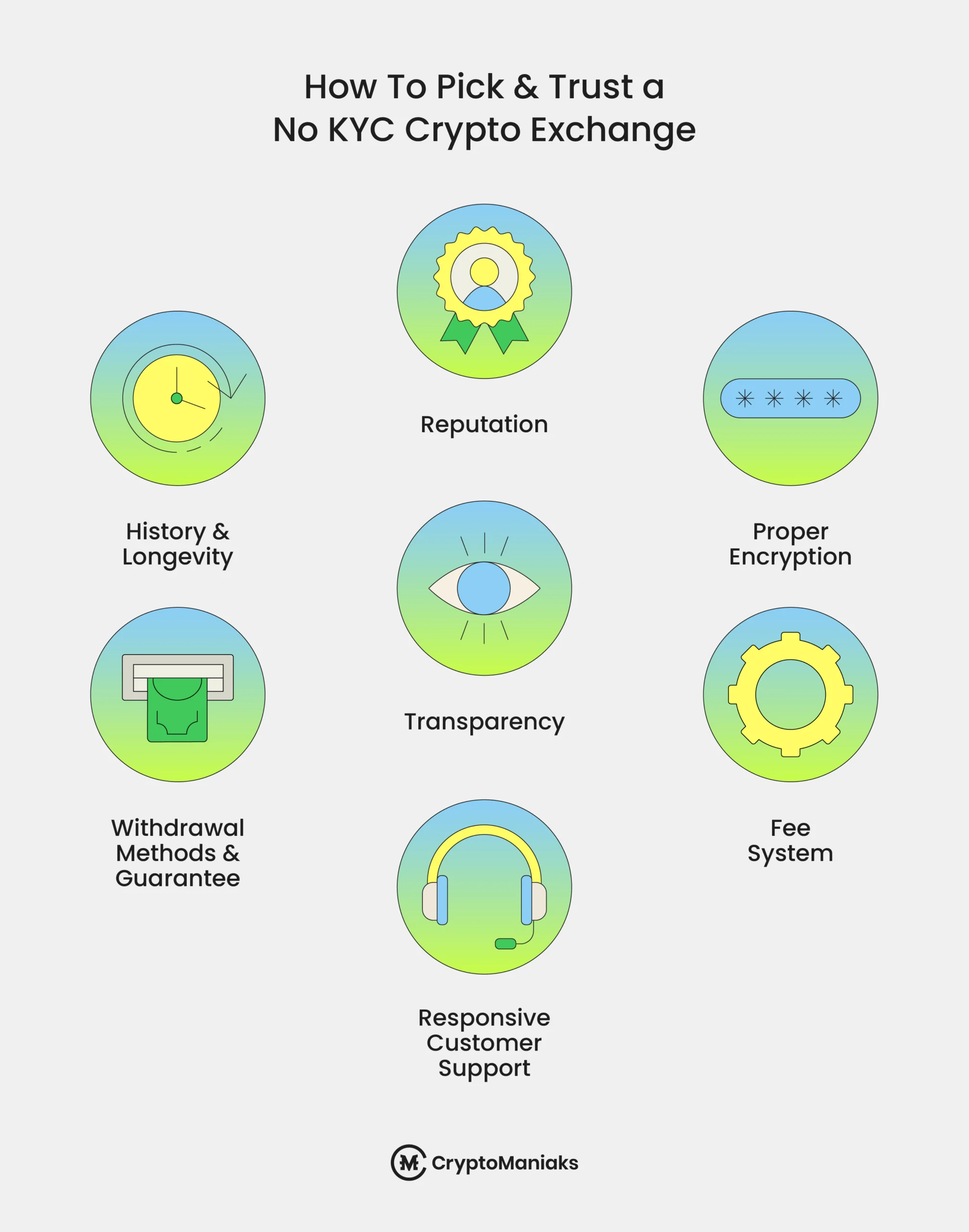
Choosing a no KYC crypto exchange requires more than privacy. You need reliability, security, and clear guarantees for safe trading.
Reputation
A strong reputation is the foundation of trust. Look for non-KYC crypto exchanges with active user bases, positive reviews, and minimal unresolved complaints. Communities like Reddit, Telegram, or Trustpilot can help reveal how an exchange truly treats its users. Poor or inconsistent feedback is a major red flag.
Proper Encryption
Even without KYC, your funds and data must remain secure. Prioritize exchanges using SSL encryption, two-factor authentication (2FA), and cold wallet storage. These protections guard against hacks and phishing attempts. A “no KYC” exchange without strong encryption undermines its own value. Privacy means nothing if your accounts can be compromised.
History and Longevity
Time-tested platforms are generally safer. An exchange that has operated for more than three years without major hacks or scandals signals reliability. New platforms may offer attractive features but carry higher risks. Always check launch dates, past security incidents, and whether the platform has withstood multiple crypto-market cycles.
Transparency
Transparency matters even when KYC isn’t required. The most reliable exchanges provide proof-of-reserves, clear ownership details, and published audits. While anonymity can benefit users, a completely opaque company creates risk. Balance is key and you should choose platforms that safeguard your identity while openly proving their financial health and operational integrity.
A reputable no-KYC exchange regularly publishes real-time proof-of-reserves and liabilities, allowing users to verify that assets are fully backed on-chain.
Withdrawal Methods & Guarantee
Before committing, confirm withdrawal policies. Can you buy BTC with no KYC and then withdraw seamlessly to your wallet? Do they support stablecoins, altcoins, or fiat off-ramps? Look for transparent daily limits and a track record of honoring withdrawals quickly. Exchanges that delay or complicate withdrawals should be avoided.
Fee System
Fees can make or break your trading experience. The best crypto exchanges with no KYC requirements provide clear maker/taker fees, withdrawal fees, and spreads. Hidden charges or vague fee tables are warning signs. Compare exchanges side by side, and remember: the lowest fees don’t always mean the best platform.
Responsive Customer Support
Even no KYC traders deserve help when issues arise. The strongest exchanges offer 24/7 live chat, ticket systems, or active community channels. Test response times before committing funds. If support is slow, dismissive, or absent, consider it a sign that the platform prioritizes volume over user trust.
Pros and Cons of Using a No KYC Exchange
Using a no KYC crypto exchange comes with clear advantages and serious trade-offs. Here’s a breakdown:
| Pros | Cons |
|---|---|
| Maintain privacy and anonymity | Higher risk of scams or shady operators |
| Faster sign-up, no ID verification | Limited fiat on/off ramps (bank or card) |
| Global accessibility, fewer regional barriers | Withdrawal limits may apply without KYC |
| Flexibility to buy BTC with no KYC and other assets | Reduced legal protections if disputes occur |
Pros
- Maintain Privacy and Anonymity: The primary appeal of non-KYC crypto exchanges is that you can trade without linking your passport, SSN, or ID to your account. This protects your privacy and reduces the risk of identity theft.
- Faster Sign-Up, No ID Verification: With no lengthy onboarding process, you can register and start trading within minutes. For traders who want to buy crypto without KYC, speed is a major advantage.
- Global Accessibility: KYC rules vary by region. By using no KYC platforms, users from countries with limited access to crypto exchanges can still participate in the market.
- Flexibility in Transactions: Many no KYC exchanges allow you to buy BTC with no KYC, trade altcoins, and withdraw to self-custody wallets seamlessly. This flexibility is ideal for users who prioritize direct control of their crypto.
Cons
- Higher Risk of Scams: No KYC exchanges are attractive to bad actors, and some platforms may operate with little oversight. Without regulation, you must be extra cautious when choosing where to trade.
- Limited Fiat Integration: Most cryptocurrency exchanges that require no KYC verification do not allow direct bank transfers or card purchases. You’ll often need to use stablecoins or crypto-to-crypto trades instead.
- Withdrawal Limits: Even no KYC exchanges usually impose caps on daily or monthly withdrawals. For larger investors, hitting these limits can quickly become frustrating.
- Reduced Legal Protections: If something goes wrong, such as a hack, frozen withdrawal, or dispute, you may have fewer legal avenues to recover funds compared to regulated exchanges.
Safety, Legal & Taxes
When using no KYC crypto exchanges, it’s important to remember that privacy doesn’t eliminate responsibility.
Safety: Always prioritize platforms with a proven reputation, strong encryption, and clear withdrawal policies. Keep only small amounts in exchange wallets, and store larger holdings in a secure, non-custodial wallet.
Legal: Regulations differ by country. Some regions explicitly restrict or ban non-KYC crypto exchanges, while others allow them in a grey area. Before you buy crypto without KYC, check your jurisdiction’s stance to avoid unintentional violations.
Taxes: No KYC does not equal tax-free. Even if an exchange doesn’t ask for identification, most jurisdictions still require you to declare and pay taxes on your crypto gains. Blockchain transactions remain traceable, and tax liability applies regardless of verification status.
Under the new OECD Crypto-Asset Reporting Framework (CARF) in 2026, centralized exchanges in many countries are required to report user crypto transactions to tax authorities. Most exchanges are now insisting on strict KYC norms beyond threshold limits, and no-KYC exchanges are becoming rarer.
As of 2026, many jurisdictions, including the EU and UK, have begun implementing CARF-aligned reporting requirements. This means exchanges may freeze accounts and request retroactive KYC if reporting obligations apply. “No KYC” access is increasingly conditional rather than permanent.
 DON’T GET REKT
Curated drops, testnets and red flag alerts straight to your inbox ✌️
 You’re in. Thanks for joining our newsletter.

CryptoManiaks Verdict on No KYC Exchanges
No KYC crypto exchanges can be a powerful tool for traders who value privacy, speed, and accessibility. They make it possible to buy BTC without KYC, avoid unnecessary hurdles, and trade globally with minimal restrictions. But they also come with trade-offs, from withdrawal limits to reduced legal protections, meaning extra caution is always required.
At CryptoManiaks, our research shows that the safest approach is to choose well-established, transparent platforms with a history of honoring withdrawals and protecting user funds. Used responsibly, no KYC exchanges can complement your strategy without compromising security.
In 2026, advanced blockchain analytics combined with tax reporting means authorities can link wallets to real identities more easily than ever, even if you used a no-KYC exchange.
Ready to explore your options? Check our full list of the best no KYC crypto exchanges in 2026 and find the one that fits your needs today.
Frequently Asked Questions
-
01.
What is KYC in Crypto?
KYC (“Know Your Customer”) is the process by which exchanges require users to submit identity documents such as passports, driver’s licenses, or SSNs. It’s designed to comply with anti-money laundering (AML) regulations and prevent illegal activity.
-
02.
Are No KYC Exchanges Illegal?
Not necessarily. Many non-KYC crypto exchanges operate legally in certain jurisdictions, while others restrict or ban them. Legality depends on local regulations, so always confirm whether these platforms are permitted in your country.
-
03.
Does No KYC Provide Full Anonymity?
No. While cryptocurrency exchanges that require no KYC verification don’t collect your ID, blockchain transactions are still public and traceable. No KYC reduces data collection, but does not guarantee complete anonymity.
-
04.
Are Binance or Coinbase No KYC crypto exchanges?
No. Both Binance and Coinbase require full KYC verification for most features, particularly fiat deposits and withdrawals. They are regulated exchanges and do not qualify as no KYC crypto exchanges.
-
05.
Do no-KYC exchanges have limits?
Yes. Most no-KYC platforms impose daily/monthly/annual withdrawal limits. These limits are designed to reduce regulatory risk. If you exceed them, the exchange may require identity verification to continue withdrawals.