


 7 min read
Best Ways To Earn Passive Income From Liquid Staking and Restaking



 AI Overview
Liquid staking (LSTs) and liquid restaking (LRTs) convert locked stake into tradable tokens that keep earning rewards and can be used in DeFi. The guide lays out low/medium/high risk strategies, safety checks, and $1,000 illustrative returns to help retail users layer yield prudently.
- Yield uplift: LSTs retain base staking rewards while tradable; LRTs add restaking incentives, enabling base + extra income on assets that would otherwise be idle.
- Risk framework: Low (hold/diversify), Medium (lend, LP, vaults), High (leverage, restake, early farms) — higher returns trade off slashing, contract, and liquidity risk.
- Execution & safety: Use hardware wallets and audited protocols, check liquidity and validator/slashing rules, size positions, set exit limits; $1k examples are directional only.
You can potentially earn a passive, flexible yield from proof-of-stake assets by using liquid staking tokens (LSTs) and liquid restaking tokens (LRTs). These tools allow staking users to further utilize what would otherwise be idle, locked assets.
Instead of sitting untouched, staked coins are turned into tokens that continue earning rewards while remaining liquid. LSTs and LRTs help you unlock extra, passive income opportunities from assets that are normally locked in validators.
This guide explains both, outlines low/medium/high-risk strategies, compares ecosystems, and shows simple $1,000-based potential earnings so beginners can act with clarity.

What are liquid staking tokens (LSTs) and liquid restaking tokens (LRTs)
LSTs (liquid staking tokens)
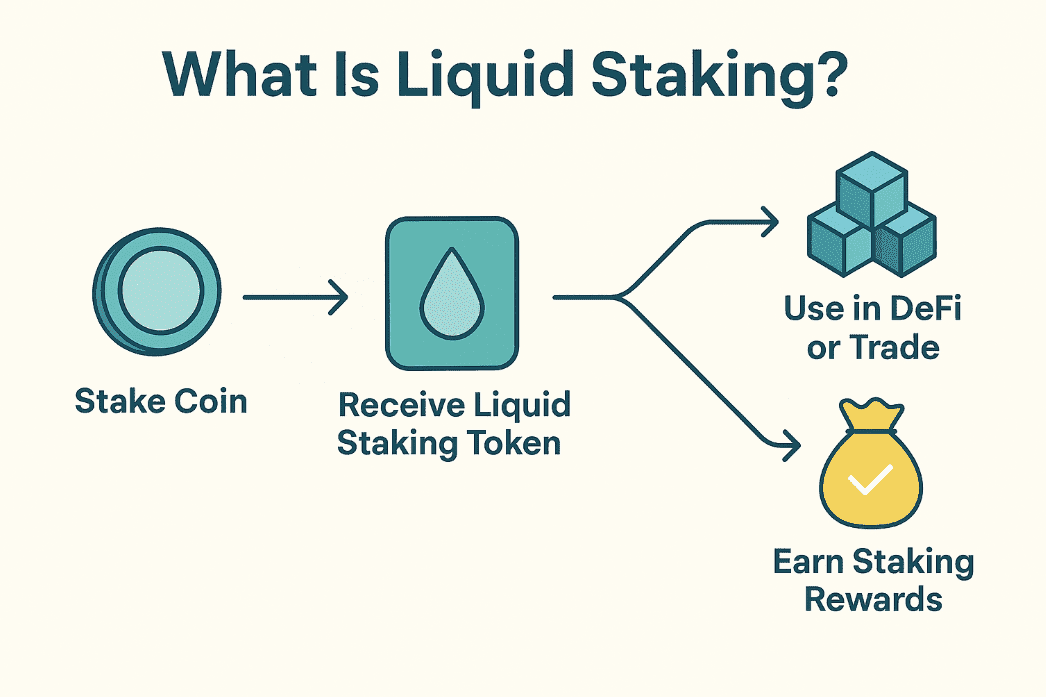
You stake a coin and receive a liquid receipt token that keeps accruing network rewards. You can still trade or use it in DeFi. LSTs help to avoid a long unbonding period. You accept smart-contract, validator, and possible tracking-error risks.
Reward rates vary by chain and may potentially range from low to mid single digits on large caps and possibly higher on smaller caps.
LRTs (liquid restaking tokens)
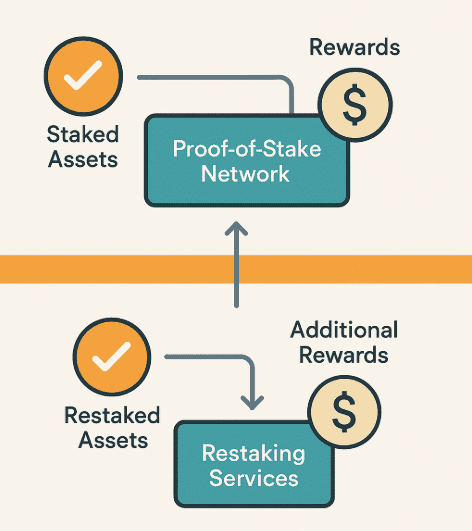
LRTs are the latest and game-changing yield-earning opportunity for users looking for additional ways to earn a passive income. You take staked assets (or LSTs) and restake them to secure extra services or networks.
You earn base staking rewards plus restaking rewards. You accept extra smart-contract and potential slashing risks from the added layer.
Yields may possibly rise into double digits during incentives, but can fluctuate.
Passive income comparison between different staking methods
| Feature | Traditional staking | LST | LRT |
| Liquidity | Low | Medium–High | High (but newer) |
| Reward source | Base staking | Base staking | Base + restaking |
| Potential APY | Low–mid single digits (large caps) | Similar base, possibly + small DeFi boost | Potentially double digits during incentives |
| Main risks | Validator, lockups | Smart-contract, tracking error, liquidity risk | Potential slashing from extra services, stack risk |
LRT and LST yields are not guaranteed and may vary based on protocol conditions, token prices, and network activity.
Blockchains at a glance
- Ethereum: Base staking may potentially sit at ~3–5% depending on conditions.
- Solana: Base staking may possibly sit ~6–8% depending on conditions.
- Cosmos family: Base staking may potentially vary widely, sometimes reaching the high single digits to double digits; token inflation and price swings can possibly offset rewards.
Use this only to set expectations. Always check current data before acting.
 DON’T GET REKT
Curated drops, testnets and red flag alerts straight to your inbox ✌️
 You’re in. Thanks for joining our newsletter.

Strategy map for liquid staking users: Choose by risk and effort
We group methods for retail users. Our focus is on explaining the methods available to retail users. Instead of naming platforms, let’s highlight the underlying process.
Low-risk (capital-preserving)
For those who want to earn passive income while keeping risks minimal, low-risk strategies focus on simply holding liquid staking tokens (LSTs) or spreading them across different blockchains.
These methods aim to preserve capital while still generating steady, flexible returns.
1. Hold the LST for base rewards
- Stake via a liquid method and keep the LST in your wallet.
- You potentially earn the network’s staking APY with full flexibility.
- Risks include smart-contract, validator selection, small tracking discounts during stress, and liquidity risk.
2. Diversify LSTs across chains
- Mix a major-cap LST (lower yield, possibly lower volatility) with a higher-yield LST (higher volatility).
- You potentially reduce risk while still earning.
- Risks: cross-chain wallet ops, varying liquidity depth.
Medium-risk (balanced yield enhancement)
These strategies aim to increase returns by using LSTs in lending markets, liquidity pools, or auto-compounding vaults. They require some active management and accept moderate risks, but they can potentially boost income significantly beyond base staking rewards.
3. Deposit LST in lending for interest (no borrowing)
- You lend the LST and potentially earn extra interest on top of staking.
- Keep it simple: Avoid leverage and treat it as an extra yield layer.
- Risks: protocol, oracle, and liquidity risk.
4. Provide liquidity in LST/native pools
- Pair LST with its underlying (e.g., staked-asset/asset).
- A correlated pair potentially reduces impermanent loss (IL) versus LST/stable pairs.
- You can possibly earn fees + incentives + base staking.
- Risks: IL during de-pegs, DEX smart-contract risk.
5. Use auto-compounders or yield optimizers
- Vaults potentially auto-reinvest fees/incentives to boost LST returns.
- You trade manual work for smart-contract complexity.
- Risks: strategy and aggregator risk, performance drift.
High-risk (aggressive yield maximization)
For experienced users comfortable with volatility, high-risk strategies try to maximize returns through leverage, restaking, and early-stage farms.
These can potentially generate much higher yields but come with greater chances of liquidation, slashing, or losing funds.
6. Leverage loops with LST collateral
- Deposit LST, borrow underlying, restake, and repeat.
- You potentially amplify yield if borrow costs stay below rewards.
- Risks: liquidation, interest-rate spikes, liquidity crunch. Treat with extreme caution.
7. Restake to LRTs for dual rewards
- Restake staked assets to secure extra services and earn more.
- Potentially reach double-digit yields during active incentive promotions.
- Risks: stacked smart-contract risk, potential slashing from restaked services, liquidity, and redemption frictions.
8. Early-stage liquidity mining with LST/LRT
- New farms can possibly offer very high emissions at launch.
- Short windows, fast decay, and execution risk.
- Risks: token dump, contract bugs, thin liquidity.
Potential LST/LRT annual passive income from $1,000 investment
Assumptions: Simple (non-compounding) math for clarity; ranges are potential/indicative; fees and taxes excluded.
Low-risk examples
| Strategy | Annual rate | $1,000 after ~1 year | Notes |
| Hold major-cap LST | ~3–5% | ~$1,030–$1,050 | Simple, liquid, fewer moving parts |
| Hold higher-yield LST (smaller cap) | ~8–12% | ~$1,080–$1,120 | Higher token volatility offsets yield |
| Diversified LST basket | ~5–8% | ~$1,050–$1,080 | Blend to balance risk/yield |
Medium-risk examples
| Strategy | Potential annual rate | $1,000 after ~1 year | Notes |
| LST → lending (no leverage) | Base + ~0.5–2% | ~$1,035–$1,070 | Depends on borrower demand |
| LST/native LP + incentives | ~7–12% | ~$1,070–$1,120 | IL lower than LST/stable, but still possible |
| Optimizer/vault on LST | Base + ~1–4% | ~$1,040–$1,090 | Smart-contract/strategy drift risk |
High-risk examples
| Strategy | Potential annual rate | $1,000 after ~1 year | Notes |
| Leveraged LST loop | ~10–20% | ~$1,100–$1,200 | Liquidations could erase gains |
| Restake to LRT | ~8–18% possibly | ~$1,080–$1,180 | Stacked risks; slashing applies |
| Early LST/LRT farms | Highly variable, potentially very high | Unclear | Time-boxed, speculative, high failure risk |
These are directional, potential illustrations, and not guaranteed returns. Actual yield/income will vary.
How to execute each method safely
Low-risk execution tips
- Use hardware wallets. Keep approvals minimal.
- Spread stake across multiple validators where possible.
- Check LST liquidity depth so you can possibly exit at fair prices.
- Track any small premium/discount versus the underlying to limit slippage.
Medium-risk execution tips
- Lending: Prefer conservative LTV if you ever borrow later. Today, focus on depositing only.
- LPing: Start with LST/native pairs to potentially reduce IL. Monitor pool health and incentives.
- Optimizers: Review strategy docs and on-chain position breakdowns. Avoid black-box products.
High-risk execution tips
- Leverage: Size small. Set alerts for utilization and borrow APR. Pre-plan delever steps.
- Restaking: Understand what your restaked stake secures. Know slashing conditions and redemption rules.
- Launch farms: Treat emissions as trading inventory. Set time-based exits. Never chase unsustainable APR.
Managing core risks (and using slashing insurance)
- Smart-contract risk: Favor audited, battle-tested approaches. Split deposits to potentially reduce single-point failure.
- Liquidity risk: Check pool depth, withdrawal queues, and historical de-peg episodes. Size positions so you can possibly exit easily (if required).
- Rate risk (for leverage): Borrow rates can potentially jump. Keep buffers. Automate delevering if possible.
- Price risk: Yield cannot possibly offset large token drawdowns. Ladder entries and diversify assets.
- Slashing risk: Restaking adds potential slashing vectors. Consider slashing insurance if available in your region. It may potentially reimburse losses from validator or AVS failures, subject to terms, coverage caps, and exclusions. Always read conditions and possibly assume partial coverage, not full.
A beginner-friendly path for LST/LRT Users
- Start with low-risk LST holding.
Earn potentially 3–8% depending on chain. Build muscle memory with wallets, approvals, and gas. - Add one medium-risk layer.
Try LST/native LP or a lending deposit. Aim for a possible +1–4% above base. Size small. - Optionally test a high-risk slice.
Allocate a small percentage to an LRT or a very modest loop. Pre-define max loss and exit rules. Consider slashing insurance where available.
Final notes on liquid staking passive income
Liquid staking and restaking turn idle stake into flexible working capital. Start simple. Layer risk gradually. Label each position by risk, liquidity, and potential return. Keep records. Reassess quarterly. Your goal is steady, possibly compounding income with controlled downside.
Quick $1,000 cheat sheet (one-year)
| Bucket | Example approach | Potential rate | $1k → 1y |
| Low | Major-cap LST hold | ~3–5% | ~$1,030–$1,050 |
| Low | Higher-yield LST hold | ~8–12% | ~$1,080–$1,120 |
| Medium | LST lending (no leverage) | Base + ~0.5–2% | ~$1,035–$1,070 |
| Medium | LST/native LP | ~7–12% | ~$1,070–$1,120 |
| Medium | LST optimizer | Base + ~1–4% | ~$1,040–$1,090 |
| High | LST leverage loop | ~10–20% | ~$1,100–$1,200 |
| High | Restake to LRT | ~8–18% | ~$1,080–$1,180 |
All figures are indicative and potential. Returns are not guaranteed. Always verify current rates, liquidity, and risks before acting.
-
01.
What is liquid staking passive income and how does it work?
Liquid staking passive income comes from converting staked coins into liquid staking tokens (LSTs). These tokens continue earning staking rewards while remaining tradable. Users can hold them, use them in DeFi, or even restake them for extra income.
-
02.
How do liquid staking tokens (LSTs) and liquid restaking tokens (LRTs) increase earnings?
LSTs allow users to earn staking rewards while keeping assets liquid for trading or lending. LRTs go further by restaking LSTs into additional services, unlocking dual rewards. Both methods help maximize returns on assets that would otherwise remain idle.
-
03.
What are the main risks of liquid staking and restaking?
The main risks include liquidity risk, smart-contract vulnerabilities, and tracking errors where LSTs trade below the underlying asset. Restaking adds another layer of potential slashing risk if services fail. Using slashing insurance and diversifying across chains can help manage these risks.



 Thank you for your feedback! We’re glad you found this article helpful.
 An error occurred while sending the form, please try again.
 We are sorry. You've already sent a message within the last 60 seconds. Please wait before sending another.
 Thank you for letting us know! Our team will review your feedback to help improve our content.
We're sorry you did not find what you were looking for. Please select the reason this article was not helpful.