


 5 min read
6 Best Liquid Restaked Tokens for Crypto Passive Income




 AI Overview
Staking is no longer enough when it comes to generating sustainable crypto passive income. That reality is no longer up for debate.
Inflationary token rewards dilute value over time, and for most assets, basic staking yields eventually become negligible.
As a result, recent years have seen a rapid rise in liquid restaked tokens. The tokens allow crypto holders to compound yield without sacrificing liquidity.
While there are many such assets, this guide focuses on proven options across Ethereum, Solana, and Bitcoin, including how each can be used to generate long-term passive income.
What Is a Liquid Restaked Token?
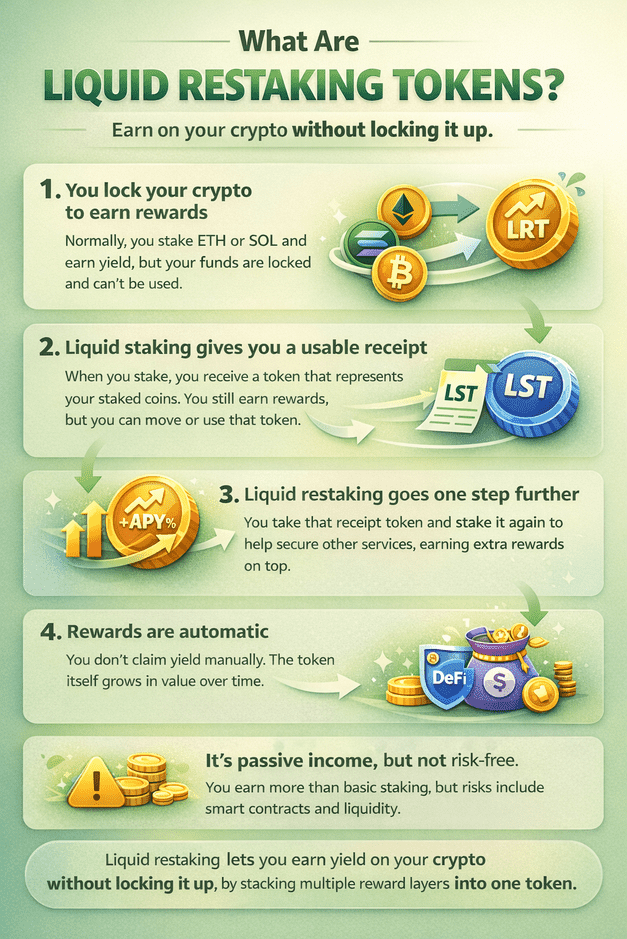
Most major blockchains now operate under proof-of-stake or hybrid consensus models. In simple terms, this means locking tokens to secure the network in exchange for rewards, usually paid in the same token.
The problem is liquidity. Traditional staking requires your tokens to be locked up for a specific time, which limits flexibility.
This led to the creation of liquid staking and later restaking.
To clarify the terminology:
- Liquid Staked Token (LST): You stake a native asset with a provider and receive a receipt token representing your staked position.
- Liquid Restaked Token (LRT): You take that LST and stake it again within additional protocols, receiving another receipt token that can be used across DeFi.
LSTs secure the base layer of a blockchain. LRTs extend that security to additional services such as oracles, bridges, data layers, and security networks, often through frameworks like EigenLayer AVSs on Ethereum.
Why Hold Liquid Restaked Tokens for Crypto Passive Income?
As the restaking market matures in 2026, LRTs offer several advantages for long-term passive income strategies:
- Compounding yields: Base staking rewards can be combined with provider incentives and DeFi yields. This often results in higher APYs or profits than staking alone.
- Flexible liquidity: Receipt tokens remain usable immediately across DeFi. So, you don’t need to lock up your original assets for a long time.
- Airdrop and points farming: Deploying LSTs and LRTs across protocols allows users to earn points, incentives, and potential airdrops alongside yield.
 DON’T GET REKT
Curated drops, testnets and red flag alerts straight to your inbox ✌️
 You’re in. Thanks for joining our newsletter.

Top Liquid Restaked Tokens for Passive Income
The assets below are selected based on liquidity depth, protocol maturity, and ease of use. These are not recommendations, but examples of established options balancing risk and reward.
Solana
Solana’s low fees and high throughput have made it a strong environment for liquid staking and restaking.
SoLayer
SoLayer secures Solana applications by issuing priority blockspace. Restaking SOL with SoLayer captures both native staking rewards and app-generated fees, currently offering yields above 6.5% APY.
JitoSOL
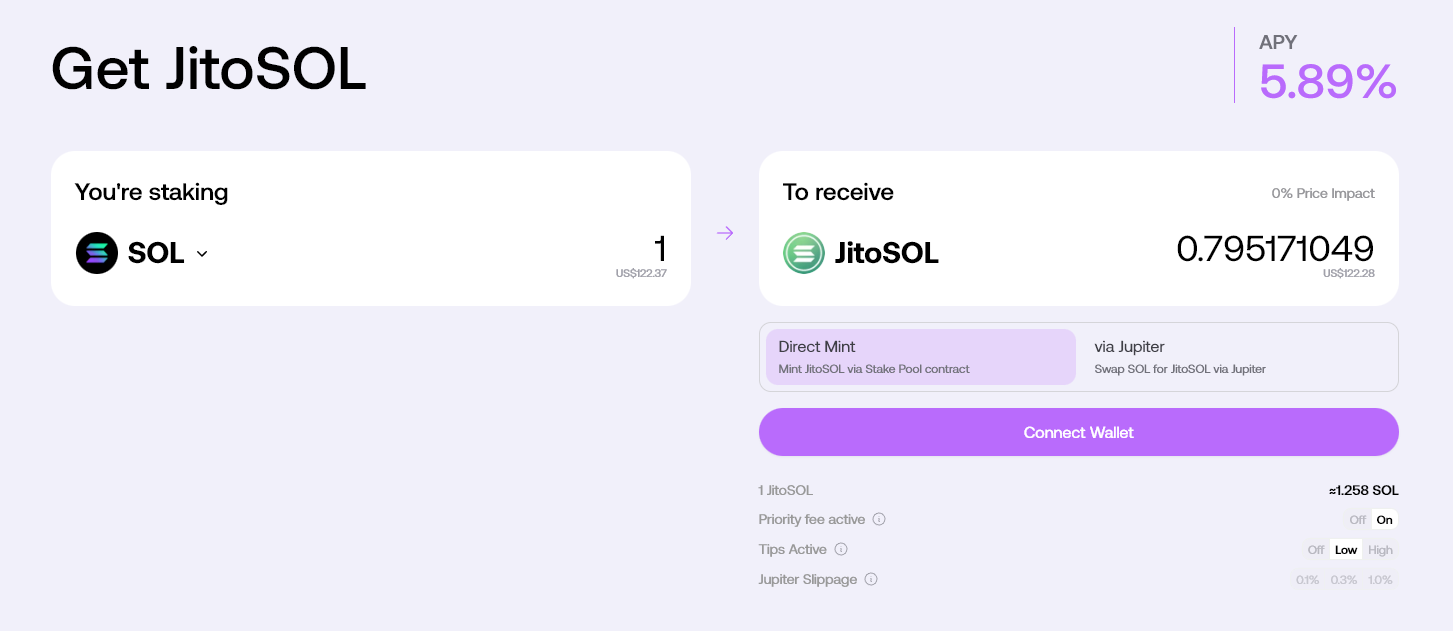
JitoSOL is a widely used Solana LST that captures MEV and priority fees. While historically an LST, the introduction of Node Consensus Networks (NCNs) now allows JitoSOL to be restaked, effectively positioning it as a low-risk entry into restaking.
Bitcoin
Bitcoin does not support native staking, but tokenized BTC has enabled yield generation across multiple chains.
Lombard (LBTC)
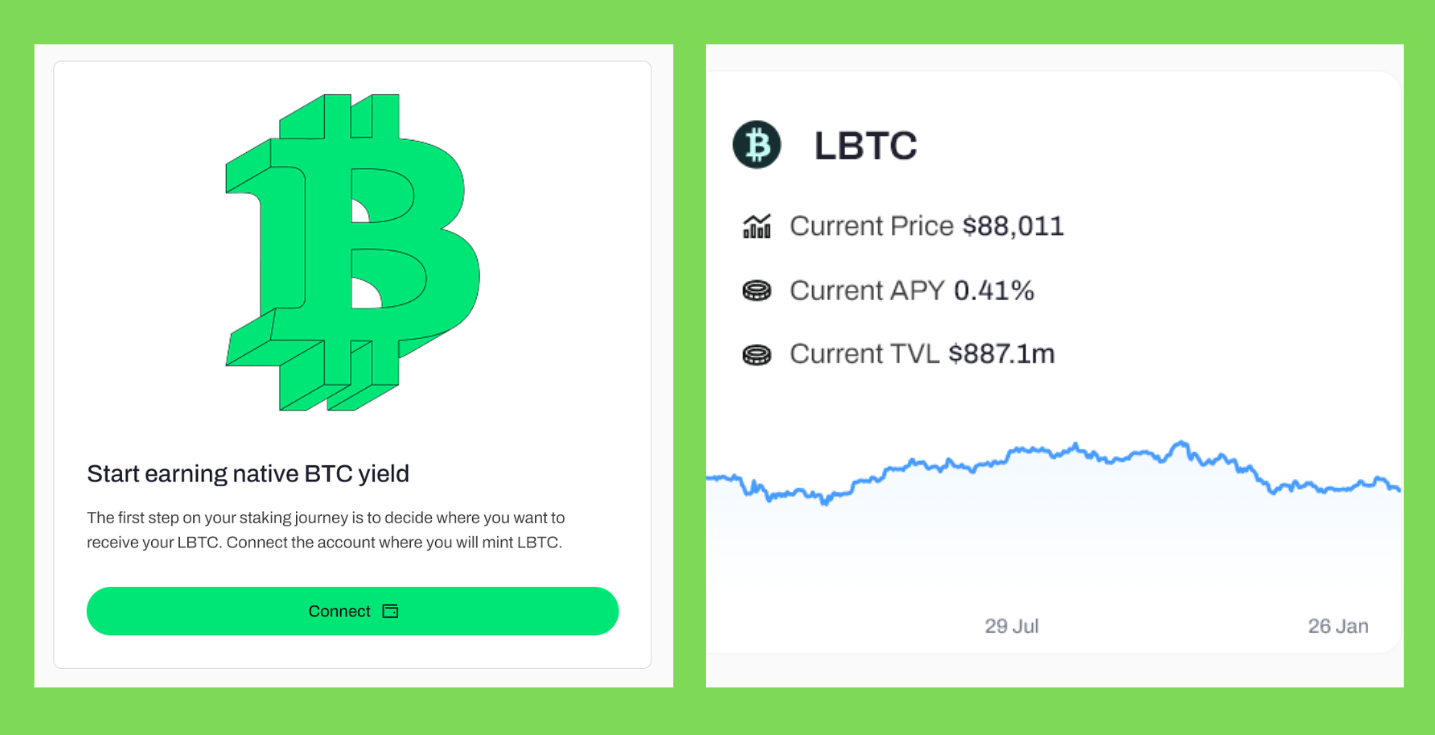
LBTC offers modest base yield, typically around 1%, but benefits from deep liquidity and large market capitalization. It is commonly used as collateral in DeFi on Ethereum and Solana.
SolvBTC
Solv Protocol functions as a yield hub for Bitcoin, issuing tokens optimized for yield across multiple strategies. Base yields exceed 3% APY, with additional upside available through DeFi deployment.
Ethereum
Ethereum remains the core ecosystem for liquid staking and restaking.
eETH (Ether.fi)
One of the most widely adopted LRTs, eETH combines base staking rewards with ecosystem incentives and extensive DeFi integrations. It is often considered a conservative restaking option.
rsETH (Kernel DAO)
rsETH aggregates multiple LSTs to maximize yield, resulting in significantly higher APYs, often near 20%, alongside substantial TVL. This comes with increased complexity and risk.
Comparing the 3 Best Liquid Restaked Tokens for Passive Income
| Ticker | Protocol | Approx. TVL | Est. APY | Est. Yield Profile | Best For |
| eETH | Ether.fi | $8.7B+ | 5% | Base staking yield + ecosystem points + DeFi yields | Conservative ETH crypto passive income |
| JitoSOL | Jito | $2.0B | 7–8% | Base staking + MEV rewards (TipRouter, NCNs) | Low-risk Solana exposure |
| LBTC | Lombard | $1.5B | 0.5–1% | Base BTC yield + DeFi lending yields | Using Bitcoin as DeFi collateral |
How You Actually Earn With LRTs (Step by Step)
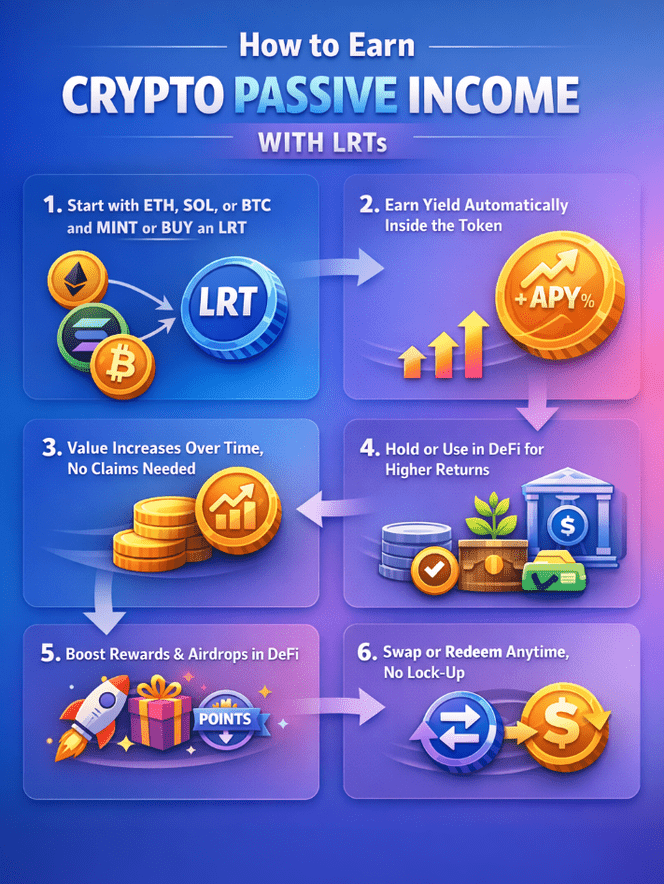
1. You start with the base asset
You begin with ETH, SOL, or BTC.
- ETH → eETH, rsETH
- SOL → JitoSOL, SoLayer
- BTC → LBTC, SolvBTC
You either:
- Mint the LST/LRT directly by depositing the base asset, or
- Buy the LST/LRT on a DEX or CEX if it’s liquid
Both work, but minting avoids slippage.
2. You earn base yield automatically
Once you hold the LRT:
- Staking rewards accumulate inside the token
- The token’s exchange rate increases over time
- You don’t claim rewards manually
This is the “passive” layer.
For example, 1 eETH today → 1.05 eETH worth of ETH over time
3. You can stop here
Simply holding the LRT already earns more than basic staking.
This is the set-and-forget option.
4. Or you deploy the LRT in DeFi (higher yield)
To increase income, you can:
- Lend it on Aave, Morpho, Kamino, etc.
- Use it in Pendle to lock fixed yields
- Loop it (borrow → re-supply) for higher APY
- Farm points and airdrops from restaking protocols
This adds complexity and risk, but also boosts returns.
5. Exit is simple
When you want out, you:
- Swap the LRT back to the base asset on a DEX, or
- Redeem it through the protocol (if available)
No long unbonding periods like traditional staking.
Final Thoughts
Liquid restaked tokens introduce additional risks, particularly around liquidity and protocol complexity. These risks can be mitigated by focusing on assets with deep liquidity, established track records, and broad DeFi integration.
For long-term crypto passive income, LRTs offer a clear evolution beyond basic staking. With only a few additional steps, users can often double or even triple effective yield while maintaining flexibility and optionality.



 Thank you for your feedback! We’re glad you found this article helpful.
 An error occurred while sending the form, please try again.
 We are sorry. You've already sent a message within the last 60 seconds. Please wait before sending another.
 Thank you for letting us know! Our team will review your feedback to help improve our content.
We're sorry you did not find what you were looking for. Please select the reason this article was not helpful.