


 6 min read
Airdrop Farming Explained: How To Do It Successfully In 2026



 AI Overview
Airdrop farming is a low-cost strategy of early, repeated interaction with new blockchain projects to qualify for retrospective token distributions. In 2026 it’s accelerated thanks to low-fee chains, gamified quests, and stronger Sybil detection that favors genuine users.
- High upside, low capital: Minimal funds and gas can yield large token gains when projects reward past activity.
- Play the long game: Consistent multi-month interactions, testnet work and community contribution increase eligibility more than one-off actions.
- Risk management: Use separate wallets on low-fee chains, verify claim sites, never share private keys, and avoid Sybil methods.
aim sites, never share private keys, and avoid Sybil methods.
l>
Airdrop farming is a strategy where crypto users engage with new blockchain projects in the hope of receiving free tokens. These tokens are distributed through ‘airdrops’, where projects reward early adopters and active users once a token is launched.
Instead of waiting for tokens to be announced, airdrop farmers participate early and consistently in protocols, aiming to qualify for future rewards.
This approach has become increasingly popular in 2026 due to the rise in token launches across Layer-2 networks, emerging DeFi apps, and NFT platforms.
With minimal upfront investment and the potential for significant returns, airdrop farming is now a popular strategy for beginner traders looking to gain exposure to new crypto assets.
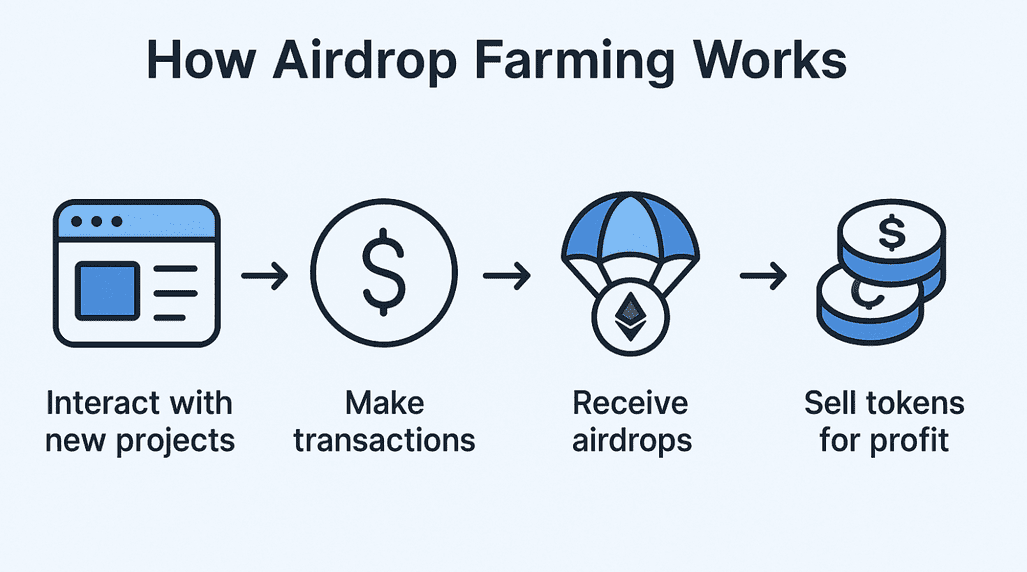
Why airdrop farming is popular in 2026
Several factors have contributed to the boom in airdrop farming this year:
- Low cost of entry: Unlike trading or DeFi yield farming, airdrop farming often requires just a crypto wallet, small gas fees, and some time.
- High reward potential: Past airdrops like Uniswap (UNI), Arbitrum (ARB), and Starknet (STRK) delivered tokens worth hundreds or thousands of dollars.
- Expansion of new blockchains: The rise of low-fee chains like Solana, zkSync Era, and Base makes airdrop farming more accessible.
- Community-focused distribution: Projects prefer rewarding active users rather than VCs, creating fairer token launches.
- Gamified participation: Platforms now use quests, points, and NFTs to incentivize user interaction before launching a token.
How airdrop farming works
Airdrop farming revolves around early and frequent interaction with a blockchain project before its token launch. Here are common actions that can qualify users for future airdrops:
- Bridging funds to a new chain
- Making swaps or trades on a protocol
- Providing liquidity or staking assets
- Voting in governance or testnet participation
- Completing quests via Zealy, Galxe, or Crew3
- Holding specific NFTs or participating in community events.
Most projects don’t announce the exact airdrop criteria beforehand to prevent manipulation. However, consistent on-chain activity is usually a key factor (see the 0G Token launch, as an example).
Step-by-step guide to get started
Step 1: Set up a crypto wallet
Install a self-custody wallet like MetaMask (for Ethereum-based chains), Phantom (for Solana), or Rabby (for multi-chain access). Write down your seed phrase securely and never share it.
Create separate wallets for airdrop farming to reduce risks. Use small amounts to cover gas fees.
Step 2: Find airdrop opportunities
Look for projects that:
- Don’t have a token yet
- Are gaining traction
- Have active communities and incentivized testnets.
Step 3: Engage with the project
Once you identify a promising protocol:
- Bridge assets to the chain (e.g., ETH to zkSync or Starknet)
- Swap tokens on the network’s native DEX
- Try borrowing/lending or staking in dApps
- Participate in governance votes or testnet feedback
- Join quests on Galxe or Zealy
- Stay active across multiple months, not just once.
Step 4: Track your activity
Maintain a spreadsheet with:
- Project name
- Tasks completed
- Wallet used
- Dates of activity
- Expected token launch window.
This helps you avoid missing claims when the airdrop goes live.
Step 5: Claim your airdrop
When a token launches:
- Confirm you’re eligible through official channels
- Connect your wallet to the claim site (never share private keys)
- Beware of scams; use only verified links
- Claim before the deadline, as unclaimed tokens often expire or return to the DAO .
Best platforms for airdrop farming in 2026
Here is a comparison table of beginner-friendly networks and tools:
| Category | Examples | Why they’re useful |
| Layer-2 networks | Arbitrum, Optimism, Starknet, zkSync Era | Low fees, active communities, history of big airdrops |
| Low-cost Layer-1s | Solana, Avalanche, Polygon | Fast, cheap, and easy to use for testing protocols |
| DeFi and NFT dApps | Blur, Uniswap, 1inch, SushiSwap | Reward users for trading, listing, or governance |
| Wallets with future potential | MetaMask, Rabby, Rainbow | Some may launch tokens in future; active use may help |
| Airdrop aggregator sites | Airdrops.io, CMC Airdrops | Track current and upcoming airdrops easily |
| Quest/task platforms | Zealy, Galxe, QuestN | Complete tasks for points, NFTs, or airdrop eligibility |
| Tracking tools | Earnifi, Bankless Airdrop Scanner | Identify unclaimed tokens linked to your wallet |
Best practices to follow
Use cost-efficient chains
Focus on chains with low fees like Arbitrum, zkSync, or Solana. Avoid overspending gas on Ethereum mainnet unless necessary.
Avoid Sybil farming
Don’t use dozens of wallets to farm the same project. Many projects use Sybil detection tools to block fake users. Focus on quality interactions in one or two wallets.
Stay active over time
Many airdrops require activity across several months. Don’t just interact once and forget. Spread your actions over time.
Use testnets
Participating in testnets is a safe and low-cost way to farm airdrops. Projects often reward testnet users during mainnet token launches.
Engage in communities
Be active in Discords, forums, and quests. Projects track community contributions, and being visible helps you stand out.
Watch for scams
Airdrop claims attract phishing attacks. Always use official links, never enter your private key, and verify announcements via Twitter or Discord.
Biggest crypto airdrop examples from recent years
- Starknet (STRK): Airdropped 700m tokens to early users. Eligibility included 5+ transactions over three different months.
- zkSync Era (ZK): Distributed 17.5% of supply to users who bridged, swapped, or completed quests.
- LayerZero (ZRO): Introduced ‘proof-of-donation’ – users donated to claim their tokens. Over 800k Sybil wallets were excluded.
- Blur (BLUR): Gamified NFT marketplace airdrop using trading points and care packages.
- BONK (BONK): Solana meme coin airdropped to NFT holders and SOL stakers.
Trends in 2026 airdrops
- More Sybil detection: Projects use analytics to detect fake wallets.
- Gamified airdrops: Projects use points, badges, and raffles to build loyalty.
- Retroactive rewards: Most airdrops still reward past usage over future promises.
- Governance participation: Projects reward active voters and DAO contributors.
- Ongoing seasons: Some projects do multiple rounds, not one-off events.
Final thoughts
Airdrop farming in 2026 is a low-risk, high-potential way for new traders to get started in crypto. It requires time, patience, and a willingness to explore new platforms. By consistently interacting with emerging protocols, keeping track of your activity, and staying engaged in communities, you can increase your chances of receiving valuable token drops.
Start small, stay safe, and focus on long-term participation over quick wins. With careful planning and genuine involvement, airdrop farming can become a rewarding part of your crypto journey.
Disclaimer: This article is for educational purposes only and does not constitute financial, investment, or legal advice. Always do your own research and consult with a qualified professional before making any financial decisions.
Frequently Asked Questions
-
01.
What is airdrop farming in crypto?
Airdrop farming is the process of interacting early with new blockchain projects in hopes of receiving free token rewards. Users perform tasks like bridging funds, swapping tokens, or using testnets. Projects later reward these users through retroactive token airdrops once their tokens launch.
-
02.
Is airdrop farming worth it in 2025 for beginners?
Yes, airdrop farming in 2025 remains a low-cost, beginner-friendly way to earn free crypto. With the rise of new Layer-2 networks and gamified tasks, beginners can start with minimal funds and potentially receive valuable tokens by being active early.
-
03.
What are the best networks to farm crypto airdrops in 2025?
Top blockchains for airdrop farming in 2025 include Layer-2 chains like Arbitrum, zkSync, and Starknet, and task platforms like Galxe and Zealy. Solana, Avalanche, and Optimism also offer low fees and frequent airdrop campaigns for new users.
-
04.
How do I farm the Robinhood airdrop in 2026?
Focus on active participation in the Robinhood Web3 Wallet and their new native chain testnet. To qualify, you should bridge assets to the Robinhood Chain, complete weekly “Discovery” quests, and maintain an active Robinhood Gold membership, which is widely expected to act as a rewards multiplier.



 Thank you for your feedback! We’re glad you found this article helpful.
 An error occurred while sending the form, please try again.
 We are sorry. You've already sent a message within the last 60 seconds. Please wait before sending another.
 Thank you for letting us know! Our team will review your feedback to help improve our content.
We're sorry you did not find what you were looking for. Please select the reason this article was not helpful.



 You’re in. Thanks for joining our newsletter.
