


 4 min read
Bitcoin Hyper Presale: Is $HYPER Legit Or A Scam?



 AI Overview
A review of Bitcoin Hyper’s public data finds its $218M presale claim unsupported, the token contract partially audited while staking/bridge components remain unaudited, and the team anonymous — together these signals point to a high‑risk project.
- Unverified fundraising: The $218M figure is unsubstantiated, appears misattributed, and on‑chain/independent sources show far smaller presale inflows.
- Risky tokenomics & yields: 30% developer allocation lacks vesting transparency and advertised APYs (up to 40,000%) are unsustainable and predatory.
- Opaque team & tech: No named founders or company records, media coverage is paid, and only the token contract is audited — key components remain unaudited.
Bitcoin Hyper ($HYPER) is a new token currently in presale that claims to be a next-generation Layer-2 solution for Bitcoin. The project has attracted attention after circulating claims that it has raised over $218million. But is Bitcoin Hyper credible, or are these just exaggerated marketing tactics?
Here’s a breakdown of what we found after reviewing publicly available information on $HYPER.
Presale claims don’t hold up
Bitcoin Hyper’s marketing materials and various sponsored articles have claimed it raised over $218m. But this figure appears to be incorrect or misleading.
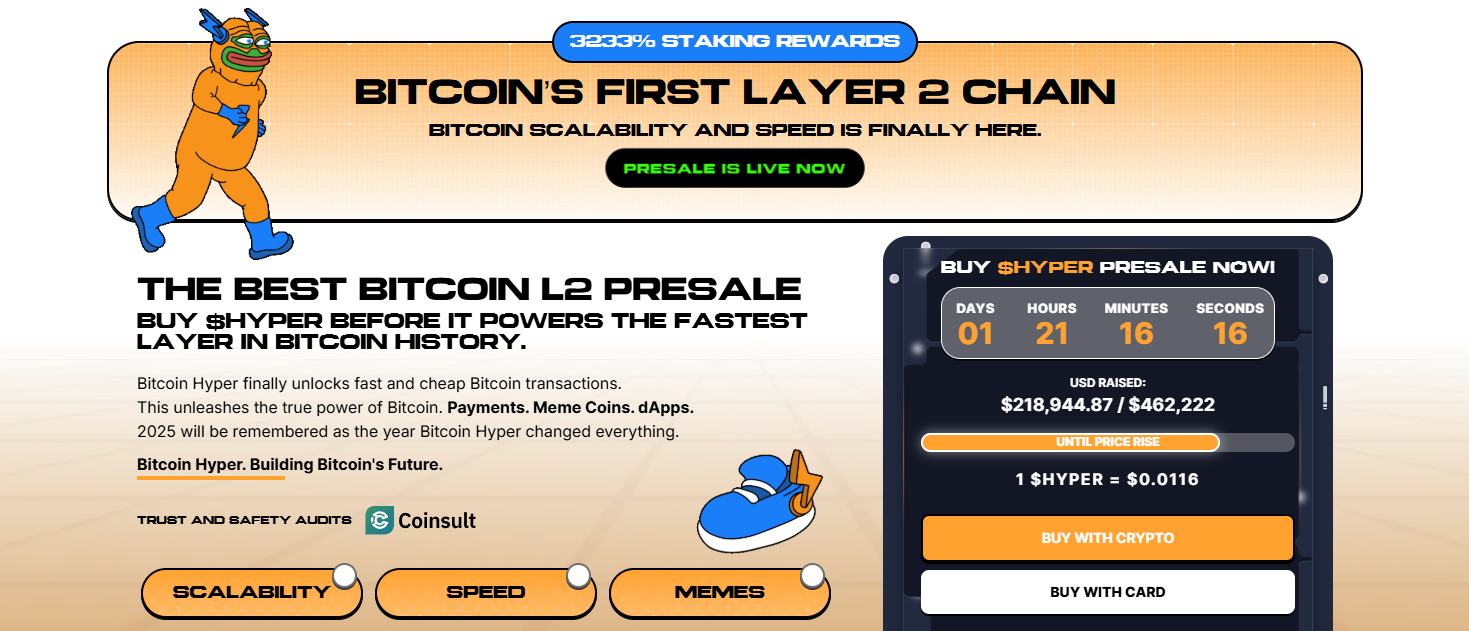
Independent sources such as NewsBTC and ModernDiplomacy reported that the presale had only raised around $100,000 in its early stages. More importantly, the figure of $218m actually relates to a different project (BlockDAG), not Bitcoin Hyper.
The project’s own website currently shows “USD Raised: $0” – likely a placeholder – but there is no verifiable audit or third-party confirmation of large inflows. No centralized exchange has listed $HYPER, and no wallet or blockchain scanner shows any evidence of high-value inflows.
Red flag: There is no credible source confirming the $218m claim.
Tokenomics raise concerns
The total supply of Bitcoin Hyper is fixed at 21 billion tokens. That supply cap is a good signal in theory — it prevents unchecked inflation. However, the distribution plan raises questions.
- 30% of the total supply is allocated to “development”, which likely means the team. That’s a large share with no public vesting schedule.
- 15% goes to community staking rewards.
- 10% is set aside for exchange listings.
- The rest (45%) is split between treasury and marketing.
More worrying is the promise of extremely high staking returns. Some promotional content lists APYs as high as 6,000% to 40,000%. These types of figures are not sustainable and are often used to attract speculative buyers who expect fast returns.
Red flag: Large developer allocation and unrealistic APYs are typical of scam projects.
Partial smart contract audit
Bitcoin Hyper’s token contract has been audited by third-party firms Coinsult and SolidProof. Both audits found no critical issues in the token contract:
- No mint function
- No blacklisting
- No owner-imposed transfer restrictions
- Trading is enabled.
However, only the token contract was audited. There is no audit for any staking, bridging, or backend contracts that may control actual token usage, which leaves a significant gap in security assurance.
SolidProof’s TrustNet score for Bitcoin Hyper is only 60.3 out of 100, indicating partial transparency and no KYC .
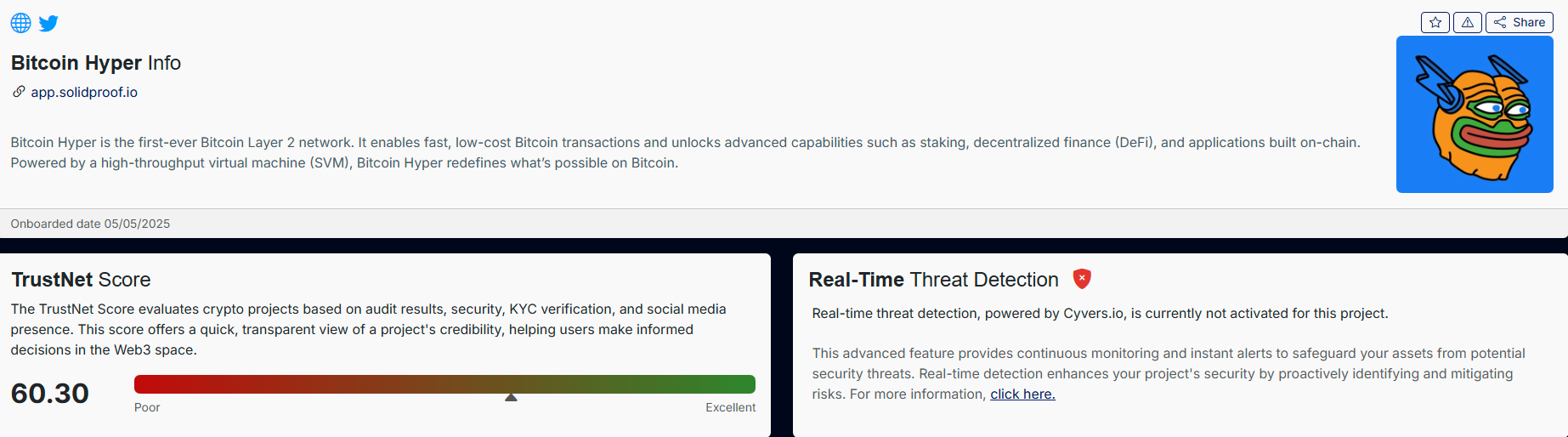
Mixed signal: The token contract is clean, but the rest of the ecosystem remains unaudited.
No transparency around the team
No team members are named on the website, whitepaper , or social channels. There is no company registration, no LinkedIn profiles, and no information on who is building the project. Coinsult notes “KYC unknown” in their audit.
No founders have participated in public interviews, and there is no developer GitHub, blog, or roadmap progress tracking.
Red flag: Anonymous teams with no history or identity are a hallmark of scams.
Sponsored media, not real coverage
Bitcoin Hyper has appeared in articles on several publications — but these are all sponsored posts or press releases. There is no coverage from reputable news outlets like CoinDesk, The Block, or Cointelegraph.
There is no listing on CoinMarketCap or CoinGecko, and no exchange has publicly supported the project.
Red flag: All media coverage is paid-for and promotional.
Misleading branding
Bitcoin Hyper’s name implies it is a Bitcoin-native project. In reality, it’s an ERC-20 token on Ethereum. The website promotes terms like “Layer 2”, “Solana VM”, and “zero-knowledge proofs”, but there’s no evidence these technologies are in use or even under development.
There’s no testnet, GitHub repo, or technical documentation proving any of these claims.
Red flag: Uses hype-driven language without proof of delivery.
Summary of red flags and signals
| Aspect | Observation |
| Presale funds | $218m claim is unverified. No blockchain or independent data supports it. Real presale figures closer to $100k. |
| Token supply | 21bn fixed supply. Positive. But 30% goes to “development” with no transparency or vesting. |
| Staking rewards | Promised APYs up to 40,000% are unrealistic and predatory. |
| Audit | Token contract audited. No red flags in basic contract. However, no audit of other critical components like bridge or staking contracts. |
| Transparency | Team is fully anonymous. No names, no company registration, no roadmap updates, no GitHub. |
| Media coverage | Entirely sponsored press releases. No credible news outlet or developer endorsements. |
| Technology claims | Claims to use ZK and Solana VM, but provides no technical proof. Whitepaper is vague and buzzword-heavy. |
Verdict
Bitcoin Hyper shows multiple red flags that indicate it is a high-risk project. From false presale claims to an anonymous team, unrealistic staking returns, and unverified technical claims, the project fits a pattern common to scam tokens.
While its token contract appears safe from immediate malicious functions like minting or blacklisting, that alone does not make it trustworthy. The complete lack of transparency, combined with misleading marketing and unverifiable fundraising numbers, should raise alarms for any potential investor.
Bottom line: Extreme caution is advised. Based on available evidence, Bitcoin Hyper does not appear to be a legitimate project and carries major risk indicators consistent with scam tokens.



 Thank you for your feedback! We’re glad you found this article helpful.
 An error occurred while sending the form, please try again.
 We are sorry. You've already sent a message within the last 60 seconds. Please wait before sending another.
 Thank you for letting us know! Our team will review your feedback to help improve our content.
We're sorry you did not find what you were looking for. Please select the reason this article was not helpful.

 You’re in. Thanks for joining our newsletter.
