


 4 min read
What Is Alpaca Finance And Why Is $ALPACA Trending?



 AI Overview
Alpaca Finance’s ALPACA token rocketed ~2,500% after Binance announced a delisting; the surge reflected market mechanics—short covering, thin liquidity and massive leverage liquidations—rather than protocol fundamentals.
- Short squeeze mechanics: Delisting triggered heavy short-covering and margin calls, creating cascading buybacks that propelled prices sharply higher.
- Liquidity & leverage amplification: Sparse order books and outsized open interest magnified modest buys into extreme moves; >$45.7M was liquidated in a day.
- Strategic takeaway: Structural market dynamics can override fundamentals—yielding rapid gains but extreme reversal risk and market‑integrity concerns for traders and venues.
Alpaca Finance is a decentralized lending and leveraged yield-farming protocol built on Binance Smart Chain (BSC), allowing users to borrow assets and farm yields with leverage.
On 24 April 2025, Binance announced that it would delist ALPACA and cease spot trading on 2 May, citing factors such as “unethical/fraudulent conduct or negligence,” material changes to tokenomics, and community sentiment.
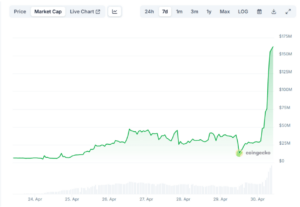
Paradoxically, instead of collapsing, ALPACA’s price exploded. The token has now increased by over 2500% in the last week of April 2025.
So, what is the ALPACA token and why is it bucking the trend?
What is Alpaca Finance?
Alpaca Finance is a decentralized borrowing and lending protocol on the Binance Smart Chain that enables leveraged yield farming. Launched in February 2021, it quickly became one of the largest BSC lending platforms. It integrates with major liquidity pools — most notably PancakeSwap — to allow users to maximize returns through leverage.
Its native token, ALPACA, functions as both a governance token for protocol decisions and an incentive mechanism: holders can stake ALPACA to earn additional rewards.
Why is ALPACA rallying?
1. Binance delisting announcement
On 24 April, Binance revealed plans to delist ALPACA on 2 May, listing key concerns such as possible negligence and tokenomic changes. Delisting often triggers sell-offs, but in this case it set the stage for a counter-intuitive rally.
2. Short squeeze dynamics
Following the delisting news, many traders bet on ALPACA’s collapse by opening short positions. As the token unexpectedly rallied, these shorts were forced to buy back at escalating prices, driving a rapid, self-reinforcing squeeze. Such dynamics have occurred in other tokens like VOXEL post-delisting, suggesting a pattern where capital players hunt short positions.
3. Extreme low liquidity
ALPACA’s circulating liquidity had thinned after the delisting announcement. When a token’s order book is sparse, even modest buy pressure can lead to outsized price moves. The convergence of delisting-induced panic and low liquidity amplified the price impact on 30 April.
4. High open interest and liquidations
By 30 April, open interest on ALPACA perpetual futures far exceeded its market capitalization , indicating an overcrowded market. Over $45.73million in positions were liquidated in a single day, including a mega $3.98m single‐trader wipeout, underscoring how margin calls accelerated the rally.
How Binance delisting triggered the price spike
- Many traders bet on a price drop (short selling): Short sellers borrow ALPACA tokens and immediately sell them on the market, hoping to buy them back later at a lower price and pocket the difference.
- The delisting news backfired: Instead of crashing, ALPACA’s price began to rise as some buyers saw an opportunity. Every uptick in price meant short sellers were suddenly under water — losing money on each token they’d sold.
- Forced buy-backs (short covering): To stop losses from mounting, short sellers had to buy ALPACA back (‘cover’ their shorts). This rush to repurchase adds fresh buying pressure, pushing prices higher — classic short squeeze dynamics.
- Margin calls accelerated the process: Brokers issue a margin call when a trader’s losses leave too little collateral in their account. To satisfy that call, short sellers must either deposit more funds or buy tokens back right away. That urgent buying drives the price up even faster.
- Low liquidity magnified every purchase: ALPACA’s order books had thinned after the delisting announcement. In a market with few tokens available, even modest buy orders can swing the price dramatically — think of a small crowd in a narrow hallway where each push sends the whole group surging forward.
- Token issuance paused: Some protocols freeze new token grants around major events. With no fresh ALPACA entering circulation, all the buying pressure fell on the fixed supply, amplifying the squeeze.
- Funding-rate imbalance lured more buyers: On perpetual futures markets, when short sellers pay high funding rates to longs, it makes holding long positions more attractive. That draws in additional buyers, piling fuel on the rally.
- Perverse market psychology: Delisting is usually bearish, but experienced traders anticipated a squeeze, instigating coordinated buys to trap shorts.
- Short covering: As ALPACA’s price ticked up, short-sellers faced mounting margin requirements and had to repurchase tokens at higher prices, reinforcing the upward spiral.
- Frozen token supply: Some protocols halt token issuance or lock liquidity before delisting; with fewer tokens entering circulation, existing supply faced heightened demand pressures.
- Funding rate imbalance: Negative funding rates (shorts paying longs) incentivized long positions, drawing fresh capital even as shorts bled, further widening the squeeze.
In summary, Alpaca Finance’s unexpected rally in April was less about protocol fundamentals and more about market mechanics — namely, a delisting-induced short squeeze against a thin order book, compounded by extreme open interest and liquidation cascades.
While spectacular, such moves carry outsized risk, as the same dynamics can reverse sharply once forced buying subsides.



 Thank you for your feedback! We’re glad you found this article helpful.
 An error occurred while sending the form, please try again.
 We are sorry. You've already sent a message within the last 60 seconds. Please wait before sending another.
 Thank you for letting us know! Our team will review your feedback to help improve our content.
We're sorry you did not find what you were looking for. Please select the reason this article was not helpful.

 You’re in. Thanks for joining our newsletter.
