


 6 min read
Monad Token Review: Truly an Ethereum Killer?




 AI Overview
Monad is a new parallel‑EVM Layer‑1 combining parallel execution, MonadBFT and MonadDB to chase Solana‑class throughput with Ethereum‑style security. Its mainnet and $MON debut combined a Coinbase presale, record validator rollout and large developer incentives.
- Technical promise: Parallel execution, 400ms finality and a low‑latency DB aim to deliver high throughput without centralization trade‑offs.
- Launch dynamics: Coinbase presale, large airdrop and Momentum incentives caused early sell pressure then recovery; 90% locked but team/VC allocations are a tail risk.
- What to watch: Sustained developer adoption, incentive effectiveness, on‑chain performance and token unlocks/listings will decide Monad’s long‑term market fate.
Watch out, Solana! There’s a new high-performance L1 trying to enter the arena. But can Monad live up to the ‘Ethereum killer’ hype?
Complex market conditions surrounded Monad’s much-anticipated mainnet launch, and sentiment is lukewarm at best, especially as MegaETH hoovers up much of the hype.
Firmly into its first week of trading, let’s take a look at Monad’s $MON token and learn more about this new “parallel EVM” Layer 1 blockchain.
What is Monad?
Offering (in theory at least) the 10,000+ transactions per second speed of Solana, combined with the security and developer network of Ethereum, Monad takes things even further with a rearchitected execution layer (smart contract hosting and transactions):
- Parallel execution: Optimistic processing of transactions at the same time, resolving conflicts post-transaction for improved speeds.
- MonadBFT: A byzantine fault tolerance mechanism unique to Monad that sees it capable of 400ms block times and instant finality.
- MonadDB: A low-latency, asynchronous database.
There are multiple benefits to all this tech wizardry, and they’re the ones blockchain enthusiasts hope for: fast, cheap transactions that are safe.
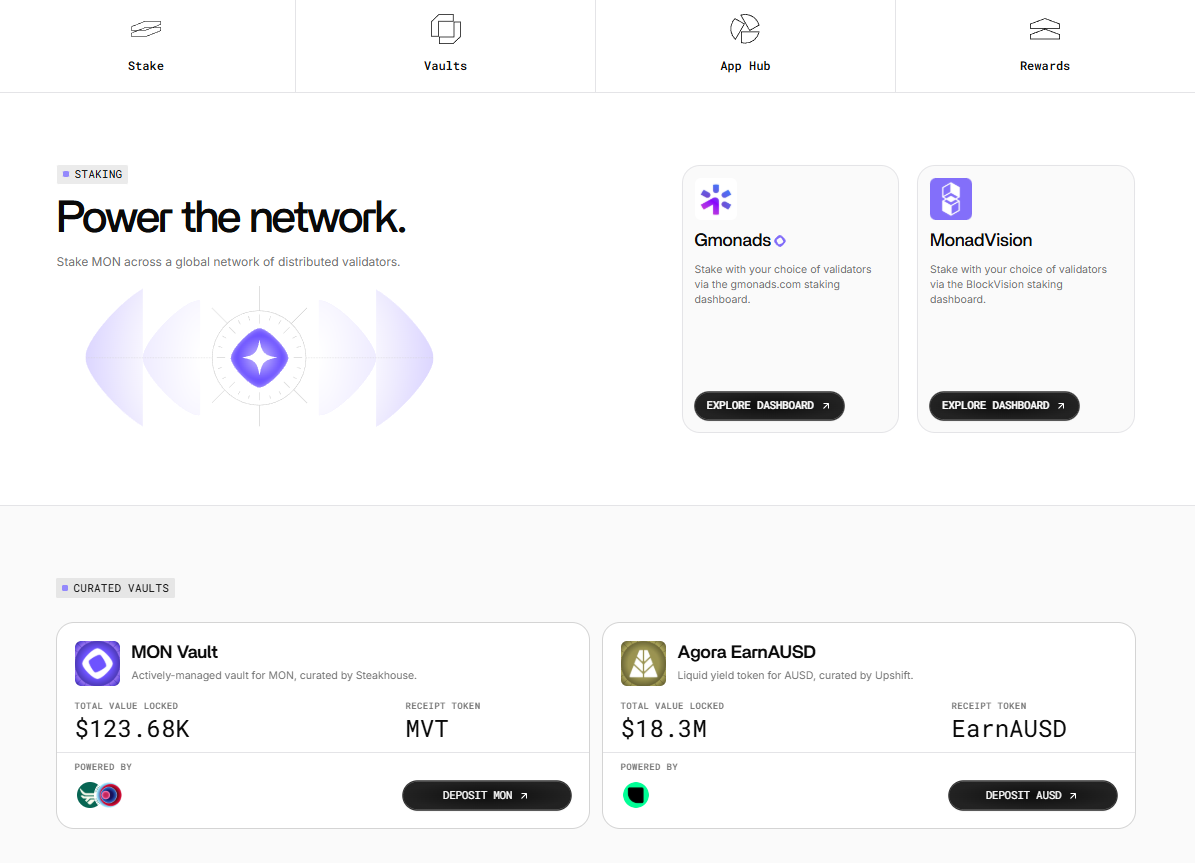
On the developer side, this means that the tech scales well and has very modest hardware transactions.
All this work is, of course, an effort to try and solve the Blockchain Trilemma: the idea that you can’t have speed and scalability, security, and decentralization all at the same time. Whether Monad has achieved a solution to this or not yet remains to be seen.
Although there are many Layer 1 blockchains today (Cardano, Near Protocol, Avalanche, to name a few), there has always been a perceived two-horse race between Ethereum and Solana.
On the one hand, Ethereum is slow and expensive, relying on the support of dozens of Layer 2s. On the other hand, Solana has suffered outages, can become congested, and uses a different programming language.
Could Monad make Layer 1s a 3-horse race, at the very least?
Perhaps, assuming it can maintain momentum post-launch.
 DON’T GET REKT
Curated drops, testnets and red flag alerts straight to your inbox ✌️
 You’re in. Thanks for joining our newsletter.

The $MON token launch
The Monad launch made crypto history for two distinct reasons: one, it was the first-ever Coinbase presale launch. Two, the blockchain went live with a record-breaking number of validators, partner projects and integrations.
Beyond that, there are several other elements that make up the launch, each worth of comment.
- Monad Momentum: This significant incentive campaign allocates a substantial amount of $MON tokens (exceeding 30% of the total supply) to projects developing on Monad, as part of a phased approach to reach 1 million users. Phase 1 has launched with dozens of incentivized partner projects, and this number will likely grow with Phase 2 and beyond.
- The presale: 7.5% of the total $MON supply was sold to the public via Coinbase’s first-ever token sale. It did not initially sell out, and speculation was high that it would not. 85,000 individuals entered the sale, and it raised $250+ million, creating initial sell pressure once investors received their allocations. Users on X reported that at some point, it appeared Coinbase had turned off the ability to sell. Initial price was set to $0.025.
- The airdrop: Monad conducted an airdrop of 3.3% of total supply to eligible recipients on the launch of mainnet. As allocations were tied in some cases to NFT holdings and large social media accounts, Monad drew criticism from loyal, long-term farmers who received smaller allocations.
- Listings: Monad naturally listed immediately on Coinbase, as well as Gate.io, Kran and other CEXs, though a Binance listing is notably absent. There is a rumour that Monad did not want to pay the Binance listing fee. In terms of DEXs, Monad listed on its native Dexs like Kuru, cross-chain Uniswap, and Solana-specific ones like Raydium.
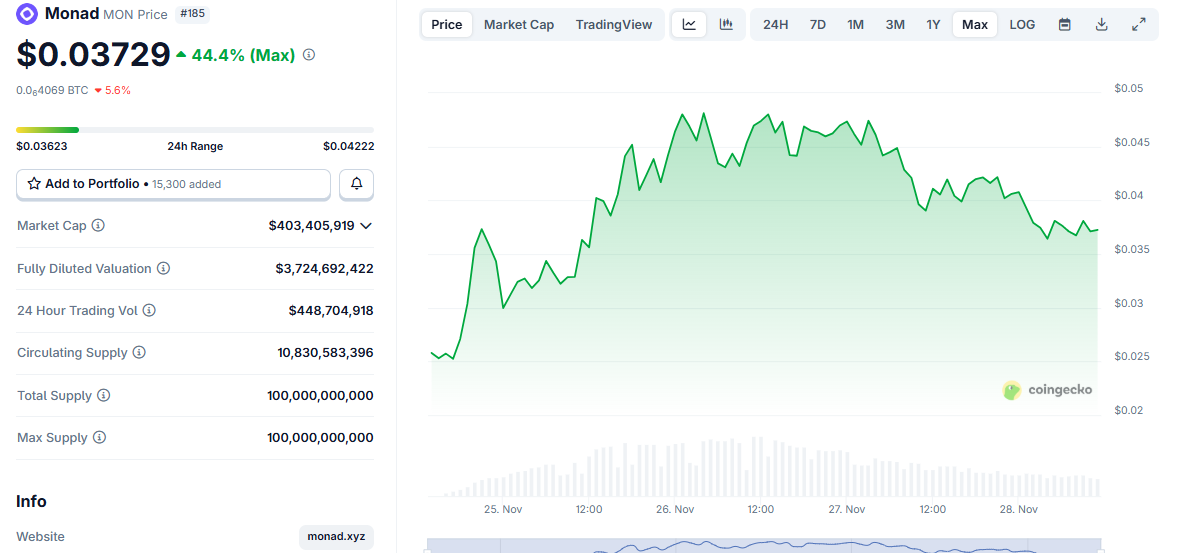
- Initial price and early trading volume: at first, the token value fell to below presale prices, causing a selling panic, but the $MON coin quickly recovered and began trending upwards. It is possibly “too big to fail” at this point in time.
What’s the community saying? Well, after initial disappointment surrounding airdrop allocations and token value, the days following the launch have seen the token price (and the market cap) move to the upside.
From the trenches watching this unfold, it felt like the sentiment started to shift towards the end of the presale, as watchers saw it go from goals unmet to oversubscribed in a short time.
$MON token use cases
As a native Layer 1 cryptocurrency, $MON is actually a coin not a token, but will no doubt be described as such anyway.
It powers the entire Monad blockchain, has reached a market cap of over $500 million at a price of nearly 5c, and is estimated to currently have hundreds of thousands of holders.
It provides holders with these benefits:
- Fees: Native gas coin for the Monad blockchain. Some fees are burned to create deflationary pressure.
- Staking: Secure the network to earn rewards.
- Governance: Participate in decentralized decision-making.
- Incentives: Provide airdrops and grants to ecosystem partner projects.
$MON’s use cases may grow over time as the new blockchain becomes more established.
Monad Roadmap
In the short term, the roadmap involves onboarding users to the chain and increasing TVL through the expansion of Monad Momentum campaigns.
Slightly further out, but early next year, we should expect to see upgrades and improvements to the chain’s technical performance.
Monad team, backing & funding
The Monad CEO and CTO are Jump alumni, with significant experience in high-frequency trading. Some members of the engineering team are Ethereum core developers.
Some criticism is directed at team allocations, which total 27% of supply, although these will not unlock for years to come.
Hundreds of millions in funding from big-name backers across seed and strategic funding rounds led by Dragonfly Capital and Paradigm.
Is Monad token worth your attention?
With 90% of supply locked up and unlocking through 2029, there is some uncertainty around whether Monad will become just another “VC insider chain”, or if it can carry bullish momentum to over a million users and $1 billion market cap.
Current sentiment surrounding Monad appears to be either extremely bullish or highly critical, with little middle ground.
Watch this one closely.



 Thank you for your feedback! We’re glad you found this article helpful.
 An error occurred while sending the form, please try again.
 We are sorry. You've already sent a message within the last 60 seconds. Please wait before sending another.
 Thank you for letting us know! Our team will review your feedback to help improve our content.
We're sorry you did not find what you were looking for. Please select the reason this article was not helpful.