


 9 min read
The History of Bitcoin – 12 Key Dates 2026




 AI Overview
A concise timeline tracing Bitcoin from early precursors through its genesis, major price cycles, protocol upgrades, exchange collapses, and regulatory turning points, showing how scarcity, crises, and institutional adoption have driven its evolution.
- Predictable scarcity: Scheduled halvings and decentralized consensus create a capped-supply dynamic that has historically underpinned long-term price rallies.
- Crisis-to-regulation: High-profile exchange failures and scams accelerated oversight, clearing the path for institutional products like spot ETFs.
- Adoption & upgrades: Protocol improvements (e.g., Taproot) and growing corporate/government accumulation shifted Bitcoin toward a macro asset role.
Rome’s incredible history was not written in a day, and neither was Bitcoin history.
More than 17 years into its journey, Bitcoin’s history has been a roller coaster of betrayals, plot twists, epic highs, and terrible lows.
In this article, you’ll find the story of Bitcoin through 12 key dates spanning the Bitcoin history timeline. Simply explained.
Here’s a quick Bitcoin history lesson.
We’re only ten years into the roller coaster which is Bitcoin history, full of betrayals, plot twists, epic highs, and terrible lows.
2005 – Before Bitcoin… Bitgold was proposed
In 2005, Nick Szabo proposed “Bitgold”.
It proposed features similar to those for which Bitcoin is known: decentralization , proof-of-work, and a blockchain-like system.
Unfortunately, BitGold never took off because of one fatal weakness:
The double-spend problem.
Users of Bitgold could spend their Bitgold twice without being “caught.”

Does Bitcoin Solve The Double Spending Problem?
The problem is similar to the piracy of movies, music, and other digital items.
Someone could copy/paste the digital token and keep spending it as long as they made copies. Essentially this is counterfeiting.
Traditional digital payment systems like VISA solve this problem with a centralized , highly secure space where they keep all records of transactions.
But if someone were to break in, they could give themselves all the money they wanted.
Bitgold could not get past that problem.
Bitgold, at the end of the day, was just another centralized payment system. Nothing truly revolutionary.
However, some say it was the inspiration that kicked off Bitcoin history.
2008 – Bitcoin’s Whitepaper is Published
In 2008, an anonymous person known as Satoshi Nakamoto arrived on the scene.
To this day, no one knows who Satoshi is or was. Satoshi first appeared on a few cryptography forums in 2008.

- In January 2009, on a site called SourceForge, Satoshi publicly released version 0.1 of the Bitcoin software. A momentous first step in Bitcoin history.
- He/she/they then launched the network by mining the first block (the “genesis block”).
- He, she, or it (a group or company), published a paper called Bitcoin – A Peer-to-Peer Electronic Cash System.
- This paper solved the double-spending problem.
- Bitcoin solved it by using a decentralized structure.
- Computers all around the world would keep a copy of the blockchain (all the transactions) and verify it with each other.
- To break the blockchain, hackers would not need to break into a single ledger (acentralized system).
- They would need to break into hundreds of ledgers around the world (a decentralized system). A major breakthrough!
- Then, in December 2010, Satoshi disappeared. Many people have claimed to be Satoshi since then, but no one has offered any verifiable proof.
- Satoshi’s anonymity remains intact. Pictures do circulate of an old Asian gentleman, but the man in question denies being Satoshi.

2009 – Bitcoin is Launched
In 2009, with help from programmer Hal Finney, Satoshi Nakamoto launched Bitcoin for the first time.
- This was arguably the most important point in the Bitcoin history timeline, because it changed digital finance forever.
- Satoshi Nakamoto mined the first blocks in the blockchain himself.
- The first transaction was from Nakamoto to Hal Finney, for a grand total of 10 bitcoins.
- The transaction was a success, and it is permanently recorded in Bitcoin history thanks to Bitcoin’s unchanging blockchain.

- Sadly, Hal Finney had been diagnosed in 2009 with “Lou Gehrig’s disease, or ALS (think Stephen Hawking).
- Hal Finney bravely battled the degenerative disease until August 2014, when he peacefully passed away.
- Until his dying breath, Hal denied being Satoshi Nakamoto and insisted he didn’t know who Nakamoto was.
2010 – 10,000 Bitcoins buy 2 Pizzas.
Another absolutely huge moment in Bitcoin history must be the first transaction between Bitcoin and a real-world item.
- This took place on May 22, 2010.
- That day has now become an anniversary day known as Bitcoin Pizza Day.

Laszlo Hanyecz organized it. He posted on Bitcointalk forum:
“I’ll pay 10,000 bitcoins for a couple of pizzas.. like maybe 2 large ones so I have some left over for the next day.“
Another user took him up on the offer and bought (with delivery) two Papa John’s pizzas for him in exchange for … 10,000 BTC!
As a reminder, here’s what 1 Bitcoin is worth as of August, 2025: $1,13,231.
2011 – Bitcoin Reaches Parity with the U.S. Dollar
The price of one Bitcoin finally reached parity with the U.S. dollar.
- For the first time, there were enough buyers to raise the price to $100 for 1 BTC.
- The parity provided a psychological “validation” to people, because one U.S. dollar is viewed as a legitimate type of monetary item.
2012 – First Bitcoin Halving
- Block reward reduced from 50 BTC → 25 BTC
- Established Bitcoin’s four-year supply cycle
- Often cited as the beginning of long-term scarcity-driven price growth
2013 – Bitcoin’s First Major Price Surge
For the first time, Bitcoin burst onto the world stage.
- People could tell something big was happening as early as February 2013.
- Indeed, Coinbase reported selling over $1 million worth of bitcoins in a single month (the price at the time had climbed from $5 to over $22 per bitcoin).
- This was the start of the first major Bitcoin bull run and bubble.

Quickly, Bitcoin reached a dizzying valuation of $1,213 per BTC.
- People around the world were shocked that “fake internet money” could be worth that much.
- But the party was over by December of the same year.
- BTC crashed to $600 per coin.
- Yes, it shot back up again to $1000, but then the price fell and stabilized between $650 and $800.
2014 – The Mt. Gox Collapse and China’s Crackdown
If you could visualize Bitcoin history, you would notice several dark craters where bad things happened.
- The first and perhaps largest was Mt. Gox.
- Mt. Gox, the largest crypto exchange in the world, suddenly shut down.
- Thousands of people with BTC on the platform were suddenly left with nothing.
- Mt. Gox simply shut its doors one day and declared bankruptcy.
- The FBI investigated and seized $2.1 to $5 million in bitcoin, but the vast majority was gone.

Another crater in Bitcoin history occurred in December 2013, when the Chinese government banned Bitcoin by preventing banks from dealing with it and its customers.
- Bitcoin price falls again by double digits.
- However, governments are starting to take notice, which provides some legitimacy to Bitcoin as an asset class.
2015 – Bitcoin Meets Competition
Ethereum is created.
- So far, the cryptocurrency space was filled with imposters and other coins trying to “be the next Bitcoin” or “be better than Bitcoin.”
- The only one to give Bitcoin true competition was Ethereum.
- That’s because Ethereum wasn’t trying to be a “better bitcoin.”
- It was taking blockchain technology and using it for something other than digital currency.
- Ethereum’s blockchain is designed to handle smart contracts .

Bitcoin’s blockchain can only handle simple exchanges of value from one address to another.
Ethereum’s blockchain can handle transactions that are far more complex, such as digital assets, crypto loan contracts, and more.
2016 – Second Bitcoin Halving
- Block reward reduced from 25 BTC to 12.5 BTC
- Set the stage for the massive 2017 bull run
- Reinforced Bitcoin’s predictable monetary policy
2016 – The ICO Craze Begins
Ethereum’s smart contracts enabled companies to raise funds in a whole new way.
- Traditionally, companies had to reach out to angel investors, accelerators, or conduct a lengthy and expensive IPO (Initial public offering) on the stock market.
- With Ethereum, all a company had to do is create an Ethereum smart contract .
- This new way of raising money was called the ICO, short for Initial Coin Offering.
- People around the world could send in ETH or BTC to the address, and the smart contract would automatically send the company’s unique new “coins” to them.
- It was like buying stocks. It was speculation, pure and simple.
- Bitcoin history was forever altered by this because a whole wave of new competitors began to pop up.
- Along with them came new ideas, new investors, more press coverage, but also scams and hacks.
2017 – Bitcoin Hits $20K
Visualizing Bitcoin history is like seeing a mountain range.
- December 2017 is one of the bigegst peaks.
- By this point, the ICO craze had generated so much media buzz, and so many new speculators.
- As a result, Bitcoin and the entire cryptocurrency market reached the peak of their latest bubble.
- Up until this point, Bitcoin had faced competition from 200+ cryptocurrencies, it had been banned by China and India, and Ethereum was taking the spotlight.
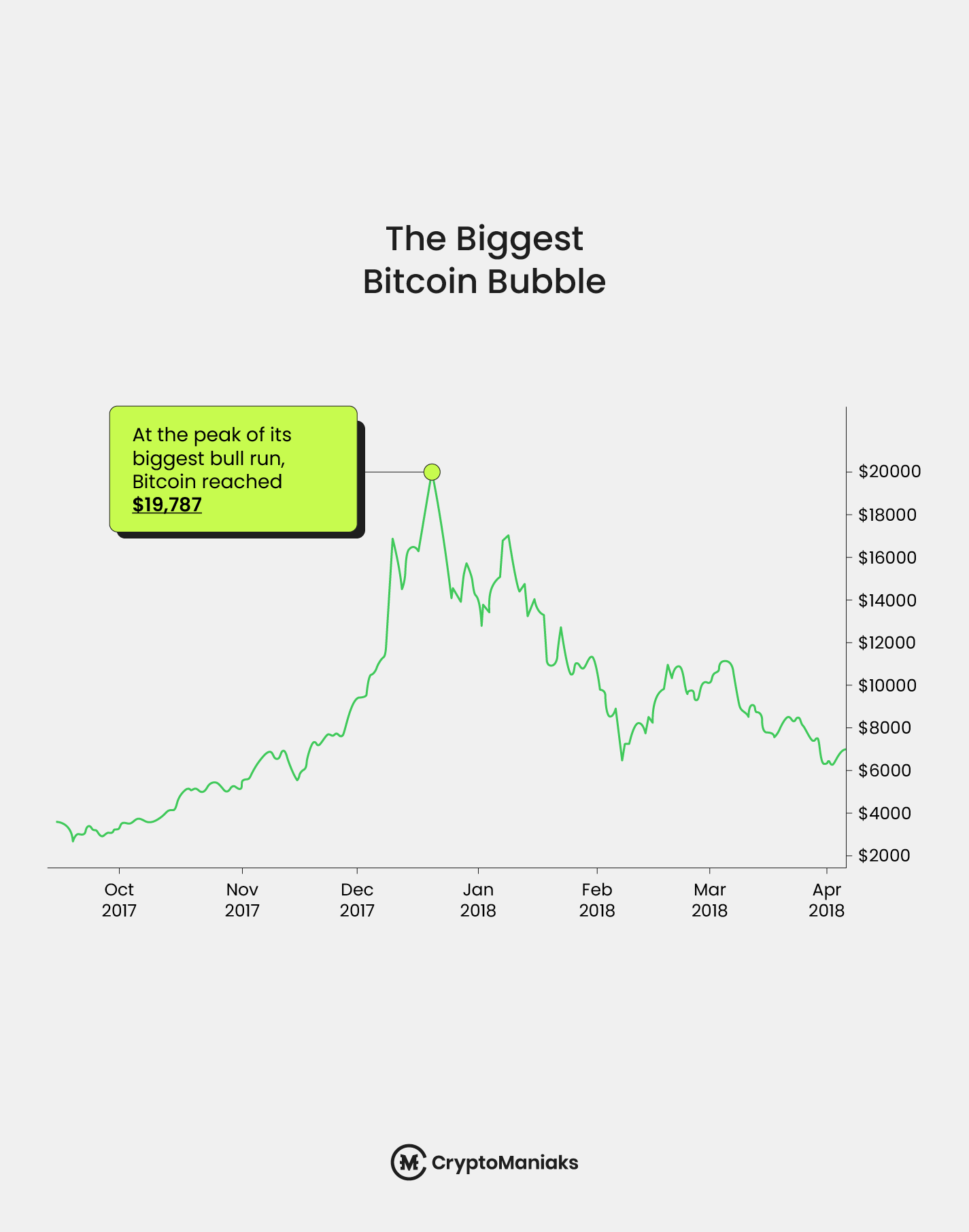
But Bitcoin managed to remain king and it emerged victorious at $19,787 per bitcoin.
But not for long….
2018 – Bitcoin’s Post-Bubble Crash
One year after the bubble popped, Bitcoin hit its lowest value at $3,300 per coin.
- But that didn’t stop Bitcoin from continuing its rise.
- Throughout the price drop, more people were mining it, more companies were using it, and more funds were investing in it.
2020 – The Third Halving and the Impact of COVID-19
Bitcoin started 2020 with a lot of healthy optimism.
- The Bitcoin halving was coming up in a few short months in May 2010; the price was hovering around $10,000; good things were on the way.
- But then, in March 2020, the Coronavirus (COVID-19) pandemic hit the world.
- Traditional markets dropped like a lead balloon. So did Bitcoin.

The price of Bitcoin quickly went down to $3,800 for a few hours.
- However, in a flash, it was soaring back up again!
- Since the big drop on March 12, 2020, the price of bitcoin has been recovering with strength.
2021 – Taproot Upgrade
- Taproot activated in November 2021
- Improved privacy
- Enabled more efficient smart contracts
- Strengthened Bitcoin’s long-term scalability
From 2021–2022 – All-Time Highs and the “Crypto Winter”
Bitcoin’s Record-Breaking All-Time High
In November 2021, Bitcoin reached a record price of nearly $69,000, its highest level ever. This milestone cemented Bitcoin’s reputation as “digital gold” for a new wave of investors.
Institutional Adoption Expands
2021 also marked key moments of mainstream adoption: Tesla purchased Bitcoin for its treasury, MicroStrategy became a massive corporate holder, and El Salvador made history as the first nation to adopt Bitcoin as legal tender.
The Crypto Winter Begins
But in 2022, a harsh downturn arrived. The collapse of Terra/Luna, along with the failures of Celsius and Voyager and the shocking bankruptcy of FTX, triggered the so-called “Crypto Winter.” Bitcoin’s price plummeted below $20,000, shaking investor confidence worldwide.
2024 – Milestones and Market Shifts
Bitcoin ETF Approval in the U.S.
In early 2024, U.S. regulators finally approved the first spot Bitcoin ETFs, opening the doors for mainstream investors to access BTC through traditional markets. Following the approval of spot Bitcoin ETFs and the fourth halving in April 2024, Bitcoin entered a powerful, institutionally driven cycle, with ETF inflows becoming one of the strongest demand drivers in its history.
The Fourth Halving
April 2024 brought Bitcoin’s fourth halving event, cutting mining rewards to 3.125 BTC. Historically, halvings have sparked bull markets, and this one followed suit.
A New All-Time High
Later in 2024, Bitcoin hit fresh all-time highs, breaking past its previous $69,000 peak, reinforcing its long-term bullish cycle.
2025 – What’s New Up Until Now
- Bitcoin ETFs became one of the fastest-growing ETF categories globally
- Long-term holders reached record-high supply percentages
- Mining increasingly shifted toward renewable and energy-optimized infrastructure
- Governments began focusing more on regulation clarity rather than bans
Price Trends in 2025
As of mid-2025, Bitcoin has shown strong resilience, consolidating above prior cycles’ highs and continuing to attract long-term holders.
Institutional Momentum Continues
Major asset managers, pension funds, and even some governments have continued to accumulate Bitcoin, strengthening its position as a global financial asset.
Global Events Shaping Bitcoin
Ongoing macroeconomic uncertainty and shifting geopolitical dynamics continue to influence Bitcoin’s demand, underscoring its role as both a hedge and a speculative growth asset.
By 2025, Bitcoin had matured from a speculative asset into a globally monitored financial instrument, with transparent regulation, institutional custody, and large-scale infrastructure supporting the network.
 DON’T GET REKT
Curated drops, testnets and red flag alerts straight to your inbox ✌️
 You’re in. Thanks for joining our newsletter.

The Future Outlook
Looking back, Bitcoin’s history has been shaped by dramatic highs, painful crashes, and groundbreaking milestones. From its anonymous creation to mainstream recognition by corporations and governments, Bitcoin has repeatedly proven its resilience.
The future will depend on adoption, regulation, and balancing innovation and risk. What’s clear is that Bitcoin remains a unique and powerful experiment in decentralized finance — one that continues to make history year after year.
2026 and Beyond
- Bitcoin is widely discussed alongside gold and bonds
- Institutional custody is now standard
- ETFs influencing price volatility and liquidity
- Growing separation between Bitcoin and speculative altcoins
- Bitcoin is increasingly viewed as a long-term store of value rather than just a payment currency
Frequently Asked Questions
-
01.
How often does Bitcoin experience a major price cycle?
Roughly every four years, often tied to halving events, Bitcoin experiences a major boom-and-bust cycle.
-
02.
What are the main drivers of Bitcoin’s price over time?
The key drivers include supply shocks (halvings), institutional adoption, regulation, technological upgrades, and macroeconomic conditions.
-
03.
Why does Bitcoin remain relevant despite volatility?
It remains relevant because it combines digital scarcity, decentralization, and growing global adoption, continuing to attract believers and investors even during downturns.



 Thank you for your feedback! We’re glad you found this article helpful.
 An error occurred while sending the form, please try again.
 We are sorry. You've already sent a message within the last 60 seconds. Please wait before sending another.
 Thank you for letting us know! Our team will review your feedback to help improve our content.
We're sorry you did not find what you were looking for. Please select the reason this article was not helpful.