


Choosing the best crypto exchange in Germany can be tricky when there are so many options available. To make things easier, our team at CryptoManiaks did the research for you. We reviewed the most trusted platforms, gathered feedback from German traders, and compared features to create this helpful guide. Our goal is to show you which exchanges are safe, affordable, and simple to use.
In this article, you’ll learn about the best features of good crypto exchanges in Germany and see which platforms are the top picks. We’ll cover the most important points, including the security of each exchange, the fees you’ll incur, the ease of use of the website or app, and the available coins. You’ll also find details on customer support and the overall reputation of each platform.
As of 2026, Germany operates under the EU’s Markets in Crypto-Assets (MiCA) framework, which standardizes crypto rules across Europe. Exchanges serving German residents must now meet stricter requirements around custody, transparency, capital reserves, and consumer protection. This has reshaped which platforms are truly suitable for German users.
We’ll also explain key topics every German trader should know, such as KYC rules, how to deposit and withdraw euros, and the basics of crypto taxes. By the end, you’ll know which exchanges best fit your needs and how to start trading in Germany the right way.
Best Crypto Exchanges in Germany 2026 Are
-
 Coins
Coins


 Deposit Methods
 Avg. Spread The difference between the buy (ask) and sell (bid) price for popular trading pairs. Lower spreads mean better pricing and less slippage for you.
 -
 Coins
Coins
 Deposit Methods

 Avg. Spread The difference between the buy (ask) and sell (bid) price for popular trading pairs. Lower spreads mean better pricing and less slippage for you.
 -
 Coins
Coins


 Deposit Methods
Avg. Spread The difference between the buy (ask) and sell (bid) price for popular trading pairs. Lower spreads mean better pricing and less slippage for you.
Deposit Methods
Avg. Spread The difference between the buy (ask) and sell (bid) price for popular trading pairs. Lower spreads mean better pricing and less slippage for you. -
 PromotionsCoins
 Deposit Methods
 Avg. Spread The difference between the buy (ask) and sell (bid) price for popular trading pairs. Lower spreads mean better pricing and less slippage for you.
 -
 Coins
Deposit Methods
Avg. Spread The difference between the buy (ask) and sell (bid) price for popular trading pairs. Lower spreads mean better pricing and less slippage for you.
Coins
Deposit Methods
Avg. Spread The difference between the buy (ask) and sell (bid) price for popular trading pairs. Lower spreads mean better pricing and less slippage for you. -
 Coins
Deposit Methods
Avg. Spread The difference between the buy (ask) and sell (bid) price for popular trading pairs. Lower spreads mean better pricing and less slippage for you.
Coins
Deposit Methods
Avg. Spread The difference between the buy (ask) and sell (bid) price for popular trading pairs. Lower spreads mean better pricing and less slippage for you. -
 PromotionsCoins
Deposit Methods
PromotionsCoins
Deposit Methods
 Avg. Spread The difference between the buy (ask) and sell (bid) price for popular trading pairs. Lower spreads mean better pricing and less slippage for you.
 -
 Coins
Coins

 Deposit Methods
Avg. Spread The difference between the buy (ask) and sell (bid) price for popular trading pairs. Lower spreads mean better pricing and less slippage for you.
Deposit Methods
Avg. Spread The difference between the buy (ask) and sell (bid) price for popular trading pairs. Lower spreads mean better pricing and less slippage for you. -
 Coins
Deposit Methods
Coins
Deposit Methods
 Avg. Spread The difference between the buy (ask) and sell (bid) price for popular trading pairs. Lower spreads mean better pricing and less slippage for you.
 -
 PromotionsCoins
Deposit Methods
Avg. Spread The difference between the buy (ask) and sell (bid) price for popular trading pairs. Lower spreads mean better pricing and less slippage for you.
PromotionsCoins
Deposit Methods
Avg. Spread The difference between the buy (ask) and sell (bid) price for popular trading pairs. Lower spreads mean better pricing and less slippage for you. -
 Coins
Deposit Methods
Avg. Spread The difference between the buy (ask) and sell (bid) price for popular trading pairs. Lower spreads mean better pricing and less slippage for you.
Coins
Deposit Methods
Avg. Spread The difference between the buy (ask) and sell (bid) price for popular trading pairs. Lower spreads mean better pricing and less slippage for you. -
 Coins
Coins
 Deposit Methods
 Avg. Spread The difference between the buy (ask) and sell (bid) price for popular trading pairs. Lower spreads mean better pricing and less slippage for you.
 -
 Coins
Deposit Methods
Avg. Spread The difference between the buy (ask) and sell (bid) price for popular trading pairs. Lower spreads mean better pricing and less slippage for you.
Coins
Deposit Methods
Avg. Spread The difference between the buy (ask) and sell (bid) price for popular trading pairs. Lower spreads mean better pricing and less slippage for you. -
 Coins
Deposit Methods
Avg. Spread The difference between the buy (ask) and sell (bid) price for popular trading pairs. Lower spreads mean better pricing and less slippage for you.
Coins
Deposit Methods
Avg. Spread The difference between the buy (ask) and sell (bid) price for popular trading pairs. Lower spreads mean better pricing and less slippage for you. -
 PromotionsCoins
 Deposit Methods
 Avg. Spread The difference between the buy (ask) and sell (bid) price for popular trading pairs. Lower spreads mean better pricing and less slippage for you.
 -
 Coins
Coins
 Deposit Methods
Avg. Spread The difference between the buy (ask) and sell (bid) price for popular trading pairs. Lower spreads mean better pricing and less slippage for you.
Deposit Methods
Avg. Spread The difference between the buy (ask) and sell (bid) price for popular trading pairs. Lower spreads mean better pricing and less slippage for you. -
 PromotionsCoins

 Avg. Spread The difference between the buy (ask) and sell (bid) price for popular trading pairs. Lower spreads mean better pricing and less slippage for you.
 -
 Coins
Coins

 Deposit Methods
 Avg. Spread The difference between the buy (ask) and sell (bid) price for popular trading pairs. Lower spreads mean better pricing and less slippage for you.
 -
 Coins
Deposit Methods
Coins
Deposit Methods

 Avg. Spread The difference between the buy (ask) and sell (bid) price for popular trading pairs. Lower spreads mean better pricing and less slippage for you.
 -
 Coins
Deposit Methods
Avg. Spread The difference between the buy (ask) and sell (bid) price for popular trading pairs. Lower spreads mean better pricing and less slippage for you.
Coins
Deposit Methods
Avg. Spread The difference between the buy (ask) and sell (bid) price for popular trading pairs. Lower spreads mean better pricing and less slippage for you.
Top German Crypto Exchanges Reviewed

Get $10 in Bitcoin when you register through a referral link from an existing member.


Established in 2011, Kraken is a trusted cryptocurrency exchange renowned for its longevity and diverse trading interfaces, catering to a broad user base.
- Supports hundreds of coins
- High liquidity
- Simple and user-friendly interface
- Good customer support options
- Lots of advanced trading features like margin, futures, and indices trading
- No insurance fund for assets on the platform
- Doesn’t offer a crypto credit card
- No personal wallet service for traders
- Supports only a few fiat currencies
Year Founded
- 2011
Headquarters
- United States
Licenses
- United States (IRS)
- Canada (CRA)
- United Kingdom (HMRC)
-
+7
Cryptocurrencies
- Bitcoin
- Ethereum
- Tether
-
+83
Available countries
- Afghanistan
- Albania
- Algeria
-
+240
Languages
- Chinese (Mandarin)
- English
- French
-
+10
Features
- Cryptowatch
- Forks
-
+29
Receive up to $100,000 worth of exclusive gifts for newcomers upon registration.
Bitunix was founded in Hong Kong in 2021. It was designed to bring a breadth of crypto features to beginner and intermediate traders.
It supports over 700 cryptocurrency trading pairs in more than 100 countries. It offers spot, P2P, and derivatives trading. With copy trading, new traders can copy the trades of successful users, with them earning a cut.
The exchange offers a myriad of new user bonuses and lotteries, letting new traders jumpstart their experience.
Rewards and tournaments are also available for existing users. Bitunix Splash gives rewards for investing in new tokens, while regular competitions in categories like trading volume or monthly profits carry up to USDT 675,000 in rewards.
Licenses
- United States (IRS)
- Canada (CRA)
- Phillipines
Cryptocurrencies
- Bitcoin
- Ethereum
- Tether
-
+78
Available countries
- Albania
- Algeria
- American Samoa
-
+233
Languages
- English
- Uzbek
- Polish
-
+12
Enjoy US$50 worth of CRO as sign-up bonus when you sign up with a referral link.


- Extensive list of supported cryptocurrencies
- Hardware wallet support
- With its Visa cards, you can spend your crypto and earn rewards
- Easy to purchase NFTs on the platform using either fiat or certain cryptos
- Higher fees for those who don't hold and use CRO
- Poor customer service
- Lack of educational resources
- Slow in-app live support
Year Founded
- 2016
Headquarters
- Singapore
Licenses
- United Arab Emirates
- Brazil
- United Kingdom (HMRC)
-
+19
Cryptocurrencies
- Bitcoin
- Holo
- Litecoin
-
+157
Available countries
- Afghanistan
- Algeria
- American Samoa
-
+200
Languages
- Danish
- Spanish
- French
-
+13
Features
- Supercharger
- Trading Arena
-
+2


- An advanced trading platform
- Low fees and high liquidity
- Supports lots of different payment options
- Efficient and dedicated phone and email support
- Lots of charting tools
- No live chat customer support
- Slow verification process
- International wire transfer takes 2 to 5 days to clear
- A few number of coins on offer
- Was hacked in 2015
Year Founded
- 2011
Headquarters
- Virgin Islands, British
Licenses
- Luxembourg
- United States (IRS)
- Spain
-
+1
Cryptocurrencies
- Bitcoin
- Ethereum
- Tether
-
+52
Available countries
- Afghanistan
- Albania
- Algeria
-
+244
Languages
- English
Features
- Institutions
- Pro Traders
-
+4
Enjoy up to 30,000 USDT Bonus when you sign up and complete tasks. Get a 10 USDT coupon when you sign up, and link your phone number and email.


Year Founded
- 2018
Headquarters
- Singapore
Licenses
- United States (IRS)
- Canada (CRA)
Cryptocurrencies
- Bitcoin
- Ethereum
- Tether
-
+96
Available countries
- Philippines
- United Kingdom
- United States
Languages
- English
- Simplified Chinese
- Chinese (Traditional)
-
+15
Features
- Futures Demo
- Copy Trading
-
+18
YouHodler Crypto Exchange, launched in Cyprus in 2018, stands as a versatile platform offering a plethora of crypto-fiat financial services including lending, trading, and savings accounts.
Year Founded
- 2017
Headquarters
- Cyprus
Licenses
- Italy
- Switzerland
- European Gaming and Betting Association (EGBA)
-
+2
Cryptocurrencies
- Bitcoin
- Ethereum
- Tether
-
+57
Available countries
- Belgium
- Canada
- Germany
-
+12
Languages
- English
- French
- Italian
-
+3
Features
- Conversion
- Turbocharge
-
+10
Get Free Bitcoin everyday upto Rs2000 INR on Sign Up, Referral, Deposit & Bitcoin Trading.
Year Founded
- 2025
Headquarters
- India
Licenses
- India
- Estonia
Cryptocurrencies
- Bitcoin
- Ethereum
- Tether
-
+77
Available countries
- China
- India
- Kenya
-
+5
Languages
- English
Features
- Free Bitcoin
- APIs
-
+9
Year Founded
- 2018
Headquarters
- Seychelles
Licenses
- Seychelles
- Estonia
- Switzerland
-
+2
Cryptocurrencies
- Shiba Inu
- Bitcoin
- PAX Gold
-
+72
Available countries
- Afghanistan
- Albania
- Algeria
-
+246
Languages
- English
- Russian
- Turkish
-
+14
Features
- Leveraged ETFs
- Copy Trading
-
+8
Get up to 1,000 USDC on your Trading Fee Balance when you register, complete identity verification, and place your first spot trade.


Founded in 2013 in London, CEX.IO one of the first crypto exchanges. The global exchange is available in over 200 countries, including the UK, US, Canada, and Australia.
CEX.IO prides itself on being a one-stop shop for all things crypto. It offers spot and margin trading across over 200 tokens, a DeFi wallet, and integrated staking features.
Beyond this, CEX.IO allows you to instantly buy crypto and spend it on the company’s crypto credit card.
Globally licensed and regulated across the EU and US, the platform uses a mix of state-of-the-art security protocols and cold storage to ensure investors’ funds stay safe. This has resulted in a hack-free record over CEX.IO’s 12 years in operation.
Year Founded
- 2013
Headquarters
- United Kingdom
Licenses
- United States (IRS)
- Lithuania
- Spain
Cryptocurrencies
- Bitcoin
- Ethereum
- Tether
-
+81
Available countries
- Australia
- France
- India
-
+5
Languages
- English
- Spanish
Features
- Exchange Plus
- API
-
+9
Earn $10 in Ethereum (ETH) when you stake $100 in ETH for the first time, up to $30 in rewards


Coinbase, a major player since its inception in 2012, is a user-friendly cryptocurrency exchange offering a secure platform for buying, selling, and managing a variety of digital assets.
- Operating since 2012, listed on Nasdaq, and has a BitLicense from New York State Department of Financial Services.
- Offers a variety of assets
- Fast crypto withdrawals
- Lists smaller assets before other big exchanges
- User-friendly interface with intuitive design
- Coinbase Pro offers much better fees!
- This has been the main complaint against Coinbase, although they have committed to hiring more staff.
- Controls customers' private keys
- Restricted to many countries
- Doesn't offer many advanced services
Year Founded
- 2012
Headquarters
- United States
Licenses
- United States (IRS)
- Canada (CRA)
- United Kingdom (HMRC)
-
+4
Cryptocurrencies
- Bitcoin
- Ethereum
- Tether
-
+68
Available countries
- Canada
- France
- Netherlands
-
+6
Languages
- English
- German
- French
-
+9
Features
- Web3
- Borrow
-
+27

Disclaimer
The information provided on this website is for informational purposes only and should not be considered as financial, investment, or legal advice. Cryptocurrency investments are volatile and high-risk in nature. Consult with a qualified financial advisor and/or tax professional before making any investment decisions. We are not responsible for any loss incurred due to the use of information on this website. Do your own research and exercise caution. Don’t invest unless you’re prepared to lose all the money you invest.
Why Trust Us?
At CryptoManiaks, we base our recommendations on research, real experience, and community feedback, so you can trust them.
Experience
- Our team has spent years studying the crypto market and testing global platforms.
- We have carefully reviewed fees, safety, ease of use, and supported coins for various platforms.
- Every suggestion for the best crypto exchange comes from research and direct testing.
Community
- We gather feedback from German traders and the wider crypto community.
- Real experiences show us what people value most in an exchange.
- By combining user insights with research, our top picks stay reliable and beginner-friendly.
Alternative Crypto Exchanges in Germany
Most of our suggested platforms are Centralized Crypto Exchanges (CEXs). These platforms are among the top-rated crypto exchanges for German users.
If you’re interested in alternatives beyond CEXs, we recommend checking out our dedicated page on Decentralized Exchanges (DEXs) for more options.
Tips on Choosing a Good German Crypto Exchange
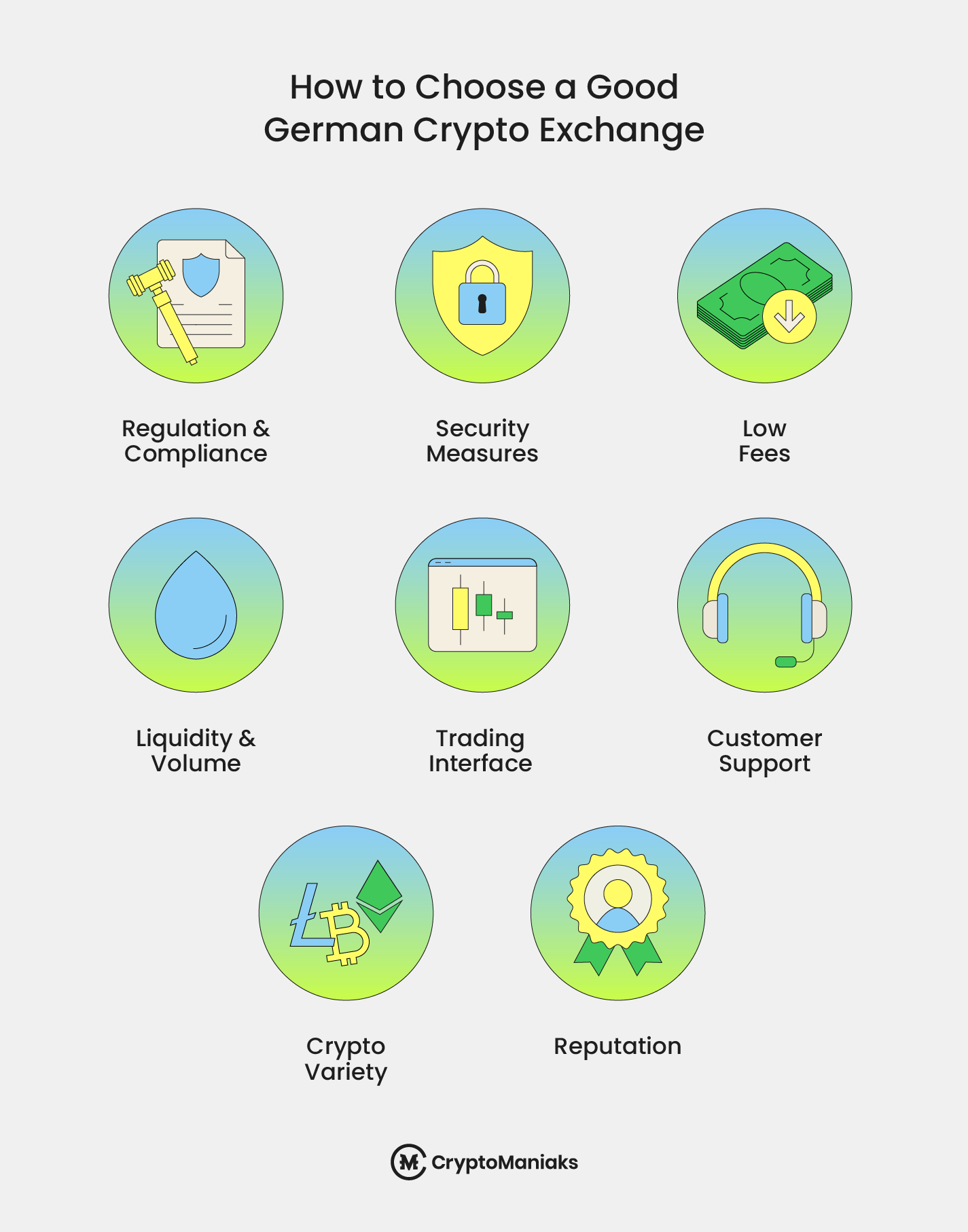
Choosing the right German crypto exchange becomes easier when you know what features to look for and how to compare them. Below are some of the key features to consider when selecting the best exchange in Germany.
- Regulation & Compliance
- Security Measures
- Low Fees
- Liquidity & Volume
- Trading Interface
- Customer Support
- Variety of Cryptocurrencies
- Reputation
We will explain each of these features in detail in the following sections.
Regulation & Compliance
Here are key tips on choosing a good German crypto exchange with regard to regulation and compliance:
- Make sure the exchange is licensed by the Federal Financial Supervisory Authority (BaFin). Germany enforces MiCA via BaFin supervision.
- Confirm compliance with Anti-Money Laundering (AML) rules and Know Your Customer (KYC) procedures.
- Assess the platform’s regular reporting obligations to the Financial Intelligence Unit.
- Check if the exchange follows the EU MiCA regulation, which sets common crypto rules across Europe and supports safe trading in Germany.
- Pick an exchange that meets IT security and capital standards to protect your funds and data.
Security Measures
Security measures are important when choosing the biggest crypto exchanges in Germany because they protect your funds and personal information from risks. The following tips highlight what to look for in a safe platform:
- Choose exchanges that offer two-factor authentication (2FA), monitor transactions, keep most funds in cold storage, and provide theft insurance.
- Pick exchanges that support self-custody wallets, especially hardware wallets, to keep your private keys safe offline.
- Check the exchange’s past security record, as trusted platforms share incidents openly and improve protections afterward.
Select exchanges that implement:
- Proof of Reserves (PoR) with third-party audits
- On-chain transparency dashboards
- Real-time risk monitoring
- Account-level withdrawal whitelisting
- Biometric login standards on mobile apps
Low Fees
Low fees are important when choosing a German crypto exchange because they help you keep more of your profits. The following tips show what to check to find platforms with fair and affordable costs:
- Compare fee structures, including trading fees, spreads, and deposits or withdrawal fees, and select exchanges that keep costs low.
- Select exchanges that reduce fees as your trading volume grows, allowing you to gain better value on frequent or large trades.
- Consider the overall costs, since some include fees in the spread instead of listing them separately.
- Check if your payment method, such as bank transfer, card, or PayPal, has extra deposit or withdrawal fees.
Liquidity & Volume
Liquidity and trading volume shape how easily traders can buy or sell crypto on German exchanges. The tips below will help you understand what to look for when assessing an exchange’s activity levels.
- Focus on exchanges with high liquidity and large trading volumes for faster trades, better prices, and smoother transactions.
- Look for exchanges with active market makers who keep orders flowing to ensure a smoother trading experience.
- Check order book depth using charts that show balanced buying and selling activity.
- Choose regulated German exchanges with transparent operations, as they attract more traders and offer stronger liquidity.
Trading Interface
The trading interface plays a big role in how easy it is to use the best crypto exchange in Germany. Here are key tips to help you evaluate whether a platform’s design and features match your needs.
- Opt for an exchange with an easy-to-use interface that works well both for beginners who want simplicity and for experienced traders who need advanced tools and charts.
- Consider exchanges with a demo mode, which lets you practice trading without using real money.
- Choose an interface that’s easy to navigate and allows quick trades to avoid errors or missed opportunities.
Customer Support
Good customer support is important when choosing a German crypto exchange because it helps you resolve issues quickly and keeps your trading experience smooth. Here are tips to guide your choice.
- Choose exchanges with several support options, such as email, live chat, and phone, ideally available 24/7 or for long hours.
- Evaluate how fast and helpful the support is. Forums or Reddit can show user experiences, including past issues with accounts or KYC.
- Check if the exchange offers FAQs, tutorials, or guides, as these resources help you solve common issues on your own and improve your experience.
Variety of Cryptocurrencies
When choosing a German crypto exchange, it is important to consider the variety of cryptocurrencies available, as this determines your trading and investment options. Here are some key factors to keep in mind.
- Look for Exchanges with Extensive Coin Listings: Choose exchanges with a wide selection of cryptocurrencies to give you access to popular, emerging, and niche coins.
- Check Listings for Specific Coins or Tokens: If you want newer altcoins, check if the exchange lists them. Exchanges that regularly add new tokens offer a better variety over time.
Reputation
Reputation matters when choosing a German crypto exchange because it reflects trust, reliability, and user experiences. The following tips highlight what to look for when evaluating an exchange’s reputation:
- Look for consistent user praise on community forums and review sites, as this reflects trust and reliability.
- Choose exchanges that show transparency and maintain clear communication.
- Prioritize exchanges with longevity and a strong market presence.
- Value industry recognition and partnerships with trusted institutions.
- Check media coverage and public relations, and prioritize exchanges with positive news and no scandals.
 DON’T GET REKT
Curated drops, testnets and red flag alerts straight to your inbox ✌️
 You’re in. Thanks for joining our newsletter.

Tips Before Registering on a German Exchange
KYC Requirements and Privacy
When choosing among the top crypto exchanges in Germany, it’s important to understand the KYC requirements and privacy policies since they determine how your personal data will be handled.
Some platforms collect more information than others, which may affect your comfort level and the features you can use. Here are some tips to consider before signing up:
KYC Compliance Basics in Germany
- Expect KYC verification on most German exchanges, as AML rules require you to provide a government-issued ID and proof of address.
- Understand that the KYC process requires personal details such as your full name, date of birth, nationality, residential address, and ID documents. For businesses, it also involves providing company registration information and the names of legal representatives.
Privacy and Personal Data Handling
- Check how the exchange stores KYC data, which by law is often kept for at least five years, and review its privacy policies and data protection practices.
- Avoid exchanges that request excessive or unrelated personal data beyond regulatory requirements to minimize privacy risks.
Practical Tips Before Registering
- Prepare a valid government ID and a proof of address, such as a utility bill or bank statement, that matches the information on your ID.
- Be ready for identity checks that may include selfies or video calls to help prevent fraud.
- Understand the exchange’s ongoing compliance rules, as some track transactions continuously and may ask for updated information or extra KYC checks later.
- Check user reviews and community feedback on German exchanges to avoid those with frequent account freezes or delays.
If privacy is a major concern, consider moving your crypto to a personal wallet instead of keeping large amounts on an exchange. There are also decentralized and privacy-focused exchanges that don’t require KYC, but they often come with limited features and higher risks.
In Germany’s regulated crypto environment, it’s especially important to be cautious when considering these options.
Euro (EUR) Deposits and Withdrawals
Before signing up for a German crypto exchange, it’s important to understand how euro (EUR) deposits and withdrawals work. Here are some tips to help you get started:
Bank Transfers and ACH Support
- Most German and EU exchanges support EUR deposits through bank transfers. They are reliable and usually come with no fees or very low costs.
- Don’t look for ACH transfers in Germany, since they’re uncommon. Instead, use SEPA transfers, which are the European equivalent and widely supported by German crypto exchanges. SEPA instant adoption is now widespread.
- Check if the exchange supports credit and debit card deposits. Some exchanges may not support such payment methods, and card payments usually incur higher fees.
- Use exchanges that support instant deposit options like Sofort or Giropay to fund your account faster, as they process EUR deposits much quicker than standard bank transfers.
Withdrawal Times and Limits
- Keep in mind that withdrawal processing times differ across exchanges and methods. Bank transfers may take 1–3 business days or longer, depending on your bank and verification status.
- Your withdrawal limits depend on your KYC level, and completing full verification can give you higher limits along with faster processing.
- Pay attention to withdrawal limits. Some exchanges set daily, weekly, or monthly caps, and large withdrawals may require extra verification to comply with anti-money laundering rules.
- Advanced or VIP users can access higher withdrawal limits, but this requires completing stricter identity verification.
By understanding how EUR deposits and withdrawals work, you can avoid delays and unexpected fees when using a German crypto exchange. Considering factors such as transfer methods, processing times, and withdrawal limits will help you manage your funds with better control and stronger security.
Tax Implications
Tax implications play a major role when trading cryptocurrency in Germany, as profits are subject to specific rules and reporting requirements.
Understanding these regulations before registering on a good German exchange can help you avoid unexpected liabilities and stay fully compliant. Here are some key tips to keep in mind:
Overview of Taxation on Crypto and Foreign Currency Gains
- Selling crypto within one year in Germany makes your profits taxable, but holding it for more than a year makes the gains tax-free.
- Keep in mind that foreign currency gains are taxed as capital income, and the rules became stricter after the 2022 ruling changes.
- Always report short-term gains from crypto trades, swaps, or sales within one year, as they are considered taxable income.
Tax Rates and Thresholds
- Crypto gains in Germany can be taxed at your personal income tax rate, which goes up to 45%, plus a 5.5% solidarity surcharge on the tax owed.
- If your total annual income stays below the tax-free allowance of about €12,096, your crypto gains are not taxed.
- Dividends, interest, and similar income are tax-free up to €1,000 per year, but anything above that is taxed at a flat rate of around 26%.
Reporting and Filing Requirements
- Report all crypto activity, such as buying, selling, trading, and staking rewards, on your annual Income Tax Return (Einkommensteuererklärung) under “other income” in Annex SO.
- File electronically through Elster, Germany’s official tax platform, or submit paper forms directly to your local Finanzamt.
- Keep a complete transaction history with purchase prices, sale proceeds, fees, and euro values to calculate your gains accurately.
Considerations Before Registering on a German Exchange
- Some exchanges provide tax reports, and using a German exchange can make reporting easier since they follow local regulations and may automatically withhold taxes.
- Accounts outside Germany must still be declared, and all foreign income must be reported to German tax authorities.
- Check whether the exchange supports exporting tax-relevant data, as complete records are essential for compliance.
In addition, it is important to track every crypto transaction carefully so you can distinguish holding periods and correctly calculate any short-term gains.
You should also consider possible tax deductions for related expenses, such as transaction fees. For foreign exchange or cross-border transactions, keep in mind that recent rules on currency gain taxation have become more complex and may require detailed calculations or professional advice.
To avoid costly mistakes, it is best to consult a tax professional who has experience with German crypto taxation, especially if you are managing a complex or large portfolio.
By following these tips, you will gain a clearer understanding of tax implications before registering on a legal crypto exchange in Germany and reduce the risk of non-compliance or unexpected tax liabilities.
CryptoManiaks’ Verdict on Best Crypto Exchanges in Germany
Germany has built a reputation as one of the safest and most supportive markets for cryptocurrency trading, backed by transparent regulations, strong investor safeguards, and rising adoption.
With numerous platforms available, the right choice comes down to your priorities—whether you value low fees, advanced security, a wide range of coins, or user-friendly features.
Our guide makes the decision easier by highlighting the best German crypto exchanges in 2026.
Explore our toplist of the best crypto exchanges in Germany to find the platform that matches your needs, whether you’re just getting started or already an experienced trader.
Frequently Asked Questions
-
01.
Can you trade crypto in Germany?
Yes. You can legally trade cryptocurrency in Germany under a clear regulatory framework. Digital assets are recognized as financial instruments rather than legal tender, which means they fall under financial laws and supervision by the Federal Financial Supervisory Authority (BaFin). Any platform that offers trading in Germany must be licensed and comply with strict Know Your Customer (KYC) and Anti-Money Laundering (AML) rules.
-
02.
Is Binance legal in Germany?
As of 2026, Binance is still accessible in Germany, but it does not hold a license from BaFin, the country’s financial regulator. The company applied for this license but withdrew its application in mid-2023 after facing regulatory challenges. This situation puts Binance in a gray area because regulators have not banned it, but also have not officially licensed or approved it. German users can still trade on the platform, but they may face restrictions on certain features, and the service does not fully support residents. Since BaFin does not oversee Binance, users lose access to German investor safeguards and face higher compliance risks.
-
03.
Is crypto tax-free in Germany?
In Germany, cryptocurrency taxes depend on how long you hold your assets and the type of income you earn from them. If you hold your crypto for over a year before selling, any gains you make are fully exempt from taxes. However, selling or trading within a year makes the profit taxable under your personal income tax rate, which can reach up to 45%, plus a 5.5% solidarity surcharge. Income from mining, staking, or other crypto-related activities is also taxed as regular income. There is a small benefit too, since gains under €1,000 per year are exempt. This makes long-term holding an attractive option for German users.
-
04.
Can German residents use non-EU crypto exchanges?
Yes. German residents can technically use non-EU exchanges, but doing so involves higher risks. These platforms are not supervised by BaFin or protected under EU law. If issues arise, users may have limited legal recourse. For better protection, use regulated EU or German exchanges.
-
05.
Are all crypto exchanges in Germany BaFin-licensed?
No. Only some exchanges hold a direct BaFin license. Others operate legally in Germany using EU “passporting rights” under MiCA, meaning they are licensed in another EU country but approved to serve German residents. Exchanges without BaFin approval or MiCA registration carry higher regulatory risk.


