





In this Crypto.com vs Robinhood comparison, I will examine how these two popular crypto exchanges stack up against each other across multiple crucial features. I’ll analyze everything from their supported cryptocurrencies and fee structures to security measures and unique offerings, helping you determine which exchange better suits your trading needs.
Throughout this article, you’ll find detailed breakdowns of each platform’s strengths and weaknesses, with direct comparisons that highlight their differences. I’ll also assign grades to each category and declare winners to simplify your decision-making process. By the end, you’ll understand which aspects of Crypto.com or Robinhood align best with your specific investment goals and experience level.
Crypto.com Wins!
Following an in-depth evaluation, we think Crypto.com takes the lead. Read on to learn what sets it apart. You can also explore our full Crypto.com Review.

Disclaimer
The information provided on this website is for informational purposes only and should not be considered as financial, investment, or legal advice. Cryptocurrency investments are volatile and high-risk in nature. Consult with a qualified financial advisor and/or tax professional before making any investment decisions. We are not responsible for any loss incurred due to the use of information on this website. Do your own research and exercise caution. Don’t invest unless you’re prepared to lose all the money you invest.
Supported Cryptocurrencies – Winner: Crypto.com
Crypto.com – 4.5/5
When comparing Crypto.com vs Robinhood by the number of available cryptocurrencies, Crypto.com clearly takes the lead with an impressive selection of hundreds of tokens available for trading. You can access major assets like Bitcoin, Ethereum, and Solana, plus a wide range of altcoins and newer projects. The platform recently added numerous coins including CDCSOL, AGENTFUN, ZRC, BINK, and BARA to its already substantial lineup.
When comparing Crypto.com vs Robinhood by trading capabilities, what makes Crypto.com stand out is the depth of trading options available. It supports numerous trading pairs, giving you flexibility to trade against USD, USDT, BTC, and in some cases EUR. This variety allows for more advanced trading strategies and better portfolio management.
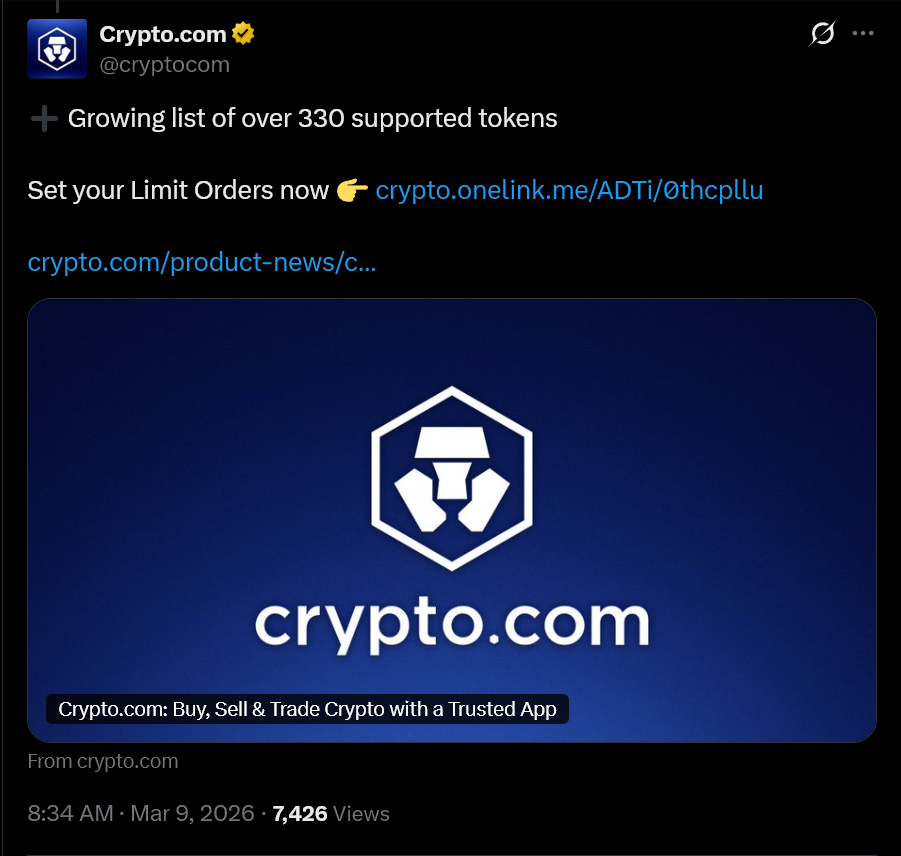
Key available coins include:
- Popular large-caps: BTC, ETH, SOL, AVAX, DOT
- Mid-caps: ATOM, NEAR, LINK
- Smaller projects: CETUS, KAIA, LUMIA, SCROLL
- Meme coins: PEPE, DOGE, SHIB
While some coins have been delisted over time (including RDN, USDP, MATIC, ARD), the constant addition of new assets keeps the offering fresh and current with market trends in 2026.
Robinhood – 2.5/5
When comparing Crypto.com vs Robinhood by cryptocurrency selection, Robinhood takes a much more conservative approach to cryptocurrency listings. As of March 2026, Robinhood offers only 79 tokens for trading. The platform limits you to major assets like Bitcoin, Ethereum, Dogecoin, Shiba Inu, and a few established altcoins, including Avalanche, Uniswap, and Chainlink.
When comparing Crypto.com vs Robinhood by trading pair diversity, all trading pairs on Robinhood are exclusively against USD, which simplifies the experience but limits trading options. The platform does display pricing information for many non-tradable cryptocurrencies, including SOL, MATIC, ADA and XRP, but you can’t actually buy or sell these assets.
Key tradable assets include:
- Major cryptocurrencies: BTC, ETH, LTC, BCH
- Popular altcoins: LINK, UNI, AVAX, XTZ
- Meme coins: DOGE, SHIB
- Stablecoins: USDC
Robinhood’s offering is suitable if you want a straightforward experience focused on the most established cryptocurrencies, but the limited selection may leave you wanting more if you’re interested in exploring the broader crypto market in 2026.
Trading Fees – Winner: Robinhood
Crypto.com – 3/5
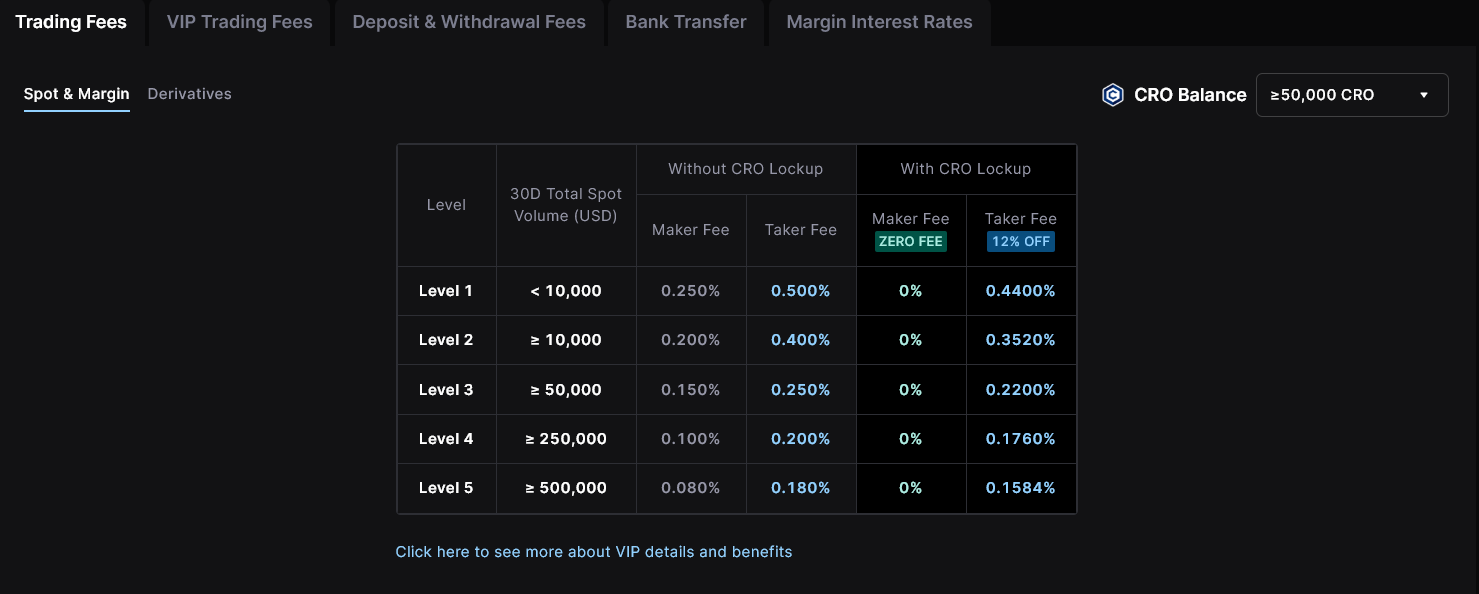
When comparing Crypto.com vs Robinhood by pricing models, Crypto.com implements a tiered fee structure for spot trading that varies based on your trading volume and CRO token holdings.
- Standard maker fees: 0.25%
- Standard taker fees: 0.50%
- VIP maker fees: as low as 0%
- VIP taker fees: as low as 0.04%
- Fee discounts scale with trading volume and CRO staking
Standard users face maker fees of 0.25% and taker fees of 0.50%, which sit on the higher end compared to other exchanges.
You can significantly reduce these costs by increasing your trading volume or staking CRO tokens. The platform offers VIP tiers where maker fees can drop to zero and taker fees as low as 0.04%.
The fee structure rewards active traders and those invested in its ecosystem. Monthly trading volume tiers scale up to millions in volume, with corresponding fee reductions at each level.
When comparing Crypto.com vs Robinhood by benefits for active users, for high-volume traders, the fee discounts can be substantial. However, casual traders who don’t stake CRO or maintain high volumes will pay more than they would on some competing platforms.
Robinhood – 5/5
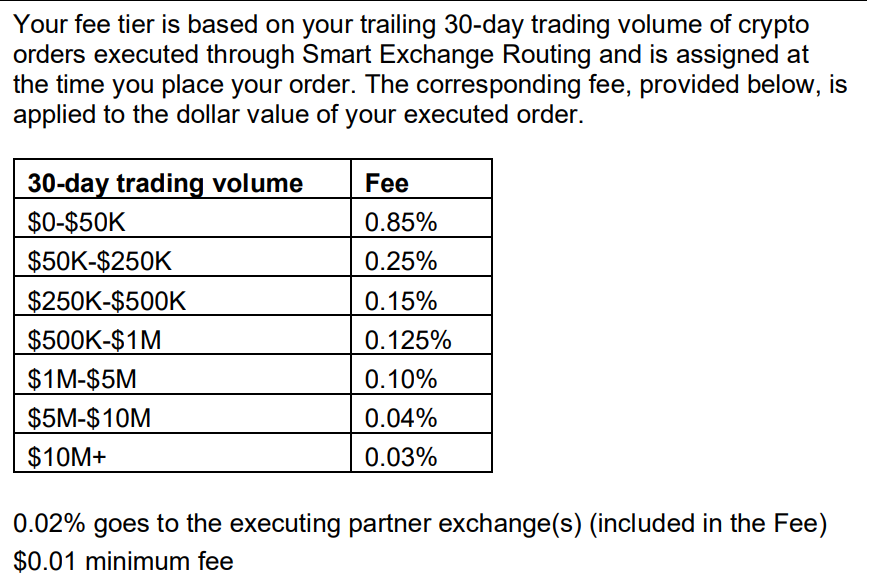
When comparing Crypto.com vs Robinhood by cost efficiency, Robinhood stands out with its commission-free cryptocurrency trading model.
- No maker or taker fees on spot trades
- Zero-fee model benefits all users equally
- No volume tiers or minimum requirements
The platform charges no maker or taker fees on spot trades, making it exceptionally cost-effective for traders of all levels.
This zero-fee approach eliminates the need to worry about trading costs eating into your profits or the complexities of tiered fee structures. Whether you’re making small purchases or large trades, there are no direct trading fees to consider.
When comparing Crypto.com vs Robinhood by accessibility for newcomers, the fee-free model makes Robinhood particularly attractive for beginners and those making frequent trades. Without minimum requirements or volume tiers to qualify for lower rates, all users benefit from the same favorable pricing.
Robinhood makes money through other means like payment for order flow rather than direct trading fees, allowing it to offer this value to crypto traders.
Withdrawal Fees – Winner: Robinhood
Crypto.com – 3/5
When comparing Crypto.com vs Robinhood by withdrawal cost policies, Crypto.com implements a variable withdrawal fee structure that depends on the cryptocurrency being withdrawn.
- Bitcoin withdrawals: 0.0004 BTC
- Ethereum: network gas fees + service fee (varies)
- Fiat withdrawal options: SEPA, PayID, ACH
- Instant debit card withdrawals: 1–2% fee
These fees are designed to cover network transaction costs but can add up for frequent users.
The platform regularly adjusts its withdrawal fee schedule based on network conditions. While larger withdrawals remain cost-effective, smaller amounts can face proportionally higher fees, making frequent small withdrawals less practical.
Robinhood – 4/5
Robinhood offers a straightforward withdrawal fee structure.
- Crypto withdrawals: network fees only, no platform markup
- ACH transfers: free (takes several business days)
- Instant debit withdrawals: 1.5% fee
- Wire transfers: flat $25 fee
For cryptocurrency withdrawals, Robinhood charges network fees only, with no additional platform markup, making it cost-effective for transferring assets to external wallets.
When comparing Crypto.com vs Robinhood by standard bank withdrawal options, Robinhood provides free ACH transfers which take several business days to process. If you need faster access to funds, debit card/instant withdrawals are available for a 1.5% fee.
Wire transfers on Robinhood cost a flat $25 fee, which is higher than ACH but provides faster processing for larger amounts. This fee is standard across all withdrawal amounts, making it predictable regardless of transaction size.
Robinhood’s simplified fee structure makes it more user-friendly for those who want to move assets between platforms or to self-custody solutions.
Minimum Deposit – Winner: Robinhood
Crypto.com – 4.5/5
When comparing Crypto.com vs Robinhood by entry barriers, Crypto.com sets its minimum deposit at $1, making the platform accessible to beginners and those wanting to start with small amounts.
- Minimum fiat deposit: $1
- Crypto deposit minimums vary by network
- Premium features may require larger CRO stakes
This low threshold allows you to test the platform without committing significant capital.
This minimum applies to fiat deposits, while cryptocurrency deposits might have different minimums based on network requirements and processing costs. The low entry point helps new users get familiar with crypto trading before scaling up their investment.
When comparing Crypto.com vs Robinhood by premium access requirements, for users looking to access premium features or higher account tiers, Crypto.com may require larger deposits or CRO token stakes. However, the basic account functions remain available to anyone meeting the minimal $1 deposit requirement.
The low minimum deposit pairs well with the platform’s extensive cryptocurrency selection, giving you an affordable entry point to explore various digital assets without a high financial barrier.
Robinhood – 5/5
When comparing Crypto.com vs Robinhood by initial investment requirements, Robinhood stands out by requiring no minimum deposit for cryptocurrency trading.
- No minimum deposit required
- Fractional investing supported
- Trade crypto with just a few dollars
You can open an account and start trading with whatever amount you feel comfortable investing, even just a few dollars.
This zero-minimum policy aligns with Robinhood’s mission to make investing accessible to everyone. When comparing Crypto.com vs Robinhood by accessibility thresholds, the absence of a deposit requirement removes a common barrier that prevents newcomers from entering the cryptocurrency market.
The platform allows fractional investing in cryptocurrencies, meaning you can purchase partial coins with small dollar amounts. This feature complements the no-minimum policy, making it possible to invest in high-priced assets like Bitcoin without needing thousands of dollars.
For beginners or casual investors looking to gradually build a position in cryptocurrencies, Robinhood’s no-minimum approach offers the most flexible entry point in the market today.
Deposit Methods – Winner: Crypto.com
Crypto.com – 4.5/5
When comparing Crypto.com vs Robinhood by funding flexibility, Crypto.com offers an extensive range of deposit methods, giving you multiple options to fund your account.
- Accepts Visa and Mastercard (may include regional fees)
- Bank transfers: SEPA, PayID, ACH, TED, PIX, Swift, FAST, FPS
- Modern payment options: Apple Pay, Google Pay, Interac, Plaid, PayString, StraitsX
- Crypto deposits supported for hundreds of coins
The platform accepts major credit and debit cards including Visa and Mastercard for instant deposits, though card deposits may incur fees depending on your region.
Bank transfers are well-supported through various regional systems including SEPA for European users, PayID for Australians, and ACH for US customers. Crypto.com has recently added more options including TED, PIX, Swift, FAST Network, and Faster Payment Service.
When comparing Crypto.com vs Robinhood by digital payment integration, modern payment solutions are also available, with Apple Pay, Google Pay, Interac, Plaid, PayString, and StraitsX all supported. These provide quick funding options that integrate with your existing digital wallets.
For crypto deposits, Crypto.com accepts hundreds of cryptocurrencies across multiple blockchain networks. You can deposit any of the coins available for trading on the platform, with new assets regularly added to the list.
Robinhood – 3/5
When comparing Crypto.com vs Robinhood by funding options, Robinhood provides a more limited but functional set of deposit methods.
- Primary method: ACH bank transfers
- Supports Visa and Mastercard for faster funding
- Instant bank transfers available (may have limits)
- Crypto deposits allowed for 15 supported cryptocurrencies
- Account-to-account funding within Robinhood
The platform primarily focuses on bank connections, with ACH transfers (bank deposits) serving as the main funding method for most users.
Credit and debit card deposits are accepted through Visa and Mastercard, offering a faster alternative to bank transfers. Robinhood also supports instant bank transfers for quicker access to funds, though this may come with limitations.
For cryptocurrency deposits, Robinhood allows transfers of the 15 tradable cryptocurrencies it supports, including Bitcoin, Ethereum, Dogecoin, and other major coins. When comparing Crypto.com vs Robinhood by asset transfer capabilities, this is significantly more limited than what Crypto.com offers.
One unique option is funding through an existing Robinhood account, allowing for easy transfers between your investment and crypto holdings within the Robinhood ecosystem. While convenient for existing users, the overall deposit options remain more restricted than competitors.
Security Features – Winner: Robinhood
Crypto.com – 4/5
When comparing Crypto.com vs Robinhood by protection measures, Crypto.com implements multiple security layers to protect your account and assets.
- 2FA via SMS and authenticator apps (Google Authenticator, Authy)
- Anti-Phishing Code to validate official emails
- Strong encryption protocols for secure connections
- Biometric authentication for mobile (fingerprint/facial recognition)
The platform offers two-factor authentication options including SMS verification and authenticator apps like Google Authenticator and Authy.
The exchange has implemented the Anti-Phishing Code feature that helps you verify emails actually come from Crypto.com, reducing the risk of falling victim to phishing attempts. This adds an extra verification step beyond standard email security measures.

When comparing Crypto.com vs Robinhood by connection security, Crypto.com uses strong encryption protocols to secure connections between users and its servers. The platform regularly updates its security infrastructure to address potential vulnerabilities and emerging threats.
The mobile app includes additional security features like biometric authentication options, allowing you to secure your account with fingerprint or facial recognition depending on your device capabilities.
Robinhood – 4.5/5
When comparing Crypto.com vs Robinhood by safety mechanisms, Robinhood stands out with its comprehensive security feature set.
- 2FA via SMS, Google Authenticator, Microsoft Authenticator, Authy, Duo
- 256-bit SSL encryption (stronger than industry standard)
- Regular security audits and threat monitoring
- Biometric login support on mobile
- Auto account lock on suspicious activity
The platform offers multiple 2FA options including SMS verification and support for popular authenticator apps like Google Authenticator, Microsoft Authenticator, Authy, and Duo Mobile.
When comparing Crypto.com vs Robinhood by encryption strength, a notable security advantage for Robinhood is its implementation of 256-bit SSL encryption, which provides stronger protection than the industry-standard 128-bit encryption. This enhanced encryption secures data transmission between your device and Robinhood’s servers.
The platform’s security infrastructure is regularly audited and updated to maintain protection against evolving cyber threats. Robinhood also monitors accounts for suspicious activity and implements automatic account locking when unusual behavior is detected.

For mobile users, Robinhood supports biometric authentication and device-specific security features, allowing for secure access while maintaining convenience for legitimate account holders.
Regulation – Winner: Robinhood
Crypto.com – 2/5
When comparing Crypto.com vs Robinhood by regulatory compliance in America, Crypto.com operates under some regulatory oversight in the US.
- Holds Money Transmitter Licenses in various states
- Registered with FinCEN
- Main platform not available for spot trading in the US
- Limited app functionality for US users
- Fragmented state-level licensing
While the exchange’s main platform is not available for spot trading and other services to US residents, it offers a separate app with limited functionality.
The platform has acquired licenses in a few US states but lacks the comprehensive state-by-state coverage needed to operate across the entire country. This fragmented regulatory status creates inconsistent service availability for US customers.
When comparing Crypto.com vs Robinhood by service availability, Crypto.com works through subsidiaries in certain states and offers a separate app with more limited functionality for US users. However, this creates a disconnected experience compared to what international users receive.
While Crypto.com continues to work on expanding its US presence, including the development of institutional-grade services, the regulatory picture remains complex. US users may have access to some services but face restrictions on trading options, coin selection, and certain platform features.
Robinhood – 5/5
When comparing Crypto.com vs Robinhood by legal standing, Robinhood has full regulatory compliance within the United States.
- Fully licensed across all US states
- Registered with the SEC and FINRA
- Crypto services registered with FinCEN and state regulators
- Regulatory clarity supports reliable tax reporting and access
As a US-based company, Robinhood Markets, Inc. has secured the necessary licenses to operate legally across the country, making it accessible to residents of all states.
The platform is registered with the Securities and Exchange Commission and is a member of the Financial Industry Regulatory Authority. Robinhood’s cryptocurrency services are properly registered with FinCEN and relevant state regulators.
This comprehensive regulatory compliance means US users can access Robinhood’s crypto services without concerns about legal gray areas or sudden service interruptions due to regulatory issues.
For US-based crypto traders, Robinhood offers the peace of mind that comes with using a fully regulated domestic platform. This regulatory clarity also provides a clear framework for how taxes and reporting work for crypto transactions.
Reputation & Trust – Winner: Robinhood
Crypto.com – 3.5/5
When comparing Crypto.com vs Robinhood by market establishment, Crypto.com has built a respectable position in the cryptocurrency market since its founding in 2016.
- Founded in 2016
- Owned by Foris DAX MT Limited, based in Singapore
- Secured naming rights for former Staples Center
- Sponsorships with Formula 1 and UFC
- Past breach occurred but user losses were covered
The platform has gained recognition through high-profile partnerships, including naming rights for the former Staples Center in Los Angeles and sponsorships with Formula 1 and UFC.
The exchange is owned by Foris DAX MT Limited and headquartered in Singapore, giving it a significant presence in the Asian market. As a publicly traded company, Crypto.com faces additional accountability and transparency requirements that enhance trust.
Despite these strengths, Crypto.com has faced security incidents in the past. The platform experienced a breach that affected some users, though it responded by improving security measures and covering customer losses.
Customer sentiment toward Crypto.com is mixed, with praise for its wide range of offerings balanced against complaints about customer service response times and occasional platform issues during high-traffic periods.
Robinhood – 4/5
When comparing Crypto.com vs Robinhood by brand history, Robinhood has established a strong reputation since its 2013 launch, primarily through its pioneering commission-free trading model.
- Founded in 2013
- US-based, operated by Robinhood Markets, Inc.
- Publicly traded, with full shareholder accountability
- Faced criticism during 2021 GameStop trading halt
- Initially lacked crypto withdrawals (now addressed)
The company is based in the United States and operates under the well-known Robinhood Markets, Inc. brand.
As another publicly traded company, Robinhood faces stringent reporting requirements and shareholder accountability, which are factors that contribute to its trustworthiness in the financial sector.
When comparing Crypto.com vs Robinhood by public relations challenges, Robinhood has faced controversy, particularly during the 2021 GameStop trading restrictions, which damaged trust among some users. In the crypto space, the platform was initially criticized for not allowing withdrawals to external wallets, though this limitation has since been addressed.
The company maintains a cleaner regulatory record in the cryptocurrency sector than many competitors. Its straightforward approach, clear fee structure, and focus on user experience have helped it maintain a generally positive reputation among mainstream cryptocurrency users.
Mobile App – Winner: Robinhood
Crypto.com – 4/5
When comparing Crypto.com vs Robinhood by mobile functionality, Crypto.com offers a feature-rich mobile app that gives you access to its full suite of cryptocurrency services.
- Full feature access from mobile
- Clean, beginner-friendly interface
- Includes Visa card, NFT marketplace, DeFi wallet
- Occasional slowdowns during high volatility
The app maintains most functionality of the web platform while optimizing the interface for smaller screens.
The user interface is clean and intuitive, making navigation straightforward even for beginners. You can easily switch between different sections like trading, earning, and wallet management with a few taps.
When comparing Crypto.com vs Robinhood by trading interface design, trading features are well-implemented, but more tailored for casual or intermediate users rather than advanced traders. The app lacks some advanced trading tools. It integrates other Crypto.com services like the Visa card management, NFT marketplace, and decentralized finance wallet connectivity.
While the app performs well overall, some users report it can occasionally slow down during high market volatility or when accessing certain data-heavy features. The app is available for both Android and iOS with frequent updates that add features and fix bugs.
Robinhood – 5/5
When comparing Crypto.com vs Robinhood by mobile user experience, Robinhood’s mobile app stands out with its exceptionally clean and fluid interface.
- Mobile-first design approach
- Integrated crypto, stock, and options trading
- Quick load times and smooth performance
- High ratings on Android and iOS
The app was designed with mobile users as the primary focus, resulting in an optimized experience that works seamlessly on smartphones.
The cryptocurrency section integrates perfectly with Robinhood’s stock and options trading features, creating a unified investment platform. Price charts, order execution, and portfolio tracking are all streamlined for efficient mobile use.
The app loads quickly and maintains responsiveness even during market volatility. This performance reliability makes it ideal for traders who need to react quickly to market movements.
Robinhood’s app receives consistently high ratings on both Android and iOS platforms. The simplified approach focuses on core functionality without overwhelming users with excessive features, creating an approachable experience for both beginners and experienced traders.
Staking & Earning – Winner: Crypto.com
Crypto.com – 4/5
When comparing Crypto.com vs Robinhood by passive income opportunities, Crypto.com offers an Earn program that lets you generate passive income on your cryptocurrency holdings.
- Bitcoin up to 1.5% APY
- Ethereum up to 2% APY
- Stablecoins up to 6.5% APY
- Polkadot up to 12.5% APY
- Flexible and fixed-term options (1 or 3 months)
- Daily interest payments
The platform supports staking for numerous cryptocurrencies with competitive interest rates that vary by asset and lock-up period.
The platform provides flexible terms as well as fixed 1-month and 3-month options with daily interest payments. Higher rates typically require locking your assets for longer periods, giving you options based on your liquidity needs.
Available earning opportunities extend beyond major cryptocurrencies to include Polkadot (up to 12.5%), Cardano, Solana, Avalanche, and many others. The wide selection makes it easy to generate yield across different parts of your portfolio.
Robinhood – 0/5
When comparing Crypto.com vs Robinhood by investment growth options, Robinhood currently doesn’t offer any staking or interest-earning programs for cryptocurrency holdings.
- No staking options
- No interest-bearing crypto accounts
- Assets remain idle unless moved elsewhere
The platform functions primarily as a trading venue without yield-generating features.
Users looking to earn passive income from their crypto assets will need to transfer their holdings to another platform or service that offers such features. This absence represents a significant gap in Robinhood’s cryptocurrency offerings.
While Robinhood excels at providing a simple trading experience, the lack of earning opportunities means your assets remain idle while held on the platform. For investors focused on growth through yield, this limitation is notable.
Futures & Derivatives – Winner: Crypto.com
Crypto.com – 4/5
When comparing Crypto.com vs Robinhood by advanced trading capabilities, Crypto.com offers a derivatives trading platform that supports various advanced trading instruments. The exchange provides both perpetual contracts and futures trading with leverage , allowing you to amplify your market exposure.
- Perpetual contracts and futures supported
- Leverage up to 200x
- Maker fees: 0.0200% to 0%
- Taker fees: 0.0400% to 0.0260% (VIP as low as 0.015%)
- Risk management tools: stop-loss, take-profit orders
- Unavailable in US, UK, Canada, Australia, and most of Europe
Derivatives trading on Crypto.com features competitive fee rates, with maker fees ranging from 0.0200% to zero and taker fees between 0.0400% and 0.0260%. VIP users enjoy even better rates, with potential taker fees as low as 0.015%.
The platform supports up to 200x leverage (2000%) on certain trading pairs, giving experienced traders significant flexibility for executing complex strategies. Risk management tools like stop-loss and take-profit orders help control exposure.
It’s worth noting that derivatives trading is not available in all regions. Numerous locations are restricted, including the United States, United Kingdom, Canada, Australia, and most European countries due to regulatory constraints.
Robinhood – 2/5
When comparing Crypto.com vs Robinhood by specialized trading products, Robinhood’s derivatives offering for cryptocurrencies is limited. While the platform does support options trading for stocks and ETFs, its crypto derivatives capabilities are minimal by comparison.
- Options trading for stocks and ETFs supported
- Options fees: $0.01 per contract
- No crypto futures or perpetual contracts
- No crypto margin or leverage
The platform allows options trading with fees of $0.01 per contract for both maker and taker sides. However, these options are primarily for traditional financial instruments rather than crypto-specific derivatives.
When comparing Crypto.com vs Robinhood by margin and leverage capabilities, Robinhood does not offer cryptocurrency futures, perpetual contracts, or leveraged trading for digital assets. This significantly limits the advanced trading strategies available to users interested in crypto derivatives.
For traders looking for sophisticated cryptocurrency derivatives products, Robinhood’s offering falls short of what specialized crypto exchanges provide. The focus remains primarily on spot trading of digital assets without complex derivatives instruments.
Supported Fiat Currencies – Winner: Crypto.com
Crypto.com – 4/5
When comparing Crypto.com vs Robinhood by currency diversity, Crypto.com supports multiple fiat currencies, giving users from different regions flexibility when depositing, trading, and withdrawing funds. The platform accepts major currencies including USD, EUR, GBP, and BRL.
- Supports: USD, EUR, GBP, BRL, CAD, SGD, AUD
- Recently added: TRY
- Removed: HKD, TWD, RUB
The multi-currency support allows you to hold balances in your preferred currency without constantly converting between different denominations. This can help reduce unnecessary exchange fees and simplify accounting for users outside the US.
Other supported currencies include CAD, SGD, and AUD, making the platform accessible across North America, Asia-Pacific, and Europe. The platform has recently added TRY (Turkish Lira) while removing support for some currencies including HKD, TWD, and RUB.
Having various fiat options proves valuable for international users who want to trade directly between their local currency and cryptocurrencies. This reduces the need for multiple conversion steps that can increase costs.
Robinhood – 1/5
When comparing Crypto.com vs Robinhood by currency support, Robinhood takes a much more limited approach, supporting only USD as its fiat currency. This single-currency model aligns with the platform’s primary focus on the US market.
- Only supports USD
- All trades, deposits, and withdrawals are in USD
- Designed primarily for the US market
For US-based users, the USD-only approach simplifies the experience by eliminating currency conversion decisions. All deposits, trades, and withdrawals are denominated in US dollars, creating a straightforward user experience.
However, this limitation significantly reduces Robinhood’s utility for international users or those who prefer to operate in currencies other than USD. Without multi-currency support, users have to handle any necessary currency conversions before depositing funds.
The USD-only approach reflects Robinhood’s concentrated market strategy rather than the global approach taken by many cryptocurrency exchanges. This makes it most suitable for US residents or those comfortable dealing exclusively in USD.
Learning Resources – Winner: Crypto.com
Crypto.com – 4.5/5
When comparing Crypto.com vs Robinhood by learning resources, Crypto.com provides an extensive educational ecosystem with diverse resources for users at all knowledge levels. The platform maintains a dedicated University section with structured courses covering cryptocurrency fundamentals, blockchain technology, and trading strategies.
- University with structured educational content
- Research and Analysis for market insights
- NFT Deep Dives and creator interviews
- Market updates, product news, and crypto event calendar
The Research and Analysis section offers market insights, project evaluations, and deep dives into blockchain innovations. These detailed analyses help users make more informed investment decisions based on data rather than market hype.
For NFT enthusiasts, Crypto.com offers NFT Deep Dives that explain concepts, showcase projects, and highlight opportunities in the digital collectibles space. Its video content features interviews with creators and project founders, giving insider perspectives.
Additional resources include regular market updates, product news, trending topics, and a calendar of upcoming crypto events. These materials are well-organized and regularly updated, making it easy to stay up to date in the fast-moving crypto space.
Robinhood – 3/5
When comparing Crypto.com vs Robinhood by educational materials, Robinhood offers a more streamlined approach, with a focus on practical learning. Its Learn and Earn program stands out by rewarding users with free cryptocurrency for completing educational modules, creating an incentive to expand your knowledge.
- Learn and Earn program with crypto rewards
- Instructional videos on YouTube
- Beginner and intermediate content focus
- Lacks in-depth or technical materials
The platform hosts instructional videos on its YouTube channel covering various aspects of cryptocurrency investing and trading. These tutorials are typically concise and focused on practical applications rather than deep theoretical concepts.
Robinhood’s educational content tends to target beginners and intermediate users with straightforward explanations of crypto concepts. The resources are designed to complement the platform’s simplified trading experience.
While helpful for newcomers, Robinhood’s learning materials lack the depth and breadth offered by more comprehensive exchanges. When comparing Crypto.com vs Robinhood by content depth, advanced traders may find themselves wanting more sophisticated analyses and technical content than what’s available.
NFT Marketplaces – Winner: Crypto.com
Crypto.com – 4/5
When comparing Crypto.com vs Robinhood by NFT functionality, Crypto.com offers a fully integrated NFT marketplace that allows you to buy, sell, and collect digital collectibles directly within its ecosystem. The platform supports NFTs across multiple blockchains, expanding the range of collections available.
- Supports NFTs across multiple blockchains
- Accepts both fiat and crypto payments
- Includes both primary drops and secondary sales
- Features exclusive brand and artist partnerships
Users can purchase NFTs using both cryptocurrency and fiat payment methods, lowering barriers to entry for collectors new to the space. The marketplace features both primary sales of new NFT drops and a secondary market for trading existing collectibles.
Crypto.com has secured partnerships with brands, artists, and sports organizations to offer exclusive NFT collections. These collaborations have included notable names across entertainment, sports, and digital art, bringing unique content to the platform.
The NFT marketplace integrates with other Crypto.com services, allowing for seamless movement between trading cryptocurrencies and collecting NFTs. The user interface is intuitive, with filtering options to discover collections based on price, blockchain, and category.
Robinhood – 0/5
When comparing Crypto.com vs Robinhood by digital art trading capabilities, Robinhood does not currently offer an NFT marketplace or any NFT-related services. The platform focuses exclusively on crypto trading without venturing into the digital collectibles space.
- No NFT marketplace or services available
- Users must rely on external platforms for NFTs
- No blockchain-based digital art integrations
This absence means users interested in NFTs have to turn to dedicated marketplaces or other exchanges that offer such functionality. For Robinhood users, this creates a disconnected experience requiring multiple platforms to engage with different aspects of the crypto ecosystem.
The lack of NFT support reflects Robinhood’s more focused approach to cryptocurrency as an investment asset rather than embracing the broader applications of blockchain technology. This limitation is notable as NFTs have become a significant segment of the overall crypto market.
While Robinhood excels at providing a streamlined cryptocurrency trading experience, users looking for exposure to digital collectibles and the growing NFT economy will need to look elsewhere for these services.
KYC/AML – Winner: Robinhood
Crypto.com – 3.5/5
When comparing Crypto.com vs Robinhood by identity verification processes, Crypto.com implements mandatory Know Your Customer procedures for all users. The verification process is thorough and required for accessing the platform’s core functionality, including buying, selling, storing, sending, and tracking cryptocurrencies.
- KYC required for all core features
- Includes ID submission, phone and email verification
- Additional verification for staking and Visa card access
- Protocols aligned with regional AML requirements
The KYC process involves multiple steps including email verification, phone number validation, personal information collection, and identity document submission. Additional verification may be required for higher-tier features like staking CRO tokens or accessing the Visa card program.
For users in different jurisdictions, Crypto.com adjusts its KYC requirements to align with local regulations, resulting in potentially different documentation needs based on your location. This can sometimes lead to longer verification times for users in certain regions.
While comprehensive, the KYC process can be time-consuming, especially for users trying to access all features. The platform maintains strict Anti-Money Laundering protocols that may occasionally trigger additional verification requests when unusual activity is detected.
Robinhood – 4/5
When comparing Crypto.com vs Robinhood by user identification process, Robinhood takes a streamlined approach to KYC verification, completing most of the process during initial account registration.
- KYC completed upfront during sign-up
- Includes name, address, and ID submission
- Single jurisdiction (US) enables a consistent process
- AML systems monitor suspicious transactions in background
Users provide their name, email, password, phone number, residential address, and identity verification documents upfront.
This front-loaded verification means most users can begin trading shortly after account approval without facing additional KYC hurdles when accessing different features. The verification process is designed to be efficient while meeting regulatory requirements.
As a US-regulated financial services provider, Robinhood maintains robust AML monitoring systems that track for suspicious transactions and activities. These systems operate largely in the background without disrupting the user experience for most customers.
The platform’s single-jurisdiction focus (United States) allows for a more standardized KYC approach compared to global exchanges that have to navigate various regulatory frameworks. This results in a more consistent verification experience for all users.
Liquidity – Winner: Crypto.com
Crypto.com – 4.5/5
When comparing Crypto.com vs Robinhood by market depth, Crypto.com demonstrates strong liquidity across its trading pairs with a liquidity score of 697, showing improvement from its previous score of 645. This solid rating indicates that users can execute trades with minimal slippage, even for larger orders.
- Liquidity score: 697 (previously 645)
- Monthly volume: $400 billion
- Market makers and LPs support depth across assets
The platform’s substantial monthly trading volume of $400 billion reflects active market participation and creates depth across various trading pairs. This high volume helps maintain tight spreads between buy and sell orders, particularly for popular cryptocurrencies.
Liquidity is distributed across multiple trading pairs and assets, with major cryptocurrencies enjoying the deepest markets. The exchange uses market makers and liquidity providers to ensure consistent trading conditions across different market segments.
For traders concerned about order execution, Crypto.com’s liquidity metrics indicate the ability to enter and exit positions efficiently without significant price impact. This becomes especially important during volatile market conditions when liquidity can fluctuate rapidly.
Robinhood – 3/5
When comparing Crypto.com vs Robinhood by trading volume transparency, Robinhood’s cryptocurrency liquidity metrics are more limited, with the platform not disclosing a formal liquidity score comparable to other exchanges.
- Monthly trading volume: $2.1 billion
- Focuses on depth in fewer cryptocurrencies
- Liquidity geared toward retail-sized trades
Its monthly trading volume of $2.1 billion, while substantial, is significantly lower than more established crypto-focused exchanges.
The platform focuses its liquidity on a smaller set of cryptocurrencies, concentrating trading activity in major assets like Bitcoin, Ethereum, and popular altcoins. This approach creates adequate depth for these selected tokens but lacks the breadth offered by larger exchanges.
As a retail-focused platform, Robinhood optimizes its liquidity for smaller trade sizes typical of individual investors rather than institutional-level orders. This strategy works well for most users but may not satisfy traders executing larger transactions.
Despite its more modest trading volume, Robinhood maintains sufficient liquidity for its target market of retail traders dealing with standard position sizes. The platform’s commission-free model helps offset any minor price impacts from slightly wider spreads.
Supported Wallets – Winner: Crypto.com
Crypto.com – 4.5/5
When comparing Crypto.com vs Robinhood by wallet support, Crypto.com offers a versatile wallet ecosystem with multiple options for managing your digital assets.
- Exchange-based custodial wallet
- Separate non-custodial DeFi Wallet with private key control
- Supports staking, swapping, and DeFi integrations
- Hardware wallet support included
The platform’s main custodial wallet integrates directly with the exchange, allowing for easy trading and access to Crypto.com’s full range of services.
Beyond the exchange wallet, Crypto.com provides a non-custodial DeFi Wallet that gives you complete control over your private keys. This self-custody solution supports hundreds of cryptocurrencies across multiple blockchains and includes features like staking, swapping, and DeFi protocol access.
The DeFi Wallet includes hardware wallet support, allowing integration with cold storage devices for enhanced security. This multi-layered approach lets you balance convenience and security based on your preferences.
For users who prefer different wallet types for different purposes, the Crypto.com ecosystem allows for easy transfers between its custodial and non-custodial solutions. The mobile-first design makes managing assets straightforward regardless of which wallet option you choose.
Robinhood – 3/5
When comparing Crypto.com vs Robinhood by storage solutions, Robinhood has expanded its wallet offerings but maintains a more streamlined approach.
- Integrated custodial wallet connected to trading interface
- Now offers a separate non-custodial wallet with key control
- Does not support staking or DeFi access
The platform provides an integrated custodial wallet for all users, directly connected to its trading interface for seamless asset management.
In addition to the custodial solution, Robinhood now offers a non-custodial wallet experience that gives users control over their private keys. This wallet supports the cryptocurrencies available for trading on the platform, allowing for self-custody of your digital assets.
The wallet functionality focuses on simplicity and user experience rather than advanced features. While you can send and receive supported cryptocurrencies, the range of additional features like staking or DeFi protocol interaction is more limited than specialized wallet solutions.
Robinhood’s wallet approach reflects its broader philosophy of making cryptocurrency accessible to mainstream users. The straightforward design prioritizes ease of use over the extensive feature sets found in more crypto-native wallet applications.
Crypto.com vs Robinhood – Final Score 9:8
In this Crypto.com vs Robinhood comparison, Crypto.com edges out Robinhood in this tight battle, winning by a single point. Crypto.com excels with its expansive cryptocurrency selection, staking options, and advanced trading features including derivatives and leverage. When evaluating Robinhood vs Crypto.com for investment options, Crypto.com also offers a robust NFT marketplace and supports multiple fiat currencies, making it suitable for international users with diverse crypto interests.
Robinhood counters with significant advantages in simplicity and cost-effectiveness. When comparing Crypto.com fees vs Robinhood, Robinhood’s commission-free trading model stands out alongside its zero minimum deposit and streamlined KYC process, creating an exceptionally accessible entry point for beginners. The platform’s superior mobile experience and full US regulatory compliance make it particularly attractive for American users focused on mainstream cryptocurrencies.
Your ideal choice between Crypto.com or Robinhood depends on your priorities. Crypto.com offers greater depth and breadth for dedicated crypto enthusiasts wanting access to the full ecosystem, while Crypto.com vs Robinhood fees show Robinhood provides a more straightforward, cost-effective approach for casual investors primarily interested in major cryptocurrencies without complex features.
Why Trust Us

At CryptoManiaks, our team combines deep expertise in cryptocurrency markets, technical analysis, and financial systems to deliver thorough comparisons you can rely on. For this Crypto.com vs Robinhood evaluation, I’ve assessed both platforms using identical parameters – everything that matters, from user experience to fee structures.
While I focus on detailed research and documentation, our team actively participates in crypto communities to gather authentic user experiences that inform our reviews. This connection to real users ensures our Crypto.com vs Robinhood comparison reflects practical trading realities beyond theoretical features.
Our review process implements a multi-reviewer system where team members independently evaluate each exchange. This collaborative methodology minimizes personal bias and provides you with comprehensively vetted information about both platforms’ strengths and limitations.
We maintain consistent evaluation criteria across all exchange reviews, allowing for fair comparisons that help you make informed decisions. Our recommendations balance technical assessment with practical usability, giving you a complete picture of how Crypto.com and Robinhood perform for different types of crypto investors.
FAQ
-
01.
Is Crypto.com better than Robinhood?
Whether Crypto.com is better than Robinhood depends on your specific needs. In the Crypto.com vs Robinhood comparison, Crypto.com offers more cryptocurrencies, advanced trading features, and international support. However, many users wonder, “Is Robinhood better than Crypto.com for beginners,” and it often is, thanks to zero-fee trading, a simpler interface, and full US regulation. Crypto.com wins for crypto enthusiasts wanting variety and features, while Robinhood excels for casual US-based investors focusing on major cryptocurrencies.
-
02.
What are the main differences between Crypto.com and Robinhood?
The key Crypto.com vs Robinhood differences include cryptocurrency selection (hundreds vs 15), trading fees (tiered vs free), fiat support (multiple currencies vs USD only), and feature depth. Robinhood offers a streamlined experience with commission-free trading, while Crypto.com provides advanced features like staking, an NFT marketplace, and derivatives trading. Robinhood has full US regulation but limited international presence, and Crypto.com operates globally with varying regional restrictions.
-
03.
Which platform has lower fees, Crypto.com or Robinhood?
Robinhood offers lower trading fees with its commission-free model for all cryptocurrency trades. Crypto.com uses a tiered fee structure starting at 0.25% maker/0.50% taker, which decreases with higher trading volume or CRO staking. For withdrawals in the Crypto.com vs Robinhood comparison, Robinhood provides free ACH transfers while charging 1.5% for instant withdrawals, whereas Crypto.com has variable withdrawal fees based on the cryptocurrency.
-
04.
Can I stake cryptocurrency on Robinhood?
Robinhood doesn’t offer staking or interest-earning features for cryptocurrencies. This is a significant difference in the Crypto.com vs Robinhood comparison, as Crypto.com provides extensive earning opportunities with competitive rates across numerous assets. If generating passive income from your crypto holdings is important, Crypto.com’s Earn program offers this functionality while Robinhood does not. Users looking to maximize returns through staking will need to transfer their assets to a platform that supports this feature or use Crypto.com instead
-
05.
Which platform is better for beginners?
Robinhood is generally better for beginners due to its simplified interface, commission-free trading, and straightforward onboarding process. The Crypto.com vs Robinhood learning curve differs significantly – Robinhood focuses on accessibility with fewer options to navigate, while Crypto.com offers more features but requires more knowledge to use effectively. Beginners primarily interested in major cryptocurrencies like Bitcoin and Ethereum will find Robinhood’s approach less overwhelming.


 You’re in. Thanks for joining our newsletter.
