





Bitcoin mining has undoubtedly made many millionaires. If you are interested in venturing into this space, pay close attention because we’ll explore the best Bitcoin miners available in 2026, providing a comprehensive guide to the top mining rigs on the market.
As experts at CryptoManiaks, we’ve conducted extensive research, consulted with our community, and personally tested numerous mining rigs to bring you the most up-to-date and reliable information.
We’ve been able to shortlist some of the best mining rigs available on the market in [current:month] 2026. We have also categorized them based on what they do best, making it easier for you to find the one that works for your specific goals.
This guide was created to save you time and money while closely examining several crucial aspects of Bitcoin mining rigs, including mining rig features such as size and noise levels and considerations for selecting the best BTC miner like energy consumption and hash rate.
Best Crypto Miners in 2026
| Model | Power Consumption | Hash Rate | Price |
|---|---|---|---|
| Antminer S19j Pro | 2,950 Watts | 100 TH/s | $3,500 – $4,500 |
| A9 ZMaster | 620 Watts | 50 TH/s | $700 – $900 |
| STU-U8 Pro | 3,300 Watts | 85 TH/s | $2,800 – $3,500 |
| Whatsminer M50S | 3,276 Watts | 126 TH/s | $4,500 – $6,000 |
| BM-K3 | 2,250 Watts | 18 TH/s | $3,000 – $3,500 |
| AvalonMiner 1066 | 3,250 Watts | 50 TH/s | $1,500 – $2,000 |
| AvalonMiner 1246 | 3,420 Watts | 90 TH/s | $2,800 – $3,500 |
| Antminer L7 | 3,425 Watts | 9.5TH/s | $3,000 – $5,000 |
| Antminer S9 | 1,350 Watts | 13.5 TH/s | $200 – $400 |
| AvalonMiner 921 | 1,800 Watts | 20 TH/s | $300 – $500 |
#1. Antminer S19j Pro – Best Bitcoin Miner Overall
| Model Name | Antminer S19j Pro |
| Manufacturer | Bitmain |
| Hash Rate | 100 TH/s |
| Power Consumption (Watts) | 2,950 Watts |
| Supported Cryptocurrencies | BTC, BCH, BSV, PPC, and more |
| Price | $3,500-$4,500 |
Antminer S19j Pro has industrial-grade components that ensure advanced temperature monitoring and foster efficiency within a high-performance unit setup. The upgraded control system enables real-time adjustments and custom optimization profiles.
It has smart power distribution technology that ensures stable operation across all hash boards. Its multiple safety mechanisms include automatic voltage regulation and emergency thermal protection.
The intelligent firmware provides detailed diagnostic tools and remote management capabilities, coming with a reinforced chassis design that incorporates advanced airflow engineering while maintaining accessibility.
#2. A9 ZMaster
| Model Name | A9 ZMaster |
| Manufacturer | Innosilicon |
| Hash Rate | 50 TH/s |
| Power Consumption (Watts) | 620 Watts |
| Supported Cryptocurrencies | ZEC, BTG, and more |
| Price | $700 – $900 |
This specialized Equihash miner incorporates advanced thermal management and custom firmware. Its cooling system includes dual ball-bearing fans and independent heat sinks. The integrated web management interface enables remote monitoring and configuration.
Protective thermal shutdown and voltage control systems safeguard the investment. Smart aluminum case design enhances heat dissipation, while compact dimensions allow versatile placement options.
#3. STU-U8 Pro
| Model Name | STU-U8 Pro |
| Manufacturer | StrongU |
| Hash Rate | 85 TH/s |
| Power Consumption (Watts) | 3,300 W |
| Supported Cryptocurrencies | BTC, BCH, BSV, PPC, and more |
| Price | $2,800-$3,500 |
Built with industrial-grade components and featuring a dual fan design for optimal heat dissipation, this Bitcoin mining rig provides stable performance in both home and data center environments.
This is one of the best Bitcoin mining rig that is streamlined with an intuitive interface and built-in monitoring tools. It also comes with overheating protection and automatic voltage regulation.
While maintenance requirements are minimal, the unit benefits from regular cleaning due to its open-air design. Its compact size allows for efficient rack mounting and simplified logistics for large-scale operations.
#4. Whatsminer M50S
| Model Name | Whatsminer M50S |
| Manufacturer | MicroBT |
| Hash Rate | 126 TH/s |
| Power Consumption (Watts) | 3,276 Watts |
| Supported Cryptocurrencies | BTC, BCH, BSV, PPC, and more |
| Price | $4,500-$6,000 |
Its sophisticated temperature control systems work alongside server-grade power supplies for maximum uptime, while its enhanced firmware delivers detailed real-time monitoring and automatic optimization.
This Bitcoin miner will give you a run for your money with its premium components that include custom-designed ASIC chips, high-grade thermal materials, and advanced error detection and self-diagnostic capabilities to ensure reliability. The professional carrier-grade design maintains consistent performance in challenging environments.
#5. BM-K3
| Model Name | BM-K3 |
| Manufacturer | iBeLink |
| Hash Rate | 18 TH/s |
| Power Consumption (Watts) | 2,250 Watts |
| Supported Cryptocurrencies | KDA |
| Price | $3,000-$3,500 |
This specialized Blake2s miner has liquid cooling compatibility and modular power supply units. It has an advanced control board that supports comprehensive monitoring capabilities and remote management.
It is also fortified with robust security measures to protect against unauthorized access and manipulation, and comes with a smart chassis design that maximizes airflow optimization while allowing quick component access during maintenance.
The customized ASIC implementation makes it particularly efficient for Kadena’s unique mining requirements.
#6. AvalonMiner 1066
| Model Name | AvalonMiner 1066 |
| Manufacturer | Canaan |
| Hash Rate | 50 TH/s |
| Power Consumption (Watts) | 3,250 Watts |
| Supported Cryptocurrencies | BTC, BCH, BSV, PPC, and more |
| Price | $1,500-$2,000 |
Avalon Miner 1066 is a power-efficient innovation that combines optimized chip arrangement and advanced air duct design. It is equipped with independent control modules for each hash board to enable precise performance tuning.
In addition, the intuitive web management interface delivers detailed monitoring tools, fostered with a durable frame design that ensures stability while maintaining accessibility.
To ensure protection, the Avalon Miner 1066 comes with multiple protection systems that guard against power surges and thermal anomalies. The balanced power-to-performance ratio makes it particularly suitable for regions with moderate electricity costs.
#7. AvalonMiner 1246
| Model Name | AvalonMiner 1246 |
| Manufacturer | Canaan |
| Hash Rate | 90 TH/s |
| Power Consumption (Watts) | 3,420 Watts |
| Supported Cryptocurrencies | BTC, BCH, BSV, PPC, and more |
| Price | $2,800-$3,500 |
AvalonMiner 1246 is one of the best Bitcoin mining rigs that comes with upgraded semiconductor technology that pairs with enhanced cooling architecture for optimal performance. The sophisticated control board delivers advanced tuning capabilities and detailed analytics.
As one of the best industrial-grade components for Bitcoin miners, it works with a reinforced power distribution system that fosters efficiency. The most notable feature is the smart error handling and automatic recovery mechanisms that ensure uptime.
Unlike other AvalonMiners, the modular construction of AvalonMiner 1246 allows for quick troubleshooting and component replacement. The unit’s adaptable performance settings make it especially valuable for mining operations in varying environmental conditions.
#8. Antminer L7
| Model Name | Antminer L7 |
| Manufacturer | Bitmain |
| Hash Rate | 9.5 TH/s |
| Power Consumption (Watts) | 3,425 Watts |
| Supported Cryptocurrencies | LTC, DOGE, XVG, and more |
| Price | $12,000-$15,000 |
Antminer L7 is a scrypt mining powerhouse that utilizes custom ASIC architecture for maximum efficiency. It offers advanced power management that works alongside sophisticated thermal controls, and its enhanced firmware provides detailed monitoring and automatic optimization.
It comes with multiple safety systems to protect against fluctuations and overheating. The industrial chassis combines durability with excellent serviceability.
It possesses a parallel mining capability that allows simultaneous Litecoin and Dogecoin mining without performance loss, and a specialized cooling design that enables sustained operation in high-density mining farms where heat management is crucial.
#9. Antminer S9
| Model Name | Antminer S9 |
| Manufacturer | Bitmain |
| Hash Rate | 13.5 TH/s |
| Power Consumption (Watts) | 1,350 Watts |
| Supported Cryptocurrencies | BTC, BCH, BSV, PPC, and more |
| Price | $200-$400 |
The Antminer S9 is designed with time-tested technology and durable components, ensuring dependable performance. Its dual-fan cooling system, though basic, effectively manages heat dissipation.
Equipped with a control board, the S9 offers essential monitoring and management features, including protection against overheating and voltage fluctuations.
With minimal maintenance needs and easy access to replacement parts, this Bitcoin mining rig is an excellent choice for beginners entering the mining space.
#10. AvalonMiner 921
| Model Name | AvalonMiner 921 |
| Manufacturer | Canaan |
| Hash Rate | 20 TH/s |
| Power Consumption (Watts) | 1,800 Watts |
| Supported Cryptocurrencies | BTC, BCH, BSV, PPC, and more |
| Price | $300-$500 |
The AvalonMiner 921 offers a reliable design paired with an efficient cooling system, making it a solid choice for entry-level miners. Its intuitive control interface provides essential monitoring capabilities, ensuring ease of use.
Built with dependable components, this miner delivers consistent performance over time. Basic safety features enhance power management, while its straightforward engineering simplifies maintenance and troubleshooting.
With a low upfront cost, it appeals to mining enthusiasts just starting out. Although it’s an older model, it can still generate passive income in areas where electricity costs are exceptionally low.
Best Bitcoin Mining Machines Listed
- Bitmain Antminer S19j Pro – One of the most powerful and efficient miners in the market.
- Innosilicon A9 ZMaster – Designed for ease of use with good performance for beginners.
- StrongU STU-U8 Pro – Efficient for small to medium-scale miners looking for profitability.
- MicroBT Whatsminer M50S – Offers top-tier power efficiency and performance.
- iBeLink BM-K3 – Excellent for professionals due to its high durability and stability in continuous mining.
- AvalonMiner 1066 – A good entry point into mining, easy to manage.
- Canaan AvalonMiner 1246 – Reliable and moderately priced miner for smaller operations.
- Bitmain Antminer L7 – Great efficiency and scalability for medium operations.
- Bitmain Antminer S9 – Beginner-friendly, cost-effective with a decent hashrate.
- Canaan AvalonMiner 921 – Easy to set up and low cost for beginner miners.
How We Rated These Rigs

Our evaluation process for most profitable Bitcoin miner centers on three crucial factors: affordability, profitability, and brand popularity. Read more about these points below.
Affordability
Affordability is crucial when selecting crypto miners, especially for Bitcoin enthusiasts. Key factors include:
- Initial cost and total ownership expenses
- Energy efficiency impacting operational costs
- Maintenance requirements and expected lifespan
- Price-to-performance ratio (hash rate per dollar invested)
- Market availability and price stability
- Financing options and payment plans
These factors help identify cost-effective options and make premium Bitcoin miners more accessible to a wider range of users.
Profitability
Profitability is a key consideration when evaluating the best crypto miners for Bitcoin mining. Factors affecting return on investment include:
- Hash rate – speed of solving mathematical problems
- Energy efficiency – measured in joules per terahash (J/TH)
- Power consumption – often increases with higher hash rates
- Bitcoin network difficulty
- Current BTC price
- Local electricity costs
- Miner’s ability to remain profitable through market fluctuations
- Advanced features – overclocking/underclocking for performance optimization
These factors interact to determine a mining rig’s potential profitability and long-term viability.
Brand Popularity
Brand popularity significantly influences Bitcoin mining equipment choices. Established brands:
- Garner trust due to reliability track record
- Offer better customer support
- Provide more readily available spare parts
- Bring benefit from extensive community knowledge
On the other hand, popular brands offer better value retention in the secondary market and often lead in innovation (improved hash rates, energy efficiency, etcetera).
The crypto mining community’s feedback and real-world performance data are valuable resources when assessing brand reliability and ranking the Best Bitcoin Mining Rigs in 2026.
For newcomers to BTC mining, opting for a popular brand can provide peace of mind and easier access to information and support.
Experienced miners might explore both established and newer brands to find the best balance of performance, cost, and reliability.
Consider the Following Mining Rig Features
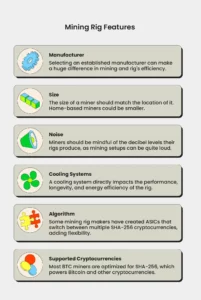
When evaluating the best crypto mining rigs, it’s essential to consider six key features:
- Manufacturer
- Size
- Noise
- Cooling system
- Algorithm
- Supported cryptocurrencies
Manufacturer
The manufacturer of Bitcoin mining equipment plays a crucial role in determining the quality, reliability, and performance of the mining rig.
Established manufacturers like Brand#1, Brand#2, and Brand#3 have built reputations for producing high-quality BTC miners with consistent performance and durability.
These well-known brands often lead in technological advancements, regularly releasing new models with improved hash rates and energy efficiency.
However, emerging manufacturers sometimes disrupt the market with innovative designs or competitive pricing.
Here’s a comparison chart of established versus emerging manufacturers.
| Established Manufacturers | Emerging Manufacturers | |
|---|---|---|
| Reputation | Well-established, trusted | Less known |
| Product Quality | Consistently high | Varies significantly |
| Technological Advancements | Regular upgrades | Innovation-focused |
| Pricing | High | Medium |
| Customer Support | Comprehensive | Limited |
| Warranty | Extensive | Limited |
| Replacement Parts | Readily available | Scarce |
| Community Knowledge | Extensive | Limited |
Size
The size of Bitcoin mining rigs is a critical factor that often goes overlooked in the excitement of entering the cryptocurrency mining space.
However, it’s especially important for those setting up home-based or space-constrained mining operations, where every inch of space matters.
Modern BTC miners come in various sizes. You can choose from compact units, suitable for small spaces or larger, industrial-scale machines designed for dedicated mining facilities.
This variety allows miners to choose equipment that not only meets their hash rate requirements but also fits seamlessly into their available space.
Proper planning ensures optimal performance and longevity of the mining equipment while maintaining a comfortable environment if operating in a shared living or working space.
Take a look at our comparison of Bitcoin mining rig sizes below to get a better understanding of how different-sized units compare in terms of performance, suitability for various environments, and other key factors.
This information will help you make an informed decision that balances your mining ambitions with your spatial constraints.
| Compact Miners | Mid-Size Miners | Large-Scale Miners | |
|---|---|---|---|
| Typical Dimensions | Small (12x6x6) | Medium (20x10x10) | Large (36x20x20) |
| Suitable Location | Home, office | Garage, cabinet | Mining farm, warehouse |
| Initial Investment | $300 – $2,000 | $2,000 – $8,000 | $8,000 – $20,000+ |
| Ideal For | Hobbyists, beginners | Small operations | Professional miners |
Noise
Noise levels are a crucial consideration when selecting Bitcoin mining equipment, particularly for home miners or those operating in residential areas.
The decibel (dB) output of mining rigs can vary significantly – from quiet models to those producing noise comparable to industrial machinery.
This variation in noise levels directly impacts where and how these miners can be set up effectively.
The following chart provides a comprehensive overview of typical noise levels associated with different types of Bitcoin mining rigs, offering comparisons to familiar sounds and suggesting suitable operational environments.
This information is essential for miners to balance their hash rate requirements with noise constraints, ensuring optimal performance while maintaining a comfortable living or working environment.
| Noise Level (dB) | Comparable Sound | Suitable Location | |
|---|---|---|---|
| Low-End Models | 50-75 dB | Vacuum cleaner | Home office |
| Mid-Range Models | 75-85 dB | Busy highway | Basement or garage |
| High-End Models | 85-95 dB | Lawnmower | Warehouse |
Cooling System
Cooling systems play a pivotal role in the performance and longevity of Bitcoin mining rigs. They’re the critical interface between the intense computational work and the operational environment.
As miners generate substantial heat during their operations, the choice of cooling system directly influences:
- Hash rates
- Long-term viability
- Efficiency of the mining setup
The following chart provides a comparison of the three primary cooling methods employed in Bitcoin mining:
- Air cooling
- Liquid cooling
- Immersion cooling
Each system offers a unique balance of efficiency, cost, complexity, and environmental impact, catering to different scales of operation and operational contexts.
Understanding these cooling options is essential for miners to optimize their setups, balancing performance needs with operational constraints and long-term sustainability goals.
Algorithm
The SHA-256 algorithm stands at the core of Bitcoin mining. It’s the cryptographic foundation upon which the entire network’s security and transaction validation processes are built.
This algorithm, developed by the US National Security Agency, defines the nature of the computational challenge that mining rigs must solve, shaping the hardware requirements and energy dynamics of the Bitcoin mining ecosystem.
Understanding the nuances of SHA-256 is crucial for anyone involved in Bitcoin mining, as it directly influences hardware choices, operational strategies, and potential profitability.
Supported Cryptocurrencies
While Bitcoin remains the primary focus for many miners, the crypto ecosystem now brings possibility of mining multiple cryptocurrencies.
This versatility can be a game-changer for miners looking to maximize profitability by adapting to market conditions and shifting between different coins as profitability dictates.
At the heart of this discussion is the algorithm compatibility of mining rigs.
Most Bitcoin mining rigs are optimized for the SHA-256 algorithm, which is not exclusive to Bitcoin but is also used by several other cryptocurrencies, including:
- Bitcoin Cash (BCH)
- Bitcoin SV (BSV)
- DigiByte (DGB)
This commonality allows for some flexibility even within specialized equipment. However, the mining hardware landscape extends beyond SHA-256, with more advanced rigs supporting a broader range of algorithms.
Best Crypto Miners and Their Features Compared
To simplify your decision, we’ve compiled this comparison table of top-performing crypto mining machines.
| Model | Power Consumption | Hash Rate | Price |
|---|---|---|---|
| Antminer S19j Pro | 2,950 Watts | 100 TH/s | $3,500 – $4,500 |
| A9 ZMaster | 620 Watts | 50 TH/s | $700 – $900 |
| STU-U8 Pro | 3,300 Watts | 85 TH/s | $2,800 – $3,500 |
| Whatsminer M50S | 3,276 Watts | 126 TH/s | $4,500 – $6,000 |
| BM-K3 | 2,250 Watts | 18 TH/s | $3,000 – $3,500 |
| AvalonMiner 1066 | 3,250 Watts | 50 TH/s | $1,500 – $2,000 |
| AvalonMiner 1246 | 3,420 Watts | 90 TH/s | $2,800 – $3,500 |
| Antminer L7 | 3,425 Watts | 9.5 TH/s | $3,000 – $5,000 |
| Antminer S9 | 1,350 Watts | 13.5 TH/s | $200 – $400 |
| AvalonMiner 921 | 1,800 Watts | 20 TH/s | $300 – $500 |
How to Select The Best Bitcoin Miner

When choosing one of the Best Bitcoin Mining Rigs in 2026 from the list we have shared, consider four key features:
- Energy consumption
- Hash rate
- Efficiency
- Price
Read more about them below.
Energy Consumption
Energy consumption stands as a pivotal factor in the complex equation of Bitcoin mining. It has significant influence over both operational strategies and long-term profitability.
Bitcoin miners demand substantial power to perform the intricate calculations necessary for validating transactions and securing the Bitcoin network.
The energy appetite of mining rigs, often measured in thousands of watts per hour, presents a double-edged sword for miners.
Higher energy consumption typically correlates with increased mining power and potentially greater rewards, but it simultaneously drives up electricity costs, which can quickly erode profit margins if not carefully managed.
The following chart offers a comparison of energy consumption aspects across different tiers of Bitcoin mining rigs.
| Power Consumption (Kilowatts per Hour) | Avg. Cost per Day in US
(price: $0.178 per kWh) |
|
|---|---|---|
| Low-End Miners | < 1kWh | $4.27 |
| Mid-Range Miners | 1 kWh – 3 kWh | $8.54 |
| High-End Miners | 3 kWh – 5 kWh | $17.08 |
Hash Rate
Hash rate is a critical metric when evaluating Bitcoin mining rigs. It represents the number of calculations a device can perform per second, typically measured in terahashes per second (TH/s).
Modern Bitcoin mining rigs showcase an impressive range of capabilities, with hash rates spanning from 30 TH/s in more modest setups to well over 100 TH/s in cutting-edge, industrial-grade equipment.
This wide spectrum reflects not only the rapid pace of technological advancement in the field but also the diverse needs of the mining community, from home enthusiasts to large-scale mining operations.
The significance of hash rate extends far beyond raw numbers. In the competitive arena of Bitcoin mining, a higher hash rate translates to an increased probability of successfully mining a block and earning the associated rewards.
Let’s take a look at the range of hash-rates you can expect based on your level of mining rig.
| Hash Rate | Share of Overall Hashrate
(612.68 EH/s) |
|
|---|---|---|
| Low-End Miners | 5 – 20 TH/s | 0.000002% |
| Mid-Range Miners | 20 – 100 TH/s | 0.000011% |
| High-End Miners | 100 – 300 TH/s | 0.000032% |
Efficiency
Now, you may look at the Hash rate and think that the higher the better, but it’s not that simple. In order for the mining rig to be considered “good” it needs to be efficient with the hashrate it’s capable of, and how much energy it consumes to do so.
Think about it, what good is a 300 TH/s mining rig, if it consumes 100 kWh? That’s when efficiency comes in.
In general it’s considered that consuming around 250 Watts per 1 TH/s is a good ratio for efficiency.
Price
In the complex ecosystem of Bitcoin mining, the price of mining equipment stands as a critical factor that can significantly influence a miner’s journey from initial investment to profitability.
The cost of Bitcoin mining rigs spans a vast spectrum. You’ll see rigs prices at a few hundred dollars (for older or less powerful models) to tens of thousands for cutting-edge, high-performance units.
Is Bitcoin Mining Still Profitable? – How to Calculate Returns
Before you begin investing in one of the Best Bitcoin Mining Rigs in 2026, it is often advisable to know if it will be profitable.
To determine if Bitcoin mining is profitable, use this basic formula: profit = revenue – costs.
Revenue = (Block reward + transaction fees) * your share of network hashrate.
Costs = electricity costs + hardware costs + other operational expenses.
Here are some examples and scenarios.
Basic scenario:
- Assuming 6.25 BTC block reward, $30,000 BTC price, 1% network share
- Daily revenue: (6.25 * $30,000 * 0.01) = $1,875
- Daily costs: $1,500 (electricity + hardware depreciation)
- Daily profit: $375
Higher hashrate:
- If your share increases to 2% of the network
- Daily revenue: (6.25 * $30,000 * 0.02) = $3,750
- Daily profit: $2,250 (assuming same costs)
Different cryptocurrency (for instance, Ethereum):
- Assume 2 ETH block reward, $2,000 ETH price, 0.5% network share
- Daily revenue: (2 * $2,000 * 0.005) = $20
- Daily costs: $15
- Daily profit: $5
Market price fluctuation:
- If BTC price drops to $20,000 (original scenario)
- Daily revenue: (6.25 * $20,000 * 0.01) = $1,250
- Daily profit becomes a loss: -$250
These examples demonstrate how profitability can vary based on network share, cryptocurrency choice, and market conditions.
Final Tips & Conclusion
When selecting from the list of Best Bitcoin Mining Rigs in 2026, it is wise to consider your specific needs, budget, and operating environment.
Factor in the initial cost, ongoing electricity expenses, and potential profitability based on current market conditions.
Remember the crypto mining industry changes rapidly, so staying informed about the latest technologies and market trends is crucial.
For those new to BTC mining, our guides on How to Mine Bitcoin and How to Build a Crypto Mining Rig provide valuable insights to get you started.
Experienced miners looking to optimize their operations can find advanced tips in our detailed equipment reviews and mining strategy articles.
Ultimately, successful Bitcoin mining requires careful planning, ongoing management, and adaptability to changing market conditions.
Frequently Asked Questions
-
01.
How much is crypto mining taxed?
Crypto mining taxation varies by country and jurisdiction. In many regions, mined crypto is treated as income and taxed at the fair market value when received. This income is often subject to self-employment or business tax rates.
Additionally, selling mined crypto may trigger capital gains tax if its value has increased. Some countries offer specific guidance for crypto mining, while others apply existing tax laws. It’s crucial for miners to keep detailed records of mining activities, expenses, and crypto values. Consulting a tax professional familiar with cryptocurrency regulations is advisable for accurate compliance.
-
02.
How much can I make mining Bitcoin?
The profitability of Bitcoin mining varies widely based on several factors. Key determinants include the cost of electricity, the efficiency of your mining equipment, the current BTC price, and the network’s mining difficulty.
High-end ASIC miners can potentially generate a few dollars to tens of dollars per day, but this can change rapidly with market fluctuations.
Profitable mining often requires significant initial investment and access to low-cost electricity. It’s crucial to use mining profitability calculators and regularly reassess your operation’s viability as market conditions and mining difficulty evolve.
-
03.
Do I need a strong setup to mine crypto?
Mining Bitcoin effectively requires specialized hardware. Consumer-grade computers or GPUs are no longer viable for profitable BTC mining due to the network’s high difficulty. Instead, purpose-built ASIC miners are essential.
These devices are designed solely for mining and offer significantly higher hash rates and energy efficiency. For other cryptocurrencies, requirements vary. Some can be mined with GPUs, while others need ASICs.
Regardless of the coin, a reliable internet connection and a stable power supply are crucial. Additionally, proper cooling systems are necessary to maintain equipment performance and longevity.
-
04.
How many Bitcoins can I mine in 1 day?
The number of Bitcoins you can mine in a day depends on several factors, primarily your mining equipment’s hash rate and the overall network hash rate. With current difficulty levels, even high-end ASIC miners typically produce only a fraction of a Bitcoin per day.
For example, a top-tier miner with 100 TH/s might generate around 0.0006-0.001 BTC daily. However, this can vary significantly based on network conditions and luck. Most miners join mining pools to receive more frequent, smaller payouts rather than attempting to mine full blocks independently.
-
05.
Why are crypto mining rigs so expensive?
Crypto mining rigs, especially those for Bitcoin, are expensive due to several factors. They use specialized ASIC chips designed specifically for mining, which require significant research and development costs. The high demand for these rigs, coupled with limited manufacturing capacity, drives up prices.
Moreover, the competitive nature of mining necessitates cutting-edge technology to remain profitable, leading to constant upgrades and innovations. The rigs’ powerful processing capabilities, energy efficiency, and durability also contribute to their cost. Additionally, supply chain issues and chip shortages can further inflate prices in the crypto mining market.


 You’re in. Thanks for joining our newsletter.
