


 8 min read
x402 AI Agent Guide 2026: How to Use, Earn, and Invest




 AI Overview
Humans are so last year. 2026 is fast becoming the year of the AI agent, or what many now call the agentic economy.
AI agents can already track markets, scan for opportunities, and act on data in real time. That opens up new ways to build income streams around data, tools, or strategies.
x402 pushes this further by letting these agents pay and operate on their own.
What is x402?
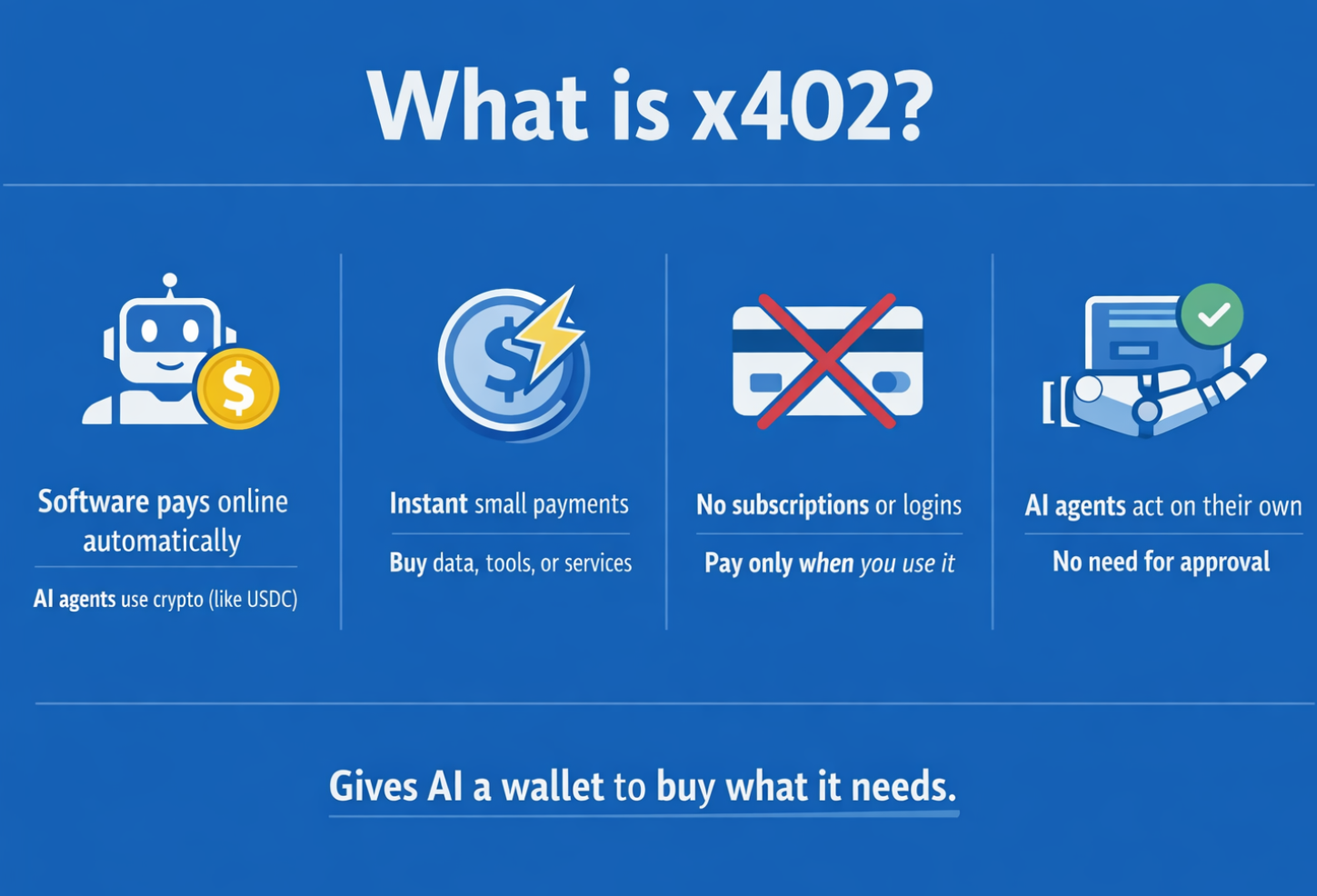
x402 is an on-chain payments protocol designed to let AI agents pay for online resources automatically.
The name comes from the old HTTP status code 402 Payment Required. In normal web systems, that kind of payment flow usually creates friction. A user has to approve the payment, enter card details, or subscribe manually.
x402 changes that by allowing AI agents to make small on-chain payments directly from a wallet. That means an agent can pay for:
- API access
- data feeds
- transaction fees
- digital services
- compute and storage resources
This allows agents to operate continuously without waiting for a human to approve every step.
The protocol has been developed with support from teams linked to Coinbase, Circle, Solana, and the x402 Foundation.

Why x402 Matters for AI Agents
AI agents are only useful if they can act, not just think.
Without a payment layer, an agent can identify an opportunity but still get stuck when it needs to pay for information, access a tool, or execute a task.
With x402, agents can:
- pay for services in real time
- access paid tools and data without subscriptions
- hire other agents or services
- keep operating 24/7
That makes x402 part of what many are calling the machine economy, where software agents transact directly with each other.
Examples of x402 in Use
A number of crypto-native AI projects are already experimenting with x402.
One example is Virtuals Protocol on Base, where AI agent characters can interact on-chain and use paid infrastructure more autonomously.
Another is SniperX on Solana, an AI trading agent designed to identify and act on short-term market opportunities.
There are also data-focused tools such as Token Analyst AI agents built by projects like Heurist.
At this stage, overall transaction volume is still small. But the infrastructure is starting to form, and that is what makes the sector worth watching.
 DON’T GET REKT
Curated drops, testnets and red flag alerts straight to your inbox ✌️
 You’re in. Thanks for joining our newsletter.

Passive Income Opportunities With x402
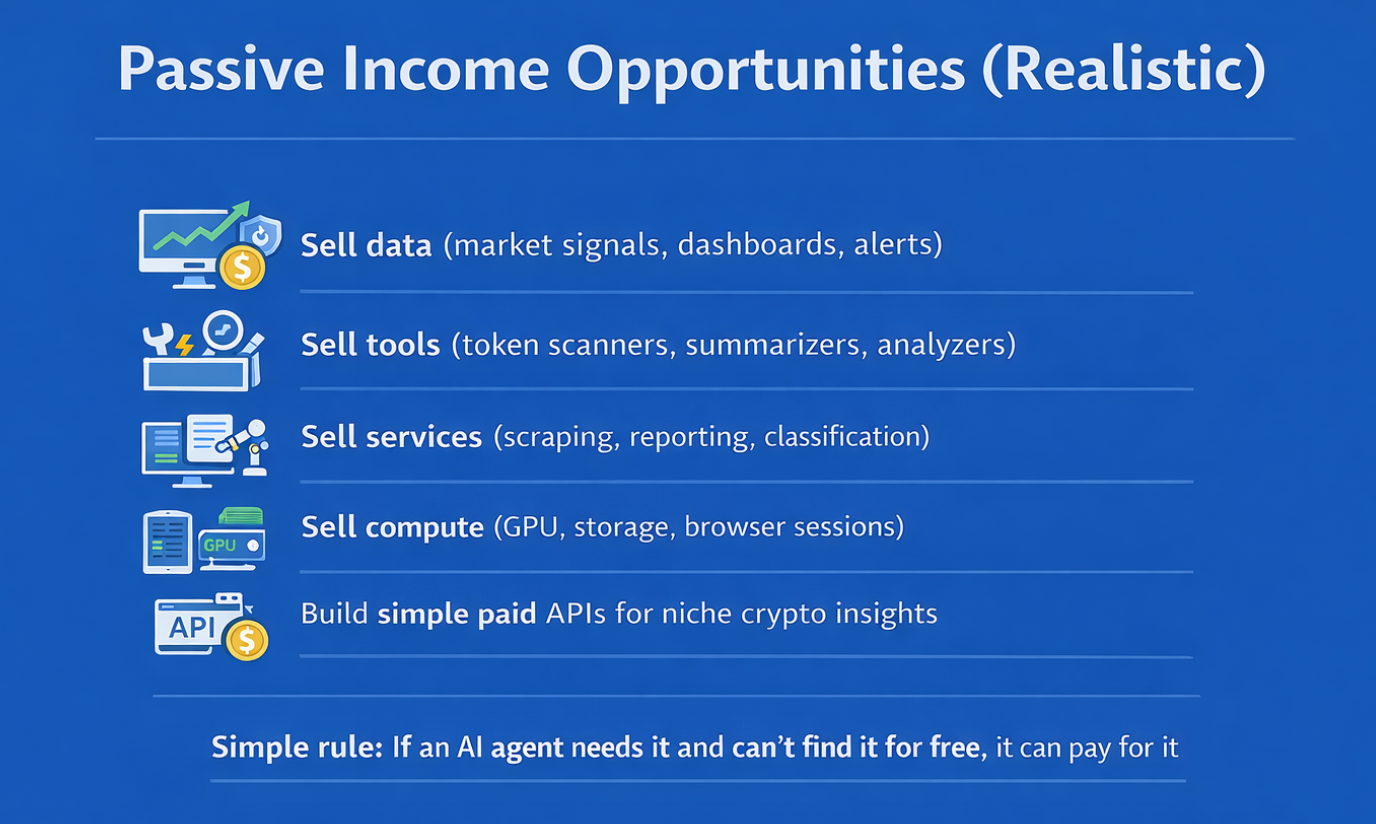
The main passive income angle is straightforward: if agents need services, data, and infrastructure, someone has to provide them.
That creates several ways to earn.
1. Sell Data to AI Agents
If you control useful data, you may be able to charge agents for access.
This could include:
- market data
- niche datasets
- on-chain analytics
- signal feeds
- research outputs
Instead of selling subscriptions to people, providers can charge software agents directly through x402-compatible payment flows.
2. Sell Skills or Services
Agents may increasingly rely on outside services to complete tasks.
That creates opportunities to offer:
- automation tools
- research modules
- prompt or workflow systems
- analytics services
- execution tools
As the ecosystem grows, these may become machine-to-machine services rather than human-facing products.
3. Provide Compute, Storage, or Infrastructure
AI agents need resources to operate.
This opens passive income opportunities for users or businesses that can provide:
- storage
- CPU or GPU compute
- hosting
- bandwidth
- uptime-critical infrastructure
If x402 becomes widely adopted, infrastructure providers could charge per use rather than through fixed subscriptions.
4. Use Agents for DeFi Yield Strategies
Some users may eventually deploy x402-enabled agents to manage capital across DeFi.
Possible strategies include:
- vault allocation
- yield optimization
- arbitrage
- liquidity management
- automated rebalancing
This is less passive than simply staking an asset, but the goal is similar: use automation to keep capital productive at all times.
How to Start with x402 if You are a Complete Beginner
If you have zero idea about AI agents, wallets or x402, do not start by trying to build a trading bot.
Start small and follow this in order.
Step 1: Understand the Basic Model
Before doing anything else, remember this simple framework:
- The agent is the software doing the task
- The wallet is what gives it money
- x402 is the payment rail that lets it buy services
- The service could be data, research, compute, browser access or another tool
That is the whole thing. An AI agent without x402 is just software that can think.
An AI agent with x402 is software that can think and pay.
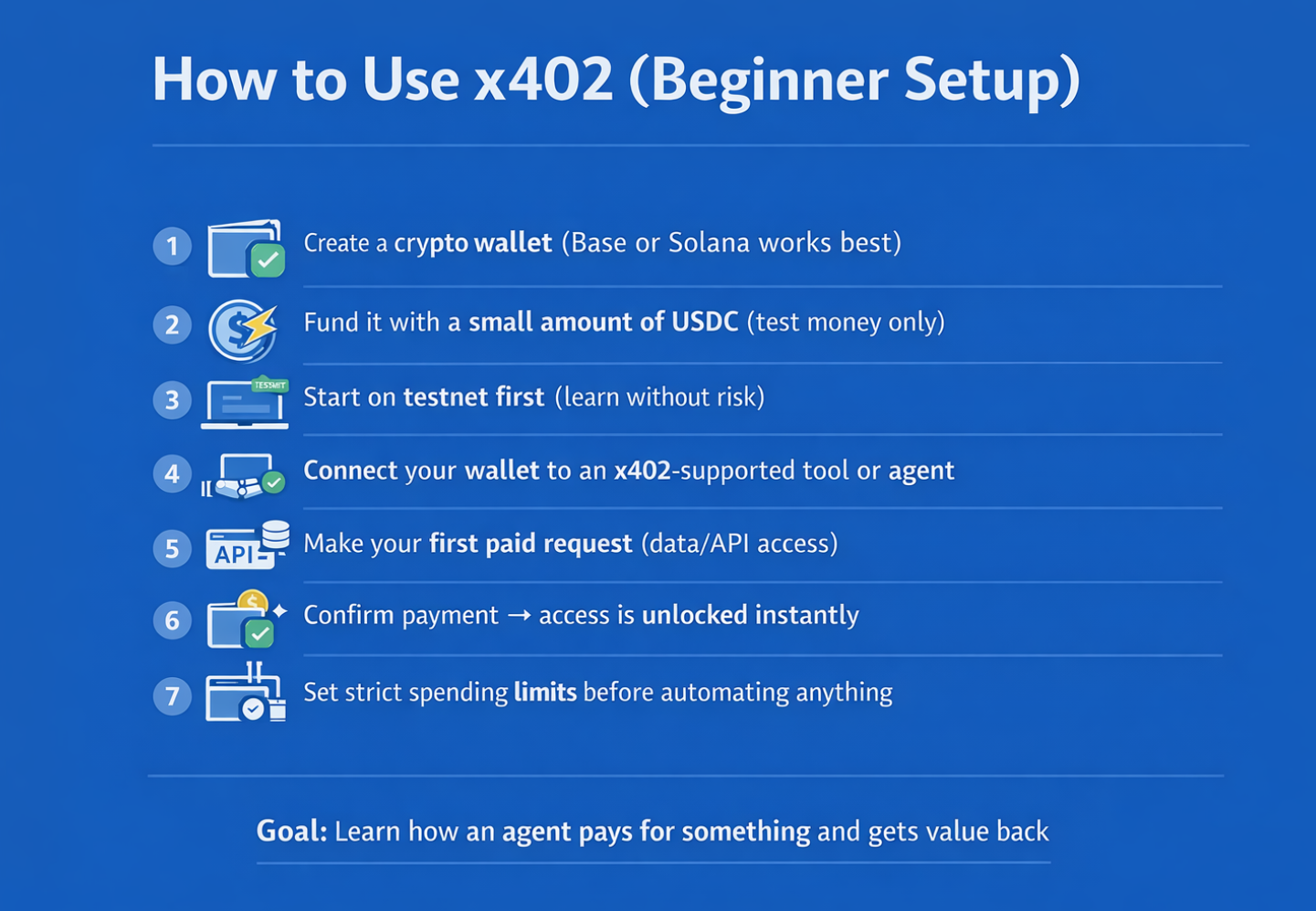
Step 2: Get a Wallet and Fund it With a Very Small Amount
You need a crypto wallet because x402 payments are usually made with stablecoins like USDC.
For beginners, the easiest route is to start with a standard wallet on a supported network such as Base or Solana.
Do not move serious capital into this wallet. Treat it like an experiment wallet. Fund it with an amount you are fully prepared to lose.
That part matters. AI agents do not remove crypto risk. They multiply the speed of mistakes if you are careless.
Step 3: Start on Testnet, not Mainnet
This is where most beginners get reckless.
Do not start with real money if you do not understand the workflow yet. Start on testnet and use faucet tokens first. That lets you learn how x402 payments work without burning actual capital.
Think of this as your practice environment.
If you cannot make one clean test payment and understand what happened, you are not ready to automate anything.
Step 4: Use a Simple Buyer Workflow First
Your first goal should not be “make passive income.”
Your first goal should be: make one paid x402 request successfully.
That means your agent or tool should be able to:
- Request a paid resource
- Receive the payment requirement
- Approve the payment through the wallet
- Access the tool or data
Once you do that once, x402 stops being theory.
At this stage, the easiest beginner use case is paying for something simple and useful, such as:
- crypto price data
- token market data
- premium API access
- browser sessions
- agent tools that perform one task
This teaches you the buyer side of the model.
Step 5: Start with Data, not Trading
This is the smartest beginner move.
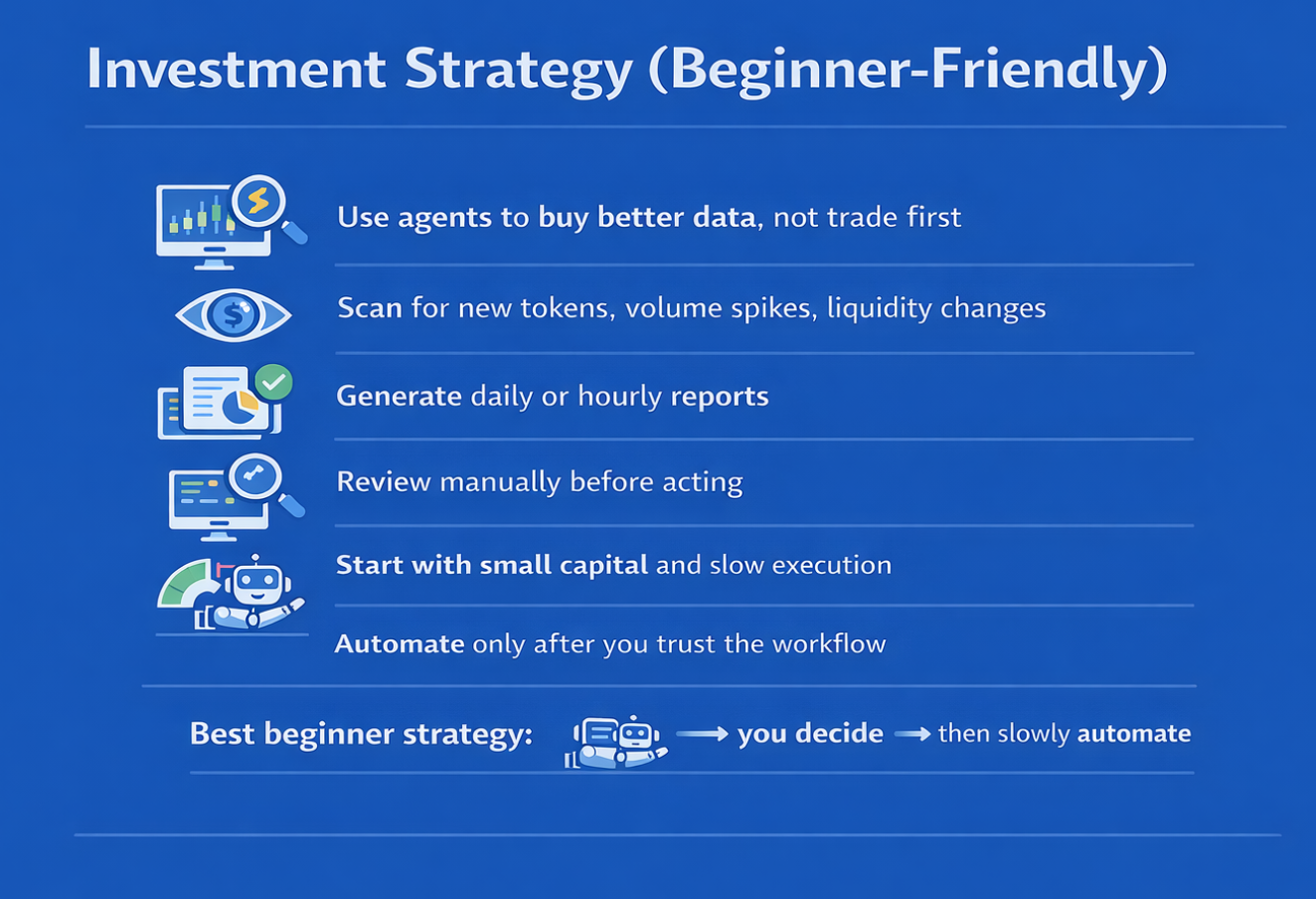
Do not jump straight into fully autonomous trading. Use x402 first to buy better inputs.
For example, you can use an agent to pay for:
- market data
- new token activity
- volatility data
- liquidity snapshots
- on-chain signals
- sentiment or news tools
Then let the agent turn that into reports, alerts or trading ideas.
This is much safer than handing it the power to trade instantly.
In other words, your first profitable use of x402 may not be a bot that makes trades. It may be a bot that gives you better decisions.
Step 6: Build One Simple Workflow
A good beginner workflow looks like this:
The agent checks a paid market data endpoint every few hours. It pays per request using x402. It then compiles a list of unusual token activity, price spikes, liquidity changes or wallet movements. Finally, it sends you a report or alert.
That is already useful.
You are not paying monthly subscriptions for five different tools. You are paying only when the agent needs something. That is one of the real advantages of x402.
Step 7: Put Hard Spending Limits in Place
This is non-negotiable.
If you are letting an agent spend money, you need hard spending limits at the wallet or policy level. Not just in the prompt.
Set limits like:
- Max spend per transaction
- Max spend per day
- Approved services only
- No repeated retries without review
Why? Because ghost spending is real.
An agent can get stuck in a loop, keep retrying a paid request, and slowly drain the wallet. In crypto, those payments are generally irreversible. If a bad automation loop runs for hours, the money is gone.
So before thinking about returns, think about containment.
Step 8: Only then Test Light Automation
Once you are comfortable paying for data and using the outputs manually, then you can experiment with light automation.
That could include:
- Auto-buying market data and generating signals
- Auto-entering bounty tasks or competitions
- Auto-publishing research or analytics as a service
- Auto-rebalancing between strategies only after human review
The safest model is still semi-automated.
Let the agent do the searching, paying, sorting and recommending. Keep final capital deployment under your control until you trust the workflow.
Investment Strategy Opportunities With x402
Beyond passive income, x402 may also create direct investment opportunities.
1. Invest in the Infrastructure Layer
The clearest long-term strategy may be backing projects building the rails for agent payments, coordination, and commerce.
That includes:
- protocols enabling agent payments
- marketplaces for machine services
- on-chain agent platforms
- infrastructure providers
If agent-to-agent commerce grows, these picks-and-shovels plays could become more valuable than individual agent projects.
2. Deploy Trading or Execution Agents
Some users may use x402-enabled agents to trade on their behalf.
This could include:
- market-making bots
- arbitrage systems
- event-driven execution tools
- bounty hunters
- competition-entry agents
The appeal is obvious: agents can monitor markets and act continuously, without the downtime or emotional errors that affect human traders.
3. Build Products for Agents, Not Just Users
One of the more overlooked investment angles is building tools specifically for agent demand.
If agents become customers, then businesses can target:
- agent-first APIs
- premium data feeds
- execution tools
- settlement services
- authentication or permissions layers
This is a higher-conviction bet on the machine economy itself.
Risks of x402 and AI Agent Strategies
The opportunity is real, but so are the risks.
Adoption Risk
The biggest question is still whether AI agents will reach meaningful scale. If adoption stalls, x402 activity may remain niche.
Smart Contract and Execution Risk
Like any on-chain system, x402-related infrastructure can fail due to bugs, exploits, or bad integrations.
Regulatory Risk
Rules around AI, autonomous finance, and machine-led transactions could change quickly.
Data Risk
Agents are only as good as the data they use. Corrupted, delayed, or manipulated data can lead to poor decisions or losses.
Ghost Spending
One of the more practical risks is repeated failed payments or looped actions. If an agent continues trying to pay for something unsuccessfully, it may keep burning fees until the wallet is drained.
That kind of failure is especially dangerous on-chain because transactions are irreversible.
Final Thoughts
x402 is one of the more interesting pieces of infrastructure emerging at the intersection of AI and crypto.
It gives AI agents a way to pay for services directly, which is a necessary step if the machine economy is going to become real rather than theoretical.
For passive income, the best opportunities may come from selling data, computing, or services to agents.
For investment, the strongest angle may be backing the infrastructure and tools that make agent commerce possible.
The sector is still early. That means the upside may be meaningful, but so is the execution risk.



 Thank you for your feedback! We’re glad you found this article helpful.
 An error occurred while sending the form, please try again.
 We are sorry. You've already sent a message within the last 60 seconds. Please wait before sending another.
 Thank you for letting us know! Our team will review your feedback to help improve our content.
We're sorry you did not find what you were looking for. Please select the reason this article was not helpful.