


 2 min read
Casper 2.0: All You Need To Know About The Upcoming Upgrade



 AI Overview
Casper Network rolls out Casper 2.0 on 6 May 2025, a protocol overhaul adding Zug consensus, a modular Sidecar, a binary port API, and native smart-contract events, which has triggered a sharp CSPR rally and renewed investor interest.
- Technical leap: Zug consensus, Sidecar modularity, binary API and native events improve finality, throughput, observability and developer workflows.
- Market reaction: CSPR jumped ~52% with higher volume; RSI near 73 signals strong momentum but elevated short-term volatility risk.
- Strategic upside: Enterprise-ready throughput and better tooling could broaden developer adoption and position Casper for scalable Web3 use cases.
The Casper Network is preparing to roll out a major protocol upgrade with the launch of Casper 2.0. This milestone marks a significant step forward in the project’s technical evolution, with changes aimed at enhancing scalability , developer usability, and overall network performance.
The anticipation has sparked renewed investor interest. CSPR, the network’s native token, surged by nearly 52% in the last trading session, reflecting heightened excitement ahead of the upgrade.
What’s new in Casper 2.0?
The project has announced that the launch has been scheduled for 6 May 2025. Casper 2.0 introduces several key changes to the protocol’s core infrastructure:
Zug consensus mechanism
The network’s existing consensus protocol will be replaced by ‘Zug’, a new lightweight consensus system designed for faster finality and improved validator responsiveness. This upgrade enhances Casper’s ability to confirm blocks more efficiently, particularly under high network load.
Modular architecture with Casper Sidecar
A major architectural change is the introduction of the Casper Sidecar, which decouples RPC (Remote Procedure Call) services from the node client. This modular setup simplifies debugging, enhances observability, and allows developers to implement updates without affecting core consensus operations.
Binary Port API
The upgrade also shifts Casper away from JSON-RPC in favor of a binary-based port API. This move reduces data serialization overhead and increases throughput, which is especially important for enterprise-grade deployments and applications that handle large volumes of transactions.
Native smart contract events
Casper 2.0 adds native support for smart contract -level events, enabling dApp developers to track on-chain activity more accurately and use gas more efficiently. This enhancement provides improved state visibility and real-time monitoring capabilities.
CSPR price surges ahead of upgrade
Market reaction to the upcoming upgrade has been strong. CSPR surged nearly 52% over the past 24 hours, reaching an intraday high of $0.025 before retracing to $0.0144 at press time.
The Relative Strength Index (RSI) had risen to 73.36, well into overbought territory, suggesting that while bullish momentum remained strong, a short-term cooldown could be likely. Daily trading volume also spiked to 38 million, underlining the increased trader activity around the event.
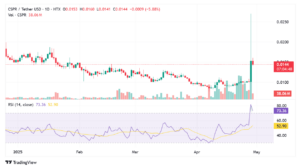
The price breakout marks a clear departure from a prolonged consolidation phase, with growing momentum fueled by expectations of enhanced network capabilities.
What’s next for Casper?
The 2.0 upgrade is expected to significantly improve the Casper Network’s appeal to developers and enterprises alike. With its modular design, faster consensus, and better tooling support, the upgrade positions Casper as a competitive option for scalable Web3 applications.
While the long-term impact of the changes remains to be seen, the upgrade marks a clear shift toward infrastructure maturity. With the launch now less than a week away, market participants and developers will closely monitor Casper’s performance as it transitions into this next phase.



 Thank you for your feedback! We’re glad you found this article helpful.
 An error occurred while sending the form, please try again.
 We are sorry. You've already sent a message within the last 60 seconds. Please wait before sending another.
 Thank you for letting us know! Our team will review your feedback to help improve our content.
We're sorry you did not find what you were looking for. Please select the reason this article was not helpful.

 You’re in. Thanks for joining our newsletter.
