


 9 min read
MegaETH Airdrop and Rewards Guide 2026




 AI Overview
MegaETH Terminal is an 8-week rewards campaign with 2.5% of token supply allocated to users.
- Farming requires real funds on MegaETH mainnet, not testnet activity.
- Earn points by bridging, using apps, providing liquidity, holding NFTs, and staying active weekly.
- Kumbaya, USDM liquidity, boosted apps, and NFT loyalty may be the strongest farming routes.
MegaETH’s $MEGA token is perhaps the most hyped crypto launch of 2026. It was immediately listed on several major exchanges, including Binance and Coinbase, and has strong community support.
But the project launched into a strange market. Some ICO participants and early airdrop farmers were left disappointed as market conditions weakened.
Still, MegaETH has continued building. The “real-time blockchain” is now gaining attention again with the launch of Terminal, its Season 1 incentive hub.
Terminal introduces an 8-week rewards campaign where users can earn points by using apps, bridging assets, providing liquidity, holding NFTs, and interacting with the MegaETH ecosystem.
If you joined the pre-deposit campaign, participated in the ICO, minted MegaETH NFTs, or hold a Fluffle soulbound NFT, you may already have some advantage. If not, there is still time to start.

MegaETH Terminal Rewards Summary
| Activity | What You Do | Reward Potential | Cost |
| Bridge assets | Use the official RabbitHole Bridge to move ETH or stablecoins to MegaETH | May count toward weekly points | Real funds required |
| Use Terminal apps | Interact with selected ecosystem apps inside Terminal | Earn app-based points | Real funds required |
| Boost apps | Choose up to 3 revealed apps to boost | Higher point yield from selected apps | Free, but choose carefully |
| Provide liquidity | LP on MegaETH apps such as Kumbaya | Earn yield and likely point boosts | Real funds required |
| Trade on apps | Swap, trade, or use products like Hit.One | Activity-based points | Real funds required |
| Hold NFTs | Pledge loyalty to NFT collections and hold supported NFTs | Point multipliers or boosts | Optional |
| Link accounts | Connect X and other wallets | Better profile and activity tracking | Free |
| Use USDM | Hold, swap, or provide liquidity with MegaETH’s native stablecoin | Yield and points potential | Real funds required |
What Is MegaETH?
MegaETH is an Ethereum Layer 2 blockchain built for real-time performance.
Like Arbitrum, Optimism, and Base, it is designed to scale Ethereum by making transactions faster and cheaper. The difference is that MegaETH is pushing for extremely low latency and very high throughput.
MegaETH claims:
- 10ms finality
- Up to 100,000 theoretical TPS
- Full EVM compatibility
- Ethereum ecosystem support
In simple terms, MegaETH wants Ethereum apps to feel instant.
That matters because many crypto applications still feel slow compared with traditional apps. MegaETH is trying to fix that by making on-chain actions happen almost immediately.
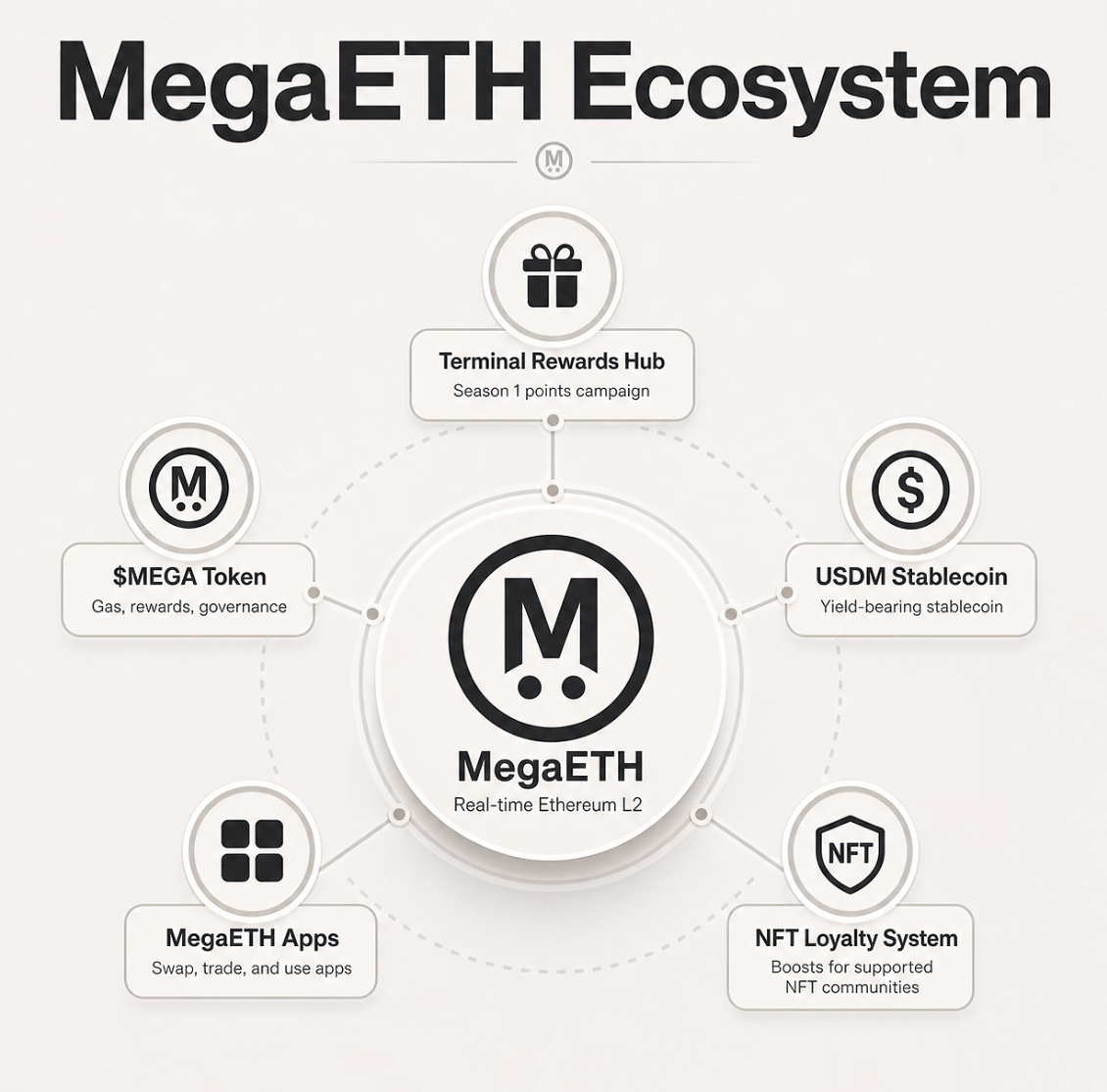
Because it is EVM-compatible, Ethereum developers can build on MegaETH using familiar tools. That could help bring DeFi apps, NFT projects, trading platforms, and consumer apps onto the chain more quickly.
MegaETH has also attracted major attention from investors and builders. Dragonfly Capital led a $20 million seed round, and the public sale reportedly saw more than $1 billion committed.
Catch The Good Stuff, Dodge The Rugs
Don’t Get Rekt delivers curated drops, testnets, and red flag alerts straight to your inbox. No hype, no spam, and it will always be free. We respect your inbox 🤞
 You’re in. Thanks for joining our newsletter.
 By submitting your email, you agree to our Terms and Privacy Policy. You can unsubscribe at any time using the link in our emails.


What Is Terminal?
Terminal is MegaETH’s Season 1 rewards hub.
It is designed to push real activity into the MegaETH ecosystem after mainnet launch. Instead of simple pre-deposit farming, Terminal rewards users for interacting with live apps.
The campaign runs for 8 weeks, with users earning points toward a future MegaETH token allocation.
MegaETH has allocated 2.5% of the total token supply to this Terminal campaign. That may sound small, but at current valuations, it could still represent a large reward pool.
Important note: MegaETH is now on mainnet, so this is not a free testnet campaign. You need real funds to participate.
Is the MegaETH Airdrop Confirmed?
Yes, MegaETH has confirmed that Terminal points will count toward a token allocation.
The campaign is not a vague “maybe.” Terminal is the official rewards hub, and points earned during the 8-week campaign are designed to determine future allocations.
Early users may receive boosts if they:
- Took part in earlier MegaETH campaigns
- Joined the pre-deposit campaign
- Participated in the ICO
- Hold Fluffle soulbound NFTs
- Minted or held supported MegaETH NFTs
- Have previous ecosystem activity
Even if you missed earlier phases, you can still farm points by using Terminal and MegaETH apps now.
How to Farm MegaETH Terminal Points
The strategy is simple: bridge in, use apps, boost the right ones, provide liquidity, and stay active each week.
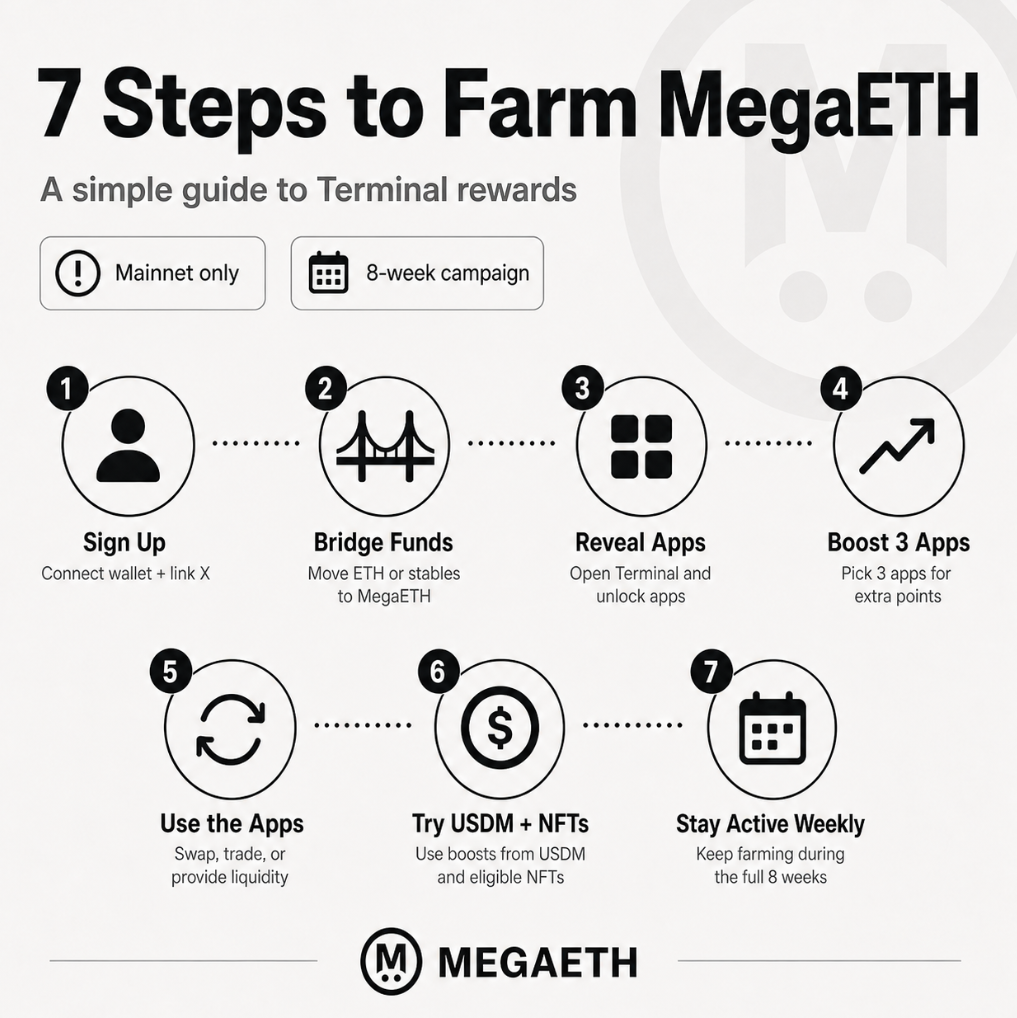
Step 1: Sign Up for Terminal
Go to the Terminal platform and connect your wallet.
Ideally, use a wallet that already has some MegaETH history, such as:
- Testnet activity
- Pre-deposit participation
- NFT minting activity
- OpenSea activity linked to MegaETH collections
If you are starting fresh, that is fine. You can still build activity from now.
You should also:
- Link your X account
- Connect other relevant wallets
- Check whether you qualify for multipliers
If you hold a Fluffle soulbound NFT, you may receive a point multiplier.
Step 2: Bridge Funds to MegaETH
To farm Terminal, you need assets on MegaETH mainnet.
You can use third-party bridges, but for this campaign, the official RabbitHole Bridge may be the better option.
That is because bridging through the official route is more likely to be tracked directly by the campaign.
Recommended actions:
- Bridge ETH or stablecoins
- Convert assets into USDM
- Keep enough ETH for gas
- Use funds gradually across apps
Do not bridge more than you are comfortable using. This is still a new ecosystem.
Step 3: Reveal Apps Inside Terminal
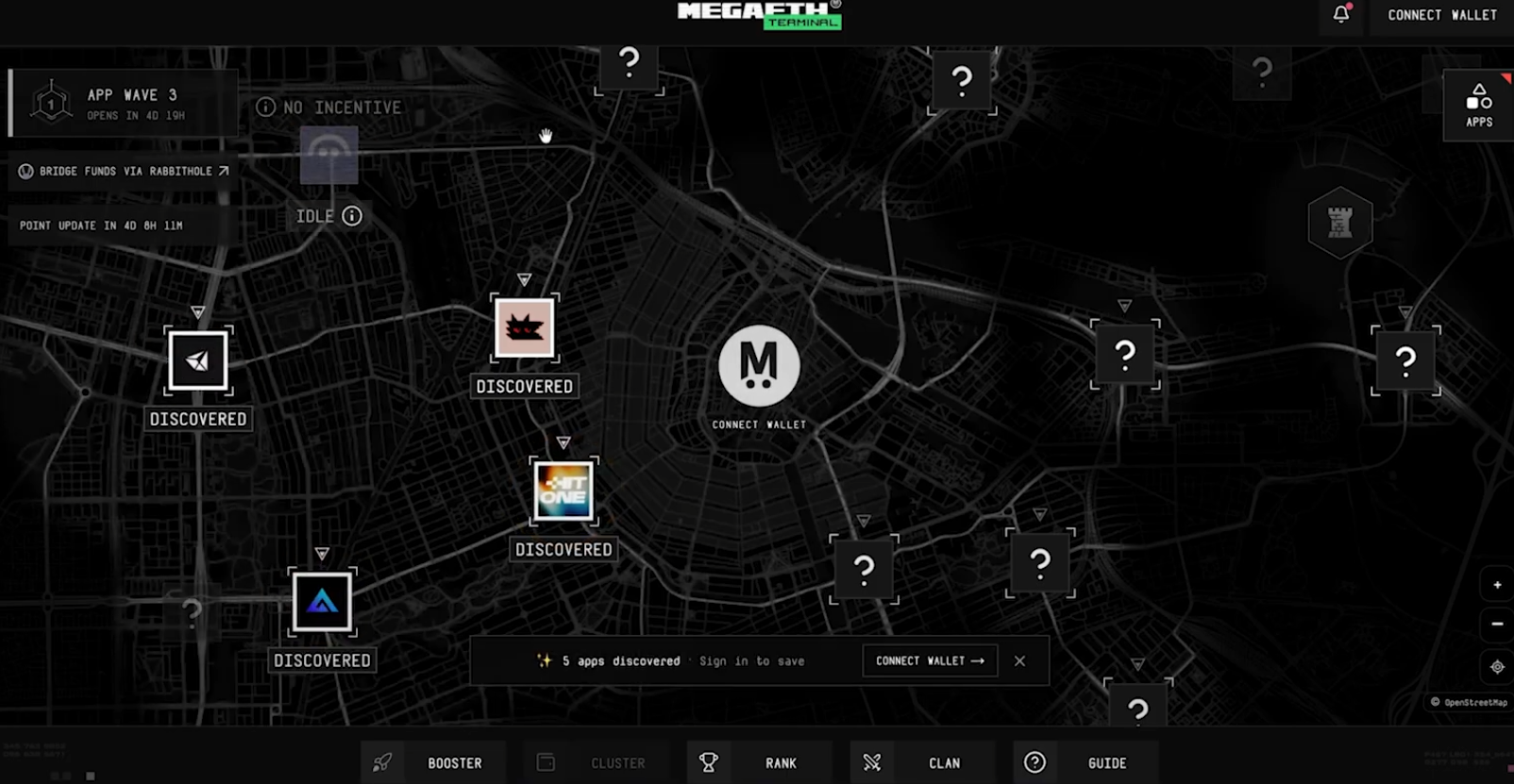
Inside Terminal, you will see tiles on a map.
Clicking these tiles reveals ecosystem apps. Each user may see a different set of apps.
Once revealed, you can choose up to three apps to boost.
This matters because boosted apps may give you higher point returns for the same activity.
Choose apps you actually plan to use. Do not waste boosts on apps you will ignore.
Step 4: Use Kumbaya for Swaps and Liquidity
Kumbaya is one of the main DEXs in the MegaETH ecosystem.
It is one of the most obvious apps to use because it supports core DeFi activity such as:
- Swapping ETH and USDM
- Providing liquidity
- Trading ecosystem tokens
A simple farming approach is:
- Swap between ETH, USDM, and other supported assets
- Provide liquidity to key pools
- Keep positions active across the campaign
Example pools include:
- WETH/USDM
- USDT0/USDM
Providing liquidity may help you earn both yield and Terminal points.
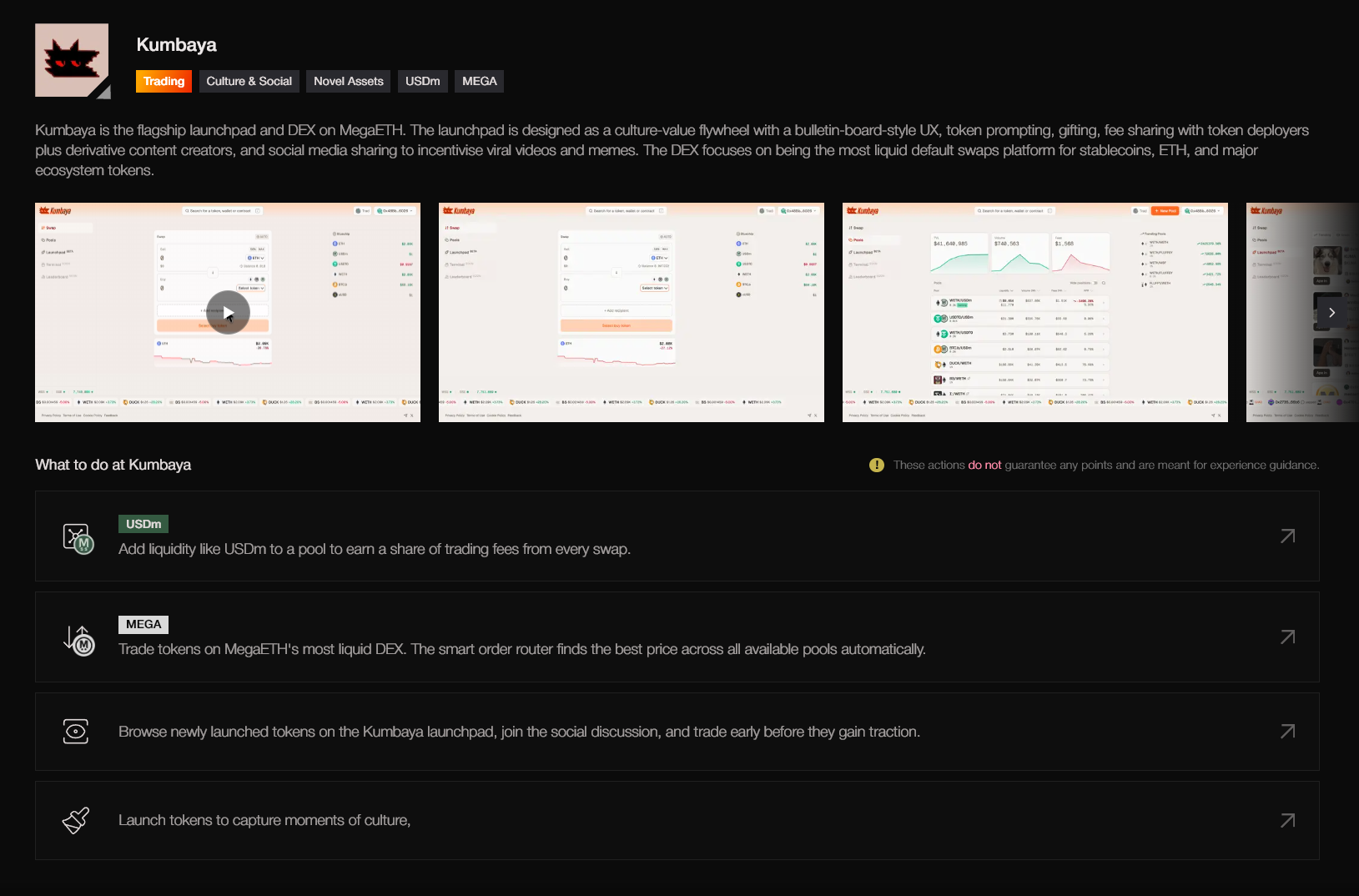
Kumbaya also supports new token launches and memecoin activity, but that carries more risk. If you are farming points rather than actively trading, simple swaps and liquidity provision may be cleaner.
Step 5: Try Hit.One for Trading Activity
Hit.One is a more experimental MegaETH app.
It lets users deposit small amounts of USDM and automatically opens highly leveraged trades through a slot-machine-style interface.
The appeal is that it shows MegaETH’s speed clearly. Trades open quickly, results feel instant, and the app is built around fast activity.
However, this is risky.
If you use Hit.One, treat it as a small experimental allocation rather than a serious investment strategy.
A safer approach:
- Use small amounts
- Recycle profits if you make any
- Avoid chasing losses
- Focus on activity, not gambling with size
This can help build Terminal activity without putting too much capital at risk.
Step 6: Try Other Ecosystem Apps
Terminal will likely add more apps as the campaign progresses.
One example outside Terminal is Pump Party, which has launched a Season 1 points program. Its Super Bunny Cannon game shows the real-time speed of MegaETH, though it is clearly high risk and more entertainment-focused.
The broader strategy is to explore new apps as they go live.
Each new app may offer:
- Separate points
- Terminal activity
- Future rewards
- NFT or token incentives
Just keep position sizes small until the ecosystem matures.
Step 7: Use NFT Loyalty Boosts
Terminal also includes an NFT loyalty system.
Users can pledge loyalty to an NFT collection, even if they do not hold that NFT. Holding supported NFTs may provide boosts for up to three NFT collections.
This has already increased attention around MegaETH NFTs.
The opportunity is clear, but so is the risk. NFT floors can move quickly during reward campaigns, then drop once farming demand cools.
If you want to use this strategy:
- Avoid chasing expensive floors
- Look for affordable collections
- Only buy NFTs you are comfortable holding
- Check whether they are eligible for boosts
NFTs can improve rewards, but they should be optional, not the whole strategy.
Step 8: Stay Active Weekly
Terminal is an 8-week campaign, so one-time activity is not enough.
A better strategy is to build a routine:
- Bridge once through the official bridge
- Swap a few times per week
- Provide liquidity in selected pools
- Use your boosted apps regularly
- Check for new tasks or app waves
- Track points weekly
- Adjust if new higher-value opportunities appear
The goal is to look like a real ecosystem user, not a one-day farmer.
What Is USDM?
USDM is MegaETH’s native yield-bearing stablecoin.
It is built using Ethena infrastructure and is designed to be a productive asset inside the MegaETH ecosystem.
USDM is backed by yield-generating assets such as tokenized US Treasuries. The yield from these reserves helps support the network economy.
USDM can be used to:
- Lower transaction costs
- Support sequencer payments
- Fund $MEGA buybacks
- Incentivize MegaETH ecosystem apps
- Provide liquidity across MegaETH DeFi
For Terminal farmers, USDM matters because many MegaETH apps use it directly.
Providing liquidity to USDM pairs may be one of the cleaner ways to earn points while staying in relatively stable assets.
MegaETH Token Utility
The $MEGA token is expected to support several parts of the ecosystem.
Likely utility includes:
- Gas fees
- Governance
- Ecosystem incentives
- KPI-based staking rewards
- Buybacks
- Advanced infrastructure mechanisms
MegaETH has also introduced a milestone-based unlock model. A large portion of supply is tied to future KPIs, which means token distribution depends partly on ecosystem progress.
This is a more complex model than a standard token launch, but it also shows that MegaETH is trying to align token supply with actual network growth.
Risks to Consider
MegaETH is promising, but farming Terminal is not risk-free.
- Real Funds Required: This is mainnet, not testnet. You are using actual ETH, stablecoins, and tokens. Losses are possible.
- New Ecosystem Risk: MegaETH apps are still early. Bugs, liquidity issues, and poor execution are all possible.
- NFT Risk: NFTs may pump during the campaign and fall afterward. Do not buy NFTs only because they might provide points unless you understand the downside.
- Leverage Risk: Apps like Hit.One can be fun, but they involve high-risk trading. Use small amounts if you test them.
- Opportunity Cost: Your funds could be earning elsewhere. Only farm if you believe the potential reward justifies the time and capital.
Final Thoughts
MegaETH Terminal is one of the more interesting airdrop campaigns of 2026.
The chain feels fast, the ecosystem is starting to come alive, and the rewards campaign gives users a clear reason to test apps beyond basic bridge-and-wait farming.
There are parts I do not love. Terminal points do not update in real time, which is ironic for a real-time blockchain. The NFT loyalty mechanics may also push users into risky floor-chasing.
Still, MegaETH is worth paying attention to.
If you already believe in Ethereum scaling and want exposure to one of the most ambitious new L2s, Terminal is a practical way to participate early while farming rewards.



 Thank you for your feedback! We’re glad you found this article helpful.
 An error occurred while sending the form, please try again.
 We are sorry. You've already sent a message within the last 60 seconds. Please wait before sending another.
 Thank you for letting us know! Our team will review your feedback to help improve our content.
We're sorry you did not find what you were looking for. Please select the reason this article was not helpful.

