


 5 min read
Is Staking Crypto Worth It For Passive Income In 2026?



 AI Overview
A 2026 primer on crypto staking: what it is, how yields and platforms changed since Ethereum’s upgrades, typical APYs across major coins, and practical steps to earn passive income while managing liquidity, slashing and custodial risks.
- Mature, steady yields: Major PoS coins now offer predictable 3–10% APYs; liquid staking and exchanges make participation easy.
- Risk trade-offs: Slashing, unbonding windows, custodial counterparty risk and token volatility can offset nominal returns.
- When to stake: Best for long-term holders to compound and offset inflation; use reputable validators and liquid staking if you need flexibility.
Cryptocurrency staking has become one of the most popular ways for long-term holders to earn passive income. Instead of letting coins sit idle in a wallet, staking allows you to participate in securing a blockchain network and get rewarded for it.
By August 2025, staking has matured into a steady, predictable way to grow your crypto holdings. But is it still worth it? Let’s break down how staking works, what returns you can expect this year, and the risks you should know before committing your coins.
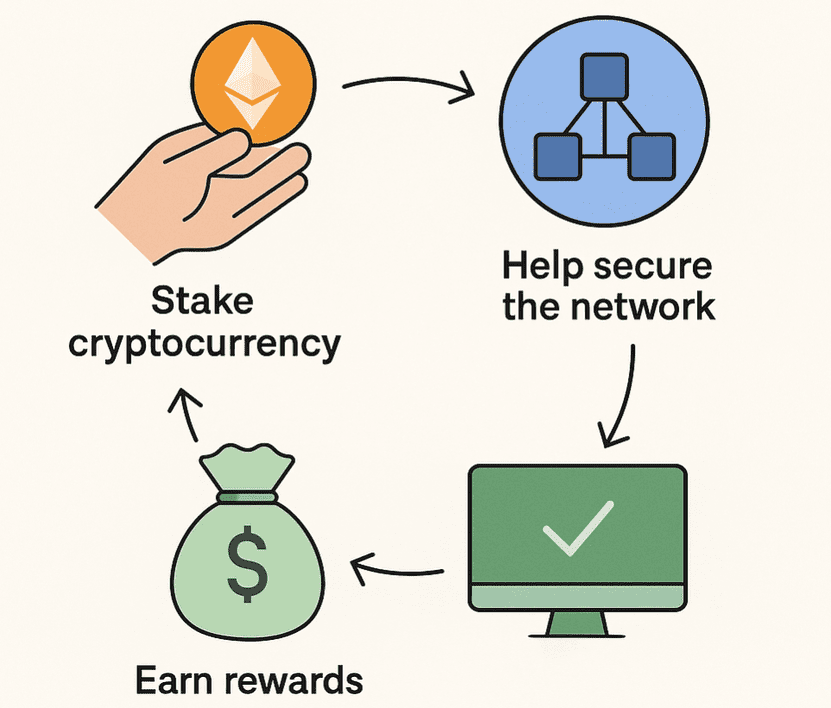
How crypto staking works
Staking is part of a proof-of-stake (PoS ) blockchain’s design. In PoS, validators secure the network and confirm transactions by locking up tokens as collateral. As a staker, you either run your own validator or delegate your tokens to one.
In return, you receive rewards paid in the same cryptocurrency. These rewards come from a mix of new token issuance (inflation) and transaction fees. The more tokens you stake, and the longer you keep them staked, the more rewards you earn.
What’s changed in staking since Ethereum’s merge
The Ethereum merge in September 2022 and the Shanghai upgrade in April 2023 changed the staking scenario. Before Shanghai, ETH stakers couldn’t withdraw their stake. Now, withdrawals are possible, removing one of the biggest risks for individuals.
Other major proof-of-stake chains have also matured:
- Cardano still offers staking with no lock-up and no slashing.
- Solana has improved uptime and stability after its early outages.
- Polkadot and Cosmos adjusted inflation and reward models to make yields more sustainable.
- Tron revamped its staking system to allow instant unstaking in many cases.
The result is that staking in 2026 is easier, more flexible, and safer than it was a few years ago.
Average staking returns in 2026
Staking yields vary depending on the cryptocurrency, platform, and whether you use native staking, a liquid staking protocol, or a centralized exchange.
Here’s a look at average annual percentage yields (APYs) for some of the top 20 proof-of-stake coins in August 2025.
Coin |
Native / liquid staking APY | Coinbase APY | Binance APY | Kraken APY |
| Ethereum (ETH) | ~4% (4.3% via Lido) | ~3–3.5% | ~5% | ~4–6% |
| Cardano (ADA) | ~4–5% | ~2% | ~4–6% | ~4–6% |
| Solana (SOL) | ~6–7% | ~5% | ~7% | ~6% |
| Binance coin (BNB) | ~2–5% | N/A | ~5–8% | N/A |
| Tron (TRX) | ~4% | N/A | ~6.1% | ~4–5% |
| Polygon (MATIC) | ~4–6% | ~2.6% | ~7.2% | ~4–5% |
| Polkadot (DOT) | ~12–15% | ~8% | ~15% | ~12–15% |
| Avalanche (AVAX) | ~7–10% | ~4.5% | ~6–7% | ~7–9% |
Note: APYs can fluctuate based on network conditions and platform fees.
Why staking rewards are different for each coin
Staking rewards depend on several factors:
- Inflation rate – Higher inflation generally means higher rewards, but also more token supply. For example, Polkadot offers 12–15% APY but inflates around 10% annually.
- Network activity – Some rewards come from transaction fees. Networks with high usage, like Ethereum, can offer sustainable yields even with low inflation.
- Participation rate – If more people stake, rewards per staker are diluted.
- Platform fees – Centralized exchanges often take a cut of staking rewards, so yields can be lower than native staking.
The pros of staking in 2026
Steady, predictable returns
For major proof-of-stake coins, staking yields in 2026 are in the 3–10% range, with some higher for coins like Polkadot and Cosmos. These are far from the unsustainable triple-digit yields of early DeFi but are steady and backed by the network’s design.
Easier access for beginners
Centralized exchanges like Coinbase, Binance, and Kraken allow one-click staking. Liquid staking platforms like Lido and Rocket Pool let you keep your stake liquid through tokens like stETH or rETH, which can be traded or used in DeFi.
Protection against inflation
If you hold a coin with a high inflation rate but don’t stake, your share of the network shrinks over time. Staking helps offset or beat inflation, preserving your ownership percentage.
The risks you need to consider
Slashing
Some networks penalize validators for downtime or misbehavior. As a delegator, you could lose part of your stake. Cardano and Tron don’t have slashing, but Ethereum, Solana, and others do. Picking reliable validators reduces this risk.
Lock-up and liquidity
Many networks require an unbonding period before you can withdraw your stake — from a couple of days (Solana) to several weeks (Polkadot, Cosmos). Liquid staking solves this but adds smart contract risk.
Custodial risk
Staking on an exchange means trusting them to hold and manage your funds. While major exchanges are generally safe, they carry counterparty and regulatory risks. If an exchange halts staking (as Kraken did in the US in 2023), you may need to move your assets.
Price volatility
APY is paid in the native token. If that token’s price drops sharply, your dollar returns can turn negative despite earning more coins.
Staking vs holding: which is better?
If you already plan to hold a proof-of-stake coin long-term, staking is usually better than leaving it idle. It increases your holdings over time and compounds returns if the price appreciates.
However, in a volatile market, the extra yield may not offset price declines. If you need liquidity or plan to trade often, staking may limit flexibility — unless you use a liquid staking option.
Tips for staking safely in 2026
- Choose reputable validators or platforms – Look for high uptime, no slash history, and transparent operations.
- Diversify your stakes – Split large holdings across multiple validators or services.
- Understand the unbonding period – Know how long it will take to withdraw your funds.
- Factor in fees and inflation – Your real return is APY minus inflation and platform fees.
- Keep records for taxes – In many countries, staking rewards are taxable as income when received.
Is staking worth it for passive income?
For most long-term investors in major proof-of-stake coins, yes — staking is worth it in 2026. It’s no longer the risky, experimental process it was a few years ago. Yields are moderate but reliable, platforms are easier to use, and liquidity options have improved.
The key is to stake assets you believe in, manage risks carefully, and understand that staking works best as a long-term strategy. Done right, it can significantly enhance your portfolio’s growth over time.
-
01.
Can you really earn passive income with staking?
Yes. Staking lets you earn additional coins over time, typically 3–10% APY for major proof-of-stake cryptocurrencies. The income is passive once your coins are staked, but it’s paid in the native token, so its value depends on the market price.
-
02.
How much Ethereum does one need to earn profitable staking rewards?
Running your own Ethereum validator requires 32 ETH. However, you can stake any amount through exchanges or liquid staking services like Lido or Rocket Pool, which pool deposits from many users. Profitability depends on ETH’s price, staking APY (around 3–4% in 2025), and fees.
-
03.
What is the best cryptocurrency for staking?



 Thank you for your feedback! We’re glad you found this article helpful.
 An error occurred while sending the form, please try again.
 We are sorry. You've already sent a message within the last 60 seconds. Please wait before sending another.
 Thank you for letting us know! Our team will review your feedback to help improve our content.
We're sorry you did not find what you were looking for. Please select the reason this article was not helpful.

 You’re in. Thanks for joining our newsletter.
