


 4 min read



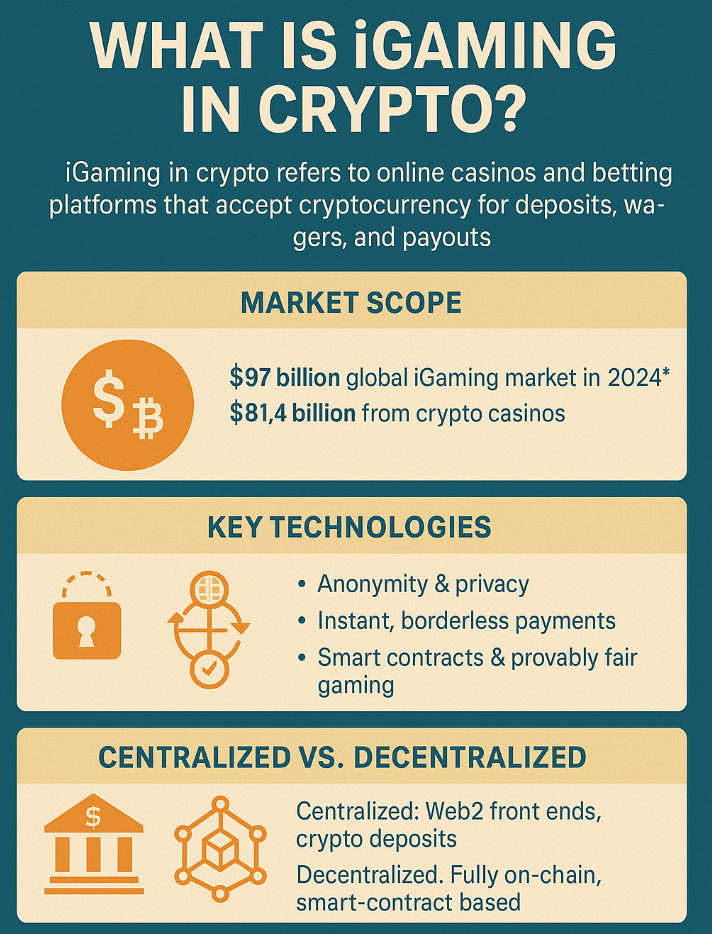
iGaming in crypto refers to online gambling platforms that integrate cryptocurrencies — such as Bitcoin (BTC), Ethereum (ETH), and stablecoins — into their payment and gaming infrastructure.
This fusion combines traditional iGaming offerings (casino games, sports betting, poker) with the unique features of blockchain technology, including decentralization , transparency, and borderless transactions.

Market scope and statistics
The global iGaming market continues its rapid expansion. According to Statista, the market reached $97billion in 2024, up 13.3% from $85.6bn in 2023. Within this broader market, crypto casinos generated an estimated $81.4bn in gross gaming revenue (GGR) in 2024, a fivefold increase since 2022.
Crypto casinos are not licensed in many major markets, including most US states, and reputable operators block players from regions they can’t serve. In 2024, leading crypto operator Stake reported $4.7bn in GGR and claimed 25 million users — on par with top traditional gambling groups.
Key technology drivers
- Anonymity and privacy: Crypto casinos often streamline or skip extensive KYC checks, appealing to users seeking pseudonymity and minimal personal-data exposure.
- Instant payments: Cryptocurrencies enable near-instant deposits and withdrawals across borders, reducing reliance on banks and cutting intermediary fees.
- Smart contracts and provably fair gaming: Decentralized applications (dApps) execute bets and payouts via on-chain code. Players can independently verify the logic of games — unlike opaque RNG systems in traditional casinos.
Centralized vs. decentralized models
- Centralized crypto casinos: Platforms like Stake, Rollbit, and Roobet operate Web2 front ends, custody user funds in proprietary wallets, and issue rapid payouts. They often hold offshore licences (e.g., Curaçao, Malta) but accept cryptocurrency deposits and withdrawals.
- Decentralized iGaming DApps: On-chain games — such as Etheroll (Ethereum) and DuckDice (multiple chains) — run entirely on smart contracts. They eliminate intermediaries but face challenges in liquidity , user-experience polish, and customer support.
Most popular cryptocurrencies for iGaming
Top online crypto casinos and sports-betting platforms increasingly support a handful of cryptocurrencies that combine liquidity, transaction speed, and user familiarity. The five leading digital assets in crypto iGaming are:
1. Bitcoin (BTC)
As the original cryptocurrency, Bitcoin remains the dominant payment rail for most crypto casinos. Roughly half of all crypto-based iGaming deposits occur in BTC, thanks to its deep liquidity and widespread exchange support. Players appreciate Bitcoin’s network security and the ability to move large sums — upwards of $100,000 per transaction — without intermediary limits.
2. Ethereum (ETH)
Ethereum ranks second in iGaming by transaction volume. Casinos favor ETH for its robust smart-contract ecosystem, which underpins provably-fair games and on-chain betting DApps. Many platforms charge lower gas fees on layer-2 networks (Arbitrum, Polygon), making ETH deposits and withdrawals both inexpensive and programmable.
3. Tether (USDT)
Tether’s USDT stablecoin sees the highest on-chain volume of any token in iGaming, accounting for an estimated 35% of all crypto casino turnover. Its 1:1 peg to the US dollar insulates players from volatility between deposit and withdrawal, and virtually all leading casinos integrate USDT on Ethereum, Tron and BNB Chain.
4. USD Coin (USDC)
USDC offers regulatory transparency (backed by audited reserves) and enjoys growing adoption among risk-averse players. Approximately 10% of stablecoin flows into crypto casinos are USDC, particularly on platforms that cater to US and European markets where compliance is a priority.
5. Litecoin (LTC) and TRON (TRX)
Litecoin and TRON often serve as secondary options for bettors seeking faster block times and minimal fees. Litecoin’s four-minute block confirmation suits swift cash-outs, while TRON’s sub-second transactions on its native network reduce on-chain settlement delays — features that appeal to high-frequency sports-bettors and micro-stake gamers.
Security risks and notable exploits
Blockchain’s immutability does not eliminate cybersecurity threats in crypto iGaming. Operators and players must guard against:
- Smart contract vulnerabilities: In November 2024, MetaWin suffered a $4m exploit of its ‘frictionless withdrawal system’, which attackers leveraged to drain hot wallets on Ethereum and Solana.
- Authentication-key breaches: On 28 February 2025, South Korea’s WEMIX gaming platform lost 8.65 million WEMIX tokens (~$6.1 million) after attackers stole monitoring-system credentials and executed multiple withdrawals over two months.
Emerging trends
- DeFi integrations: Yield-bearing staking pools let users earn interest on idle bankrolls.
- NFT utility passes: Exclusive tables or VIP bonuses unlocked by holding casino-branded NFTs.
- Metaverse and VR gaming: Casinos within virtual worlds, enabling more immersive experiences and social interaction.
- Layer-2 scaling: Adoption of rollups and sidechains to reduce fees on high-volume betting operations.
Final thoughts
Crypto iGaming has matured into a multi-billion-dollar ecosystem, driven by rapid market growth and innovative technologies. Yet it faces significant security and regulatory hurdles. Operators should embrace Zero Trust security, rigorous vulnerability management, and robust identity-data frameworks to balance seamless play with risk mitigation.
By combining blockchain’s transparency with enterprise-grade controls, the industry can sustain growth while safeguarding players and upholding regulatory standards.
-
01.
What is iGaming in crypto?
Crypto iGaming refers to online gambling platforms that use cryptocurrencies — like Bitcoin, Ethereum, or stablecoins — for betting, payouts, and deposits. It includes casino games, sports betting, poker, and other wagering activities, all powered by blockchain or crypto payment systems.
-
02.
Are crypto gambling and iGaming the same?
Not exactly. Crypto gambling is a broader term that includes all forms of betting with cryptocurrencies, including decentralized prediction markets. Crypto iGaming typically refers to structured online gaming platforms — such as casinos or sportsbooks — that accept crypto payments.
-
03.
Is crypto iGaming legal?



 Thank you for your feedback! We’re glad you found this article helpful.
 An error occurred while sending the form, please try again.
 We are sorry. You've already sent a message within the last 60 seconds. Please wait before sending another.
 Thank you for letting us know! Our team will review your feedback to help improve our content.
We're sorry you did not find what you were looking for. Please select the reason this article was not helpful.

 You’re in. Thanks for joining our newsletter.
