


If you’re looking for the best South African crypto exchange, you’re in the right place. In this guide, we’ll walk you through the leading platforms where South Africans can buy, sell, and trade digital assets securely and at fair rates. With more people in South Africa exploring Bitcoin and other cryptocurrencies as investments or payment methods, choosing the right exchange has never been more important.
As of 2026, all crypto asset service providers (CASPs) operating in South Africa are required to be registered with the Financial Sector Conduct Authority (FSCA) under the FAIS Act. Platforms that are not registered may face enforcement actions or banking restrictions.
At CryptoManiaks, we’ve done the hard work for you. Our team has researched local and international platforms, spoken to South African traders, and analyzed fees, regulations, and payment options in detail. This guide will provide a clear, trustworthy overview of the best crypto exchanges South Africa has to offer in 2026.
In this article, you’ll learn:
- Which exchanges are considered reliable for South African users
- What features matter most when choosing a platform
- How to register and get started trading in South Africa
- Key facts about taxes, regulations, and payment methods in ZAR
By the end, you’ll know exactly where to buy cryptocurrency in South Africa safely, whether you’re a beginner or a seasoned trader.
Best South African Crypto Exchanges in 2026 Listed
-
 Coins
Coins


 Deposit Methods
 Avg. Spread The difference between the buy (ask) and sell (bid) price for popular trading pairs. Lower spreads mean better pricing and less slippage for you.
 -
 Coins
Coins
 Deposit Methods

 Avg. Spread The difference between the buy (ask) and sell (bid) price for popular trading pairs. Lower spreads mean better pricing and less slippage for you.
 -
 PromotionsCoins
Deposit Methods
Avg. Spread The difference between the buy (ask) and sell (bid) price for popular trading pairs. Lower spreads mean better pricing and less slippage for you.
PromotionsCoins
Deposit Methods
Avg. Spread The difference between the buy (ask) and sell (bid) price for popular trading pairs. Lower spreads mean better pricing and less slippage for you. -
 PromotionsCoins
 Deposit Methods
 Avg. Spread The difference between the buy (ask) and sell (bid) price for popular trading pairs. Lower spreads mean better pricing and less slippage for you.
 -
 Coins
Coins


 Deposit Methods
Avg. Spread The difference between the buy (ask) and sell (bid) price for popular trading pairs. Lower spreads mean better pricing and less slippage for you.
Deposit Methods
Avg. Spread The difference between the buy (ask) and sell (bid) price for popular trading pairs. Lower spreads mean better pricing and less slippage for you. -
 Coins
Deposit Methods
Avg. Spread The difference between the buy (ask) and sell (bid) price for popular trading pairs. Lower spreads mean better pricing and less slippage for you.
Coins
Deposit Methods
Avg. Spread The difference between the buy (ask) and sell (bid) price for popular trading pairs. Lower spreads mean better pricing and less slippage for you. -
 Coins
Deposit Methods
Avg. Spread The difference between the buy (ask) and sell (bid) price for popular trading pairs. Lower spreads mean better pricing and less slippage for you.
Coins
Deposit Methods
Avg. Spread The difference between the buy (ask) and sell (bid) price for popular trading pairs. Lower spreads mean better pricing and less slippage for you. -
 PromotionsCoins
Deposit Methods
PromotionsCoins
Deposit Methods
 Avg. Spread The difference between the buy (ask) and sell (bid) price for popular trading pairs. Lower spreads mean better pricing and less slippage for you.
 -
 Coins
Coins

 Deposit Methods
Avg. Spread The difference between the buy (ask) and sell (bid) price for popular trading pairs. Lower spreads mean better pricing and less slippage for you.
Deposit Methods
Avg. Spread The difference between the buy (ask) and sell (bid) price for popular trading pairs. Lower spreads mean better pricing and less slippage for you. -
 Coins
Deposit Methods
Coins
Deposit Methods
 Avg. Spread The difference between the buy (ask) and sell (bid) price for popular trading pairs. Lower spreads mean better pricing and less slippage for you.
 -
 PromotionsCoins
Deposit Methods
Avg. Spread The difference between the buy (ask) and sell (bid) price for popular trading pairs. Lower spreads mean better pricing and less slippage for you.
PromotionsCoins
Deposit Methods
Avg. Spread The difference between the buy (ask) and sell (bid) price for popular trading pairs. Lower spreads mean better pricing and less slippage for you. -
 Coins
Deposit Methods
Avg. Spread The difference between the buy (ask) and sell (bid) price for popular trading pairs. Lower spreads mean better pricing and less slippage for you.
Coins
Deposit Methods
Avg. Spread The difference between the buy (ask) and sell (bid) price for popular trading pairs. Lower spreads mean better pricing and less slippage for you. -
 Coins
Coins
 Deposit Methods

 Avg. Spread The difference between the buy (ask) and sell (bid) price for popular trading pairs. Lower spreads mean better pricing and less slippage for you.
 -
 Coins
Deposit Methods
Avg. Spread The difference between the buy (ask) and sell (bid) price for popular trading pairs. Lower spreads mean better pricing and less slippage for you.
Coins
Deposit Methods
Avg. Spread The difference between the buy (ask) and sell (bid) price for popular trading pairs. Lower spreads mean better pricing and less slippage for you. -
 Coins
Deposit Methods
Avg. Spread The difference between the buy (ask) and sell (bid) price for popular trading pairs. Lower spreads mean better pricing and less slippage for you.
Coins
Deposit Methods
Avg. Spread The difference between the buy (ask) and sell (bid) price for popular trading pairs. Lower spreads mean better pricing and less slippage for you. -
 PromotionsCoins
 Deposit Methods
 Avg. Spread The difference between the buy (ask) and sell (bid) price for popular trading pairs. Lower spreads mean better pricing and less slippage for you.
 -
 Coins
Coins
 Deposit Methods
Avg. Spread The difference between the buy (ask) and sell (bid) price for popular trading pairs. Lower spreads mean better pricing and less slippage for you.
Deposit Methods
Avg. Spread The difference between the buy (ask) and sell (bid) price for popular trading pairs. Lower spreads mean better pricing and less slippage for you. -
 Coins
Coins

 Deposit Methods
 Avg. Spread The difference between the buy (ask) and sell (bid) price for popular trading pairs. Lower spreads mean better pricing and less slippage for you.
 -
 Coins
Deposit Methods
Avg. Spread The difference between the buy (ask) and sell (bid) price for popular trading pairs. Lower spreads mean better pricing and less slippage for you.
Coins
Deposit Methods
Avg. Spread The difference between the buy (ask) and sell (bid) price for popular trading pairs. Lower spreads mean better pricing and less slippage for you.
Best South African Crypto Exchanges Reviewed

Get $10 in Bitcoin when you register through a referral link from an existing member.


Established in 2011, Kraken is a trusted cryptocurrency exchange renowned for its longevity and diverse trading interfaces, catering to a broad user base.
- Supports hundreds of coins
- High liquidity
- Simple and user-friendly interface
- Good customer support options
- Lots of advanced trading features like margin, futures, and indices trading
- No insurance fund for assets on the platform
- Doesn’t offer a crypto credit card
- No personal wallet service for traders
- Supports only a few fiat currencies
Year Founded
- 2011
Headquarters
- United States
Licenses
- United States (IRS)
- Canada (CRA)
- United Kingdom (HMRC)
-
+7
Cryptocurrencies
- Bitcoin
- Ethereum
- Tether
-
+83
Available countries
- Afghanistan
- Albania
- Algeria
-
+240
Languages
- Chinese (Mandarin)
- English
- French
-
+10
Features
- Cryptowatch
- Forks
-
+29
Receive up to $100,000 worth of exclusive gifts for newcomers upon registration.
Bitunix was founded in Hong Kong in 2021. It was designed to bring a breadth of crypto features to beginner and intermediate traders.
It supports over 700 cryptocurrency trading pairs in more than 100 countries. It offers spot, P2P, and derivatives trading. With copy trading, new traders can copy the trades of successful users, with them earning a cut.
The exchange offers a myriad of new user bonuses and lotteries, letting new traders jumpstart their experience.
Rewards and tournaments are also available for existing users. Bitunix Splash gives rewards for investing in new tokens, while regular competitions in categories like trading volume or monthly profits carry up to USDT 675,000 in rewards.
Licenses
- United States (IRS)
- Canada (CRA)
- Phillipines
Cryptocurrencies
- Bitcoin
- Ethereum
- Tether
-
+78
Available countries
- Albania
- Algeria
- American Samoa
-
+233
Languages
- English
- Uzbek
- Polish
-
+12


Bitget is a reputable cryptocurrency exchange known for its user-friendly interface and advanced trading features. With a focus on security and customer satisfaction, Bitget offers a wide range of digital assets for trading and investment opportunities.
Year Founded
- 2018
Headquarters
- Cayman Islands
Licenses
- United States (IRS)
- Australia (ATO)
- Canada (CRA)
Cryptocurrencies
- Bitcoin
- Ethereum
- Tether
-
+93
Available countries
- Afghanistan
- Albania
- Algeria
-
+246
Languages
- English
- Japanese
- Vietnamese
-
+16
Features
- API Trading
- Vote to List
-
+13


- An advanced trading platform
- Low fees and high liquidity
- Supports lots of different payment options
- Efficient and dedicated phone and email support
- Lots of charting tools
- No live chat customer support
- Slow verification process
- International wire transfer takes 2 to 5 days to clear
- A few number of coins on offer
- Was hacked in 2015
Year Founded
- 2011
Headquarters
- Virgin Islands, British
Licenses
- Luxembourg
- United States (IRS)
- Spain
-
+1
Cryptocurrencies
- Bitcoin
- Ethereum
- Tether
-
+52
Available countries
- Afghanistan
- Albania
- Algeria
-
+244
Languages
- English
Features
- Institutions
- Pro Traders
-
+4
Enjoy US$50 worth of CRO as sign-up bonus when you sign up with a referral link.


- Extensive list of supported cryptocurrencies
- Hardware wallet support
- With its Visa cards, you can spend your crypto and earn rewards
- Easy to purchase NFTs on the platform using either fiat or certain cryptos
- Higher fees for those who don't hold and use CRO
- Poor customer service
- Lack of educational resources
- Slow in-app live support
Year Founded
- 2016
Headquarters
- Singapore
Licenses
- United Arab Emirates
- Brazil
- United Kingdom (HMRC)
-
+19
Cryptocurrencies
- Bitcoin
- Holo
- Litecoin
-
+157
Available countries
- Afghanistan
- Algeria
- American Samoa
-
+200
Languages
- Danish
- Spanish
- French
-
+13
Features
- Supercharger
- Trading Arena
-
+2
YouHodler Crypto Exchange, launched in Cyprus in 2018, stands as a versatile platform offering a plethora of crypto-fiat financial services including lending, trading, and savings accounts.
Year Founded
- 2017
Headquarters
- Cyprus
Licenses
- Italy
- Switzerland
- European Gaming and Betting Association (EGBA)
-
+2
Cryptocurrencies
- Bitcoin
- Ethereum
- Tether
-
+57
Available countries
- Belgium
- Canada
- Germany
-
+12
Languages
- English
- French
- Italian
-
+3
Features
- Conversion
- Turbocharge
-
+10
Enjoy up to 30,000 USDT Bonus when you sign up and complete tasks. Get a 10 USDT coupon when you sign up, and link your phone number and email.


Year Founded
- 2018
Headquarters
- Singapore
Licenses
- United States (IRS)
- Canada (CRA)
Cryptocurrencies
- Bitcoin
- Ethereum
- Tether
-
+96
Available countries
- Philippines
- United Kingdom
- United States
Languages
- English
- Simplified Chinese
- Chinese (Traditional)
-
+15
Features
- Futures Demo
- Copy Trading
-
+18
Get Free Bitcoin everyday upto Rs2000 INR on Sign Up, Referral, Deposit & Bitcoin Trading.
Year Founded
- 2025
Headquarters
- India
Licenses
- India
- Estonia
Cryptocurrencies
- Bitcoin
- Ethereum
- Tether
-
+77
Available countries
- China
- India
- Kenya
-
+5
Languages
- English
Features
- Free Bitcoin
- APIs
-
+9

Year Founded
- 2018
Headquarters
- Seychelles
Licenses
- Seychelles
- Estonia
- Switzerland
-
+2
Cryptocurrencies
- Shiba Inu
- Bitcoin
- PAX Gold
-
+72
Available countries
- Afghanistan
- Albania
- Algeria
-
+246
Languages
- English
- Russian
- Turkish
-
+14
Features
- Leveraged ETFs
- Copy Trading
-
+8
Get up to 1,000 USDC on your Trading Fee Balance when you register, complete identity verification, and place your first spot trade.


Founded in 2013 in London, CEX.IO one of the first crypto exchanges. The global exchange is available in over 200 countries, including the UK, US, Canada, and Australia.
CEX.IO prides itself on being a one-stop shop for all things crypto. It offers spot and margin trading across over 200 tokens, a DeFi wallet, and integrated staking features.
Beyond this, CEX.IO allows you to instantly buy crypto and spend it on the company’s crypto credit card.
Globally licensed and regulated across the EU and US, the platform uses a mix of state-of-the-art security protocols and cold storage to ensure investors’ funds stay safe. This has resulted in a hack-free record over CEX.IO’s 12 years in operation.
Year Founded
- 2013
Headquarters
- United Kingdom
Licenses
- United States (IRS)
- Lithuania
- Spain
Cryptocurrencies
- Bitcoin
- Ethereum
- Tether
-
+81
Available countries
- Australia
- France
- India
-
+5
Languages
- English
- Spanish
Features
- Exchange Plus
- API
-
+9

Disclaimer
The information provided on this website is for informational purposes only and should not be considered as financial, investment, or legal advice. Cryptocurrency investments are volatile and high-risk in nature. Consult with a qualified financial advisor and/or tax professional before making any investment decisions. We are not responsible for any loss incurred due to the use of information on this website. Do your own research and exercise caution. Don’t invest unless you’re prepared to lose all the money you invest.
Why Trust Us?

We test trading platforms, compare features, and listen to South African traders every step of the way.
Experience: Our team has years of hands-on experience using crypto exchanges across Africa, Europe, and the US. We know what really matters when it comes to fees, regulations, and ease of use.
Community: We actively engage with South African crypto communities, from Telegram groups to trading forums, to understand local pain points and preferences. This means our recommendations reflect what South African traders actually need, not just what looks good on paper.
Here’s How to Choose a Crypto Exchange in South Africa
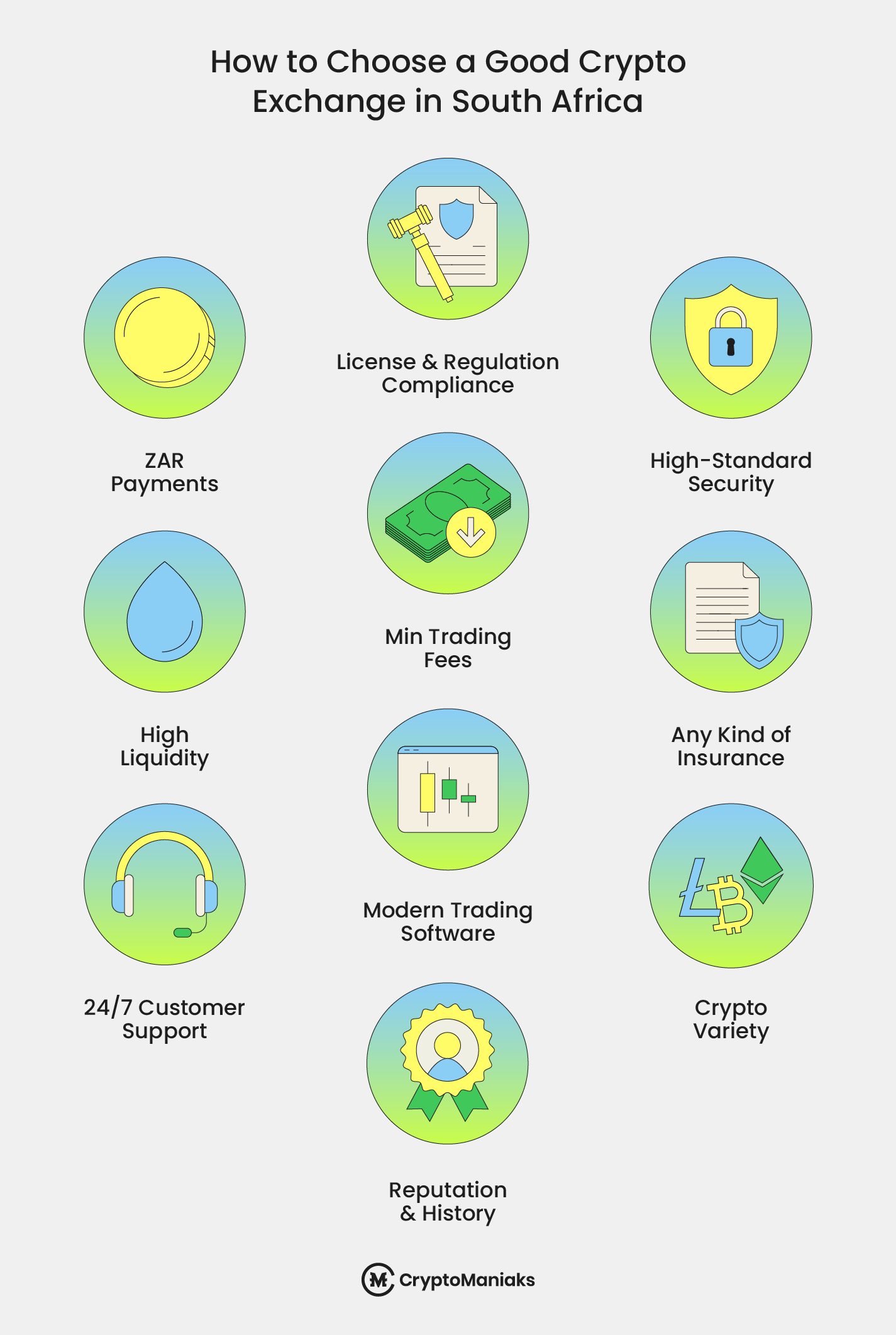
Picking the right South African crypto trading platform can feel overwhelming, but focusing on the essentials makes it easier. Below are the key features every trader should evaluate before signing up.
- License & Regulation Compliance: Make sure the platform is registered with South African authorities (such as the FSCA) or holds a reputable international license. This protects you from scams and ensures the exchange operates legally. Many exchanges now comply with the global Travel Rule, which may require sharing sender and recipient information for certain crypto transfers. This can occasionally slow withdrawals but improves regulatory compliance.
- ZAR Payments: Check if the exchange allows easy deposits and withdrawals in South African Rand (ZAR) through bank transfers, EFT (Electronic Funds Transfer), or local payment providers.
- High-Standard Security: Look for features like cold storage, multi-signature wallets, and regular security audits to keep your funds safe.
- Minimal Trading Fees: Small differences in trading fees add up over time. South African traders should compare both maker/taker fees and withdrawal charges.
- High Liquidity: Exchanges with strong liquidity let you buy and sell quickly without large price slippage, which is especially important for active traders.
- Modern Trading Software: A fast, intuitive platform (web and mobile app) makes trading more efficient and beginner-friendly.
- 24/7 Customer Support: Reliable support in English (and ideally accessible via live chat) can save you time and frustration.
- Large Choice of Crypto Assets: Whether you want just Bitcoin or a wide selection of altcoins, the best exchanges offer variety.
- Any Kind of Insurance: Some platforms provide insurance against hacks or operational failures, giving you extra peace of mind.
- Reputation and History: Always check how long the exchange has been operating and what its track record is with users in South Africa.
Tips Before Registering on a South African Exchange
Before you sign up with a South African crypto exchange, it’s important to understand how local rules, payment systems, and banks will affect your experience. Here are the key things to consider:
KYC Requirements and Privacy
Almost every regulated exchange in South Africa requires KYC (Know Your Customer) verification. This means you’ll need to upload a valid South African ID or passport, plus proof of address such as a recent Eskom utility bill or a bank statement from Standard Bank, FNB, Nedbank, ABSA, or other reputed banks. Exchanges that skip KYC may seem convenient but carry higher risks, and withdrawals can be frozen if your identity isn’t verified.
South African Rand (ZAR) Deposits and Withdrawals
Bank Transfers and ACH Support: The easiest way to fund your account is through EFT or instant deposits supported by local banks. Some exchanges also allow card payments via Visa/Mastercard, but these often carry higher fees. Always check whether the platform supports withdrawals directly to your South African bank account, and whether it uses the SARB’s (South African Reserve Bank) approved channels.
In 2026, South African banks generally favor FSCA-registered local exchanges. Using offshore platforms may occasionally result in delayed deposits or additional compliance checks. South African Banks are stricter with offshore exchanges and some international platforms experience:
- Delayed EFT reversals
- Payment reference rejections
- Periodic account reviews
Withdrawal Times and Limits: In South Africa, EFT withdrawals are typically processed within 1–2 business days, though some exchanges offer near-instant transfers to major banks like Capitec and FNB. Be aware that your KYC status can affect limits. Basic verified accounts may have low withdrawal ceilings, while fully verified accounts enjoy higher transaction limits.
By checking these details before registering, you will be able to avoid platforms that don’t align with your banking needs in South Africa.
How To Register on a South African Crypto Exchange
Getting started with the best South African crypto exchange is straightforward, but there are a few local details worth keeping in mind. Here’s a step-by-step guide:
Step 1: Create an Account
Visit the exchange’s official website, or download its app from the Google Play Store or Apple App Store. Use your real details, as they must match your ID.
- Enter your email address and create a username.
- Choose a strong password (at least 12 characters with numbers and symbols).
- Confirm you’re registering from South Africa if prompted.
Step 2: Verify Your Account
- After signing up, confirm your account via the verification email.
- Some exchanges with local banking integration (like VALR or Luno) will also ask you to confirm your South African mobile number using an SMS code.
Step 3: Activate Your Account (KYC)
South African exchanges comply with FSCA and FIC (Financial Intelligence Centre) regulations, so you’ll need to complete KYC:
- Upload a photo of your green ID book, smart ID card, or South African passport.
- Provide a recent proof of residence (for example, an Eskom bill or a bank statement from FNB, ABSA, Standard Bank, Nedbank, or Capitec).
- Wait for verification. Local exchanges usually process this in a few minutes, but international platforms may take up to 1 business day.
Step 4: Increase Your Security
Once your account is active, protect it:
- Enable 2FA (Two-Factor Authentication) through an app like Google Authenticator.
- If using a mobile device, activate biometric login (fingerprint or FaceID) for faster, secure access.
- Avoid relying solely on SMS codes, since SIM-swap fraud has been a growing problem in South Africa.
- In 2026, phishing scams and fake payment portals remain one of the biggest risks for South African crypto users. Always verify URLs and avoid clicking exchange links shared on WhatsApp or Telegram.
Step 5: Fund Your Account
You can now deposit funds and start trading:
- For ZAR deposits, use EFT/instant bank transfers from Standard Bank, FNB, Nedbank, ABSA, or Capitec.
- Some platforms also accept Ozow or PayFast, which are popular local payment gateways.
- If you prefer, deposit crypto directly from an external wallet. Here’s a guide on how to send crypto from wallet to wallet.
Once your account is funded, you’re ready to buy Bitcoin or trade a wide range of cryptocurrencies safely in South Africa. Here’s a guide on how to buy crypto with a credit card.
Crypto Taxes in South Africa: Are They High?
Navigating crypto taxes in South Africa can be confusing, but SARS (South African Revenue Service) has made it clear: yes, cryptocurrency is taxable. How much you pay depends on the type of activity you’re engaged in, not whether you earn a profit.
- Crypto-to-crypto trades are taxable
- Stablecoin conversions are taxable events
Trading Method 1 – No Tax
- Hodling crypto (buying and holding) is not taxable until you sell or exchange it.
- Transferring crypto between your own wallets is also not considered a taxable event.
Trading Method 2: Capital Gains Tax (CGT – up to ~18%)
If your crypto activity is considered an investment, SARS applies Capital Gains Tax:
- Each individual has a R40,000 annual exclusion on total capital gains.
- Only 40% of your remaining gain is taxable.
- That taxable portion is then taxed at your marginal income tax rate, with an effective maximum of about 18%.
- For companies, 80% of the gain is included, taxed at the corporate rate (generally 27%, effectively around 21.6%).
Trading Method 3: Income Tax (up to 45%)
If SARS sees your crypto activity as revenue-generating, such as frequent trading, mining, staking rewards, or earning crypto as payment, you’ll be taxed under Income Tax. For individuals, this can mean rates of up to 45%, while companies are taxed at the standard corporate rate.
SARS Tracks Crypto Closely
- SARS classifies crypto as intangible assets, not currency.
- All disposals, trades, or income events must be reported.
- Failure to declare can lead to heavy penalties, including fines, interest, and even criminal prosecution.
- As of 2026, SARS increasingly uses data-sharing agreements with local and international exchanges, meaning undeclared crypto activity is easier to detect than in previous years.
Step-by-Step: File Your Crypto Taxes in SA
Step 1: Categorize each crypto event as either capital (investment) or revenue (income).
Step 2: Calculate gains and losses in ZAR at the time of each transaction.
Step 3: Apply the R40,000 annual exclusion for capital gains, then calculate the taxable portion.
Step 4: Add this to your income and apply the correct tax rate.
Step 5: For income-based crypto (staking, mining, airdrops, payments), report the full amount as gross income.
Step 6: Deduct eligible costs such as exchange fees or advisory services.
Step 7: File everything on your ITR12 return, either annually or provisionally if required.
 DON’T GET REKT
Curated drops, testnets and red flag alerts straight to your inbox ✌️
 You’re in. Thanks for joining our newsletter.

Final Tips
Choosing the best crypto exchange South Africa has to offer comes down to balancing security, low fees, and reliable ZAR payment options. Always double-check whether the platform is properly licensed, keep your account secure with 2FA, and track your trades for tax purposes.
If you are a beginner user, start small until you’re comfortable with the platform’s features and withdrawal process. Experienced traders should prioritize exchanges with high liquidity, and advanced tools.
Above all, remember that crypto markets are volatile. Never invest more than you can afford to lose.
Frequently Asked Questions
-
01.
Is crypto trading legal in South Africa?
Yes. Crypto trading is legal in South Africa, but cryptocurrencies are classified as financial products under the FSCA. This means exchanges must be registered, and traders must comply with KYC/AML rules. Crypto is not considered legal tender, but you are free to buy, sell, and hold it.
-
02.
Does Bitstamp work in South Africa?
Yes, South Africans can use Bitstamp. However, since it’s an international exchange, deposits and withdrawals in ZAR are not always supported. You’ll likely need to use a bank that allows international transfers or fund your account with crypto.
-
03.
Is Bybit available in South Africa?
Yes. Bybit is accessible in South Africa and supports ZAR deposits.
-
04.
Where can South Africans buy Bitcoin online?
You can buy Bitcoin online through local South African exchanges which support ZAR deposits. Alternatively, you can use global exchanges such as Binance or Kraken, though you may need to fund your account with crypto or via international bank transfers.