


 5 min read
How to Build the Best $1,000 Crypto Portfolio with Bitcoin and 3 Altcoins



 AI Overview
What’s This?
An artificial intelligence tool created this summary, which was based on the text of the article and checked by an editor. Read more about how we use artificial intelligence in our journalism.A practical barbell crypto plan pairs a Bitcoin core with ETH, BNB and SOL satellites to capture amplified upside while protecting principal. It prescribes DCA entries, mechanical profit-skimming into BTC, and concrete loss/rebalance rules for disciplined growth.
- Structure & allocations: 70/30 barbell with BTC 50% (core), ETH 20%, BNB 15%, SOL 15%; five-week DCA entry to spread timing risk.
- Profit-skimming: Sell 20% of an alt at +50% and another 20% at +100%, plus a 30% high-watermark ratchet, routing gains into BTC to lock profits.
- Risk controls: Trim 25% of an alt if down 30% with BTC weak, pause alt buys if BTC −15% from 30‑day high, avoid leverage and favor self-custody.
As Bitcoin hits another all-time high above $125,000, new investors often face a dilemma: how do you capture upside without exposing yourself to full-blown volatility?
A barbell crypto portfolio offers a practical answer. It balances stability and growth by combining a conservative core (such as Bitcoin) with a few higher-risk, higher-reward altcoins. The goal isn’t to chase every pump — it’s to grow your holdings steadily, lock in profits, and let Bitcoin anchor your long-term value.
With $1,000, even a beginner investor can build a disciplined barbell portfolio that benefits from crypto’s cycles while protecting the initial capital.
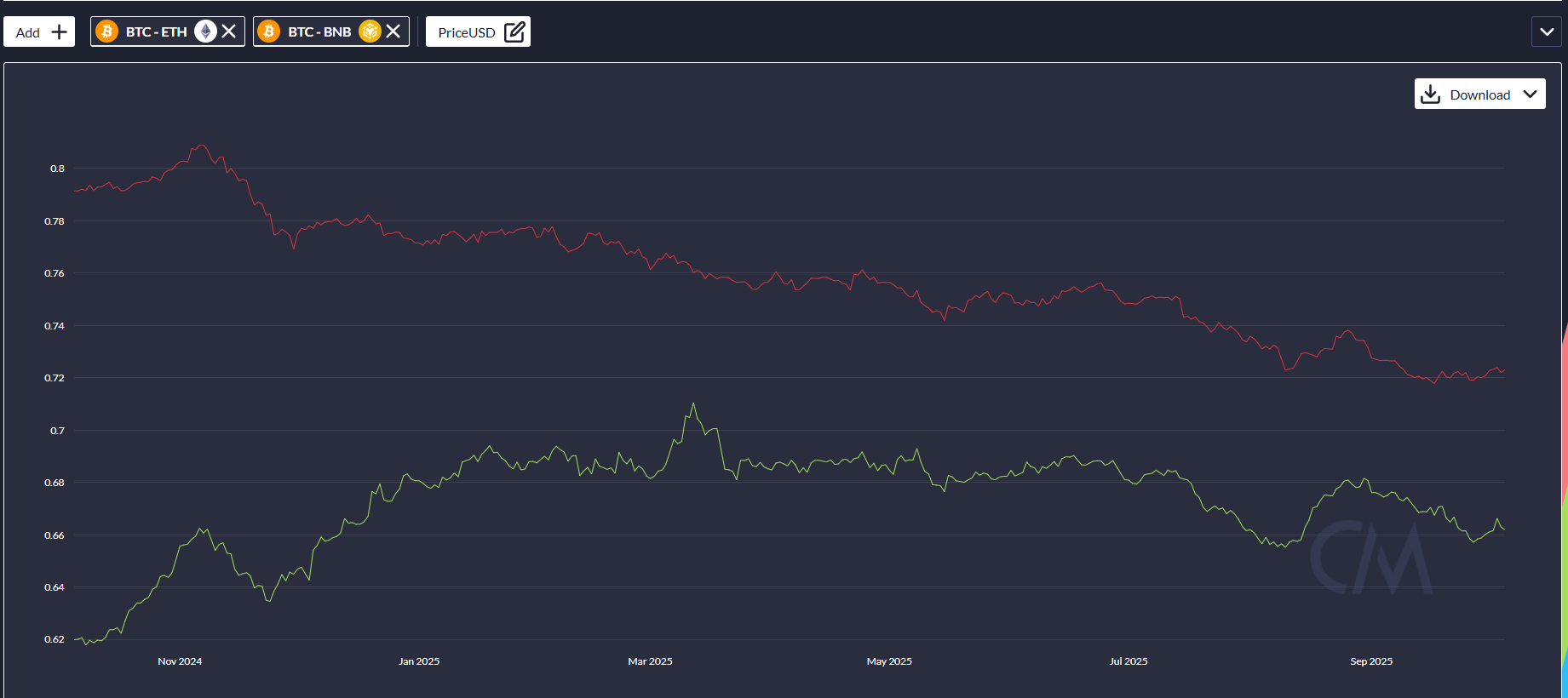
The key is picking altcoins that move in sync with Bitcoin — not random tokens that decouple or collapse when sentiment turns. In this case, the best altcoins to pick are Ethereum, BNB, and Solana.
Here’s Why These Altcoins Fit a Bitcoin Barbell Strategy
To make a barbell strategy work, the selected altcoins must correlate strongly with Bitcoin while offering higher beta exposure — meaning they amplify Bitcoin’s trend during bull runs and correct harder during pullbacks.
Over time, this creates opportunities to harvest profits from altcoin rallies and rotate gains back into Bitcoin.
In 2025, Ethereum (ETH), Binance Coin (BNB), and Solana (SOL) have constantly maintained a correlation of above 0.70 with BTC.
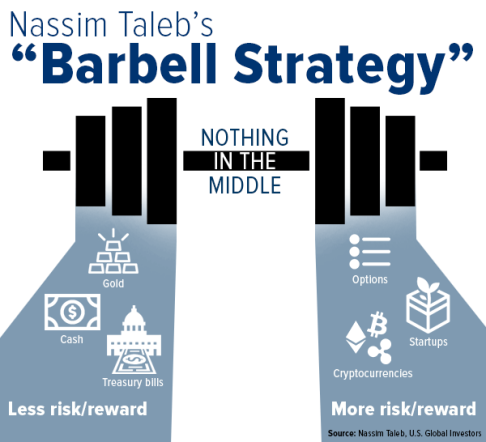
Barbell crypto portfolio explained
A barbell portfolio is an investment strategy that combines two opposite ends of the risk spectrum — very safe, low-risk assets and very risky, high-reward assets — while avoiding the middle ground of moderate-risk investments.
- One side of the “barbell” holds conservative assets, such as government bonds, cash, or short-term Treasuries. These provide stability and liquidity.
- The other side holds high-risk, high-return assets, such as growth stocks, venture investments, or crypto. These aim to generate strong returns that can significantly boost the portfolio’s performance.
- The “middle” — moderate-risk assets like corporate bonds or balanced mutual funds — is largely avoided, as it offers neither strong safety nor exceptional upside.
The approach was popularized by Nassim Nicholas Taleb, author of The Black Swan. The core idea is risk asymmetry: protect most of your capital from losses, but allow a small portion to take big, optional bets. A seemingly small capital deployed through the barbell strategy can potentially yield better gains.
 DON’T GET REKT
Curated drops, testnets and red flag alerts straight to your inbox ✌️
 You’re in. Thanks for joining our newsletter.

How to build a $1,000 barbell crypto portfolio?
1) Portfolio design
- Barbell split: 70% core / 30% satellite.
- Allocations:
- BTC: 50% → $500
- ETH: 20% → $200
- BNB: 15% → $150
- SOL: 15% → $150
Why this works: BTC anchors risk; ETH provides liquid alt exposure; BNB and SOL act as higher-beta growth legs. When alts run, you skim and feed BTC.
How to enter (DCA so you don’t mistime)
- Five weekly buys (or ten twice-weekly buys) to spread entries.
- Weekly plan (5 weeks; total $1,000):
- BTC: $100/week
- ETH: $40/week
- BNB: $30/week
- SOL: $30/week
If the price spikes by more than 8% in a day, skip that day and buy on the next scheduled day. This avoids chasing.
3) Profit-retention rules (the “keep what you win” part)
Set these automation-friendly rules and don’t improvise mid-cycle:
- Per-coin skim rule (alts)
- When any alt (ETH/BNB/SOL) rises by +50% from your average cost, sell 20% of that position and move proceeds to BTC.
- If it later reaches +100% from cost, skim another 20% to BTC.
- Do not make fresh buys of that alt the same week you skim.
- Portfolio high-watermark ratchet
- When your total portfolio hits a new all-time value, immediately move 30% of the new unrealized gain to BTC.
- Example: portfolio jumps from $1,100 to $1,180 (gain +$80). Move $24 (30% of $80) into BTC.
- Rebalance band (maintains the barbell)
- Target satellite = 30%.
- If satellite > 36%, trim alts proportionally back to 30% and send the excess to BTC.
- If satellite < 24%, top up alts with new contributions only; don’t sell BTC to add risk.
4) Loss control (keep drawdowns survivable)
- Alt pain rule: If any alt is down 30% vs your average cost and BTC is flat/down week-over-week, cut 25% of that alt and move to BTC. Review narrative risk before re-adding.
- No leverage. Ever.
- Fees: Use limit orders where possible; avoid over-trading.
5) Ongoing contributions (optional but powerful)
- Add a small $50–$100/month DCA. Split 70/30 across BTC/your lagging alt. This smooths entries and helps mean-reversion.
6) Simple weekly routine (10 minutes)
- Check allocations: Is satellite above 36%? Trim to BTC.
- Check per-coin gains: Any +50% or +100% from cost? Skim as per rule.
- Track averages: Update your average costs after every buy/sell.
- Security: Verify 2FA and withdrawal whitelists.
7) Example to make it concrete
- You buy SOL total $150 over five weeks; your avg cost = $X.
- SOL rallies +60% from $X → value ≈ $240.
- Skim 20% of position value → $48 to BTC.
- New SOL position ≈ $192; you have banked gains to the core.
8) When to pause risk?
- If BTC falls >15% from its 30-day high, pause all new alt buys. Continue BTC DCA only.
- Resume alt DCA after two green weeks for BTC on a weekly close basis.
9) Reassessment cadence
- Quarterly: Review if the three alts still justify satellite slots on liquidity, listing depth, and network health. Replace weakest with a stronger large-cap only if needed. Keep the same rules.
10) Custody and hygiene
- Prefer self-custody for medium-term holds; keep an exchange float only for scheduled DCA and rebalancing.
- Record every trade, fee, and transfer for taxes and PnL tracking.
Quick reference table (your $1,000 starter plan)
| Bucket | Asset | Portion % | $ Amount | Buy plan |
| Core | BTC | 50% | $500 | $100/week × 5 |
| Core | ETH | 20% | $200 | $40/week × 5 |
| Satellite | BNB | 15% | $150 | $30/week × 5 |
| Satellite | SOL | 15% | $150 | $30/week × 5 |
Profit rules: +50% from cost → skim 20% to BTC; +100% → skim another 20%.
Bands: Satellite >36% → trim to 30% (to BTC).
Drawdown: Any alt –30% vs cost with weak BTC → cut 25% to BTC.
Pause: BTC –15% from 30-day high → halt new alt buys.
Here’s why this works
- You enter gradually to reduce timing risk.
- You harvest wins mechanically into BTC, so profits don’t vanish in the next pullback.
- You cap downside on alts and keep your core growing.
- You avoid guesswork with clear triggers you can execute consistently.
Final thoughts
When Bitcoin climbs, these correlated altcoins usually follow with amplified returns. The barbell strategy uses that relationship to your advantage: you skim profits from altcoins once they outperform and reinvest in Bitcoin, steadily converting short-term gains into long-term strength.
While the correlation between Bitcoin and altcoins can vary, especially as BTC enters traditional financial markets, the barbell strategy still remains a viable method for managing risk and capitalizing on market opportunities through a balanced portfolio.
This dynamic balance — Bitcoin’s stability on one end and correlated growth assets on the other — keeps your portfolio adaptable across market phases while protecting your core capital.
Disclaimer: The information provided in this article is for educational and informational purposes only and does not constitute financial, investment, or trading advice. Cryptocurrency investments are highly volatile and carry significant risk, including potential loss of capital. Past performance and historical correlations do not guarantee future results. Readers should conduct their own due diligence and consult a licensed financial advisor before making investment decisions.



 Thank you for your feedback! We’re glad you found this article helpful.
 An error occurred while sending the form, please try again.
 We are sorry. You've already sent a message within the last 60 seconds. Please wait before sending another.
 Thank you for letting us know! Our team will review your feedback to help improve our content.
We're sorry you did not find what you were looking for. Please select the reason this article was not helpful.