


 6 min read
5 Ways to Earn Passive Income Using Tokenized Gold Coins




 AI Overview
What’s This?
An artificial intelligence tool created this summary, which was based on the text of the article and checked by an editor. Read more about how we use artificial intelligence in our journalism.Tokenized gold converts allocated physical bullion into blockchain tokens that track the gold price and can be held, transferred, or deployed in crypto finance to earn modest passive income without handling physical bullion.
- Programmable utility: Tokens enable lending, collateralization, and liquidity provision, letting investors earn yields while keeping gold exposure.
- Risk–return tradeoffs: Yields are modest; choose CeFi (counterparty risk), DeFi (smart‑contract risk), or collateral/liquidity strategies (liquidation/impermanent loss) accordingly.
- Issuer concentration matters: PAXG and XAU₮ dominate liquidity and integrations; custody, audits, and redemption terms determine real-world reliability.
Tokenized gold coins turn physical gold into blockchain-based digital tokens that you can hold, transfer, and deploy in crypto-based financial systems. Each token represents a fixed amount of real gold stored in professional vaults, usually one troy ounce or one gram. The token price closely tracks the global gold price, giving investors gold exposure without handling bullion.

What makes tokenized gold different from traditional gold investments is utility. Physical gold generally sits idle in a vault. Tokenized gold can be lent, used as collateral, or integrated into DeFi protocols to generate passive income.
The yields are usually modest, but for investors looking to combine capital preservation with incremental income, tokenized gold has become an increasingly relevant option in 2026.
This article explains what tokenized gold is, why investors choose it over physical gold, the major active issuers today, and the most realistic ways to earn passive income using tokenized gold coins.
What is Tokenized Gold?
Tokenized gold is a blockchain-based representation of ownership in physical gold. Each token is backed 1:1 by allocated gold bars held in secure vaults by a custodian. “Allocated” means the gold is specifically reserved for token holders rather than pooled without clear ownership.
Most leading gold tokens are issued on public blockchains, commonly Ethereum, using standard token formats. This allows them to be stored in self-custody wallets, transferred globally, traded on exchanges, or used in smart contracts.
Tokenized gold does not change the underlying asset. It changes how gold can be owned and used.
Why Investors Choose Tokenized Gold Over Physical Gold
Tokenized gold is not a replacement for physical bullion in every portfolio. It introduces different tradeoffs that appeal to a specific type of investor.
Practical Advantages
- Fractional Access: You can buy small amounts (even fractions of an ounce) without dealing with coins, premiums, or shipping.
- 24/7 Transferability: Tokens move like crypto, not like bullion. That helps with rebalancing and global transfers.
- Programmable Utility: You can lend tokenized gold, post it as collateral, or LP it on DEXs. Physical gold typically can’t do that without intermediaries.
- No Personal Storage Logistics: Vaulting and insurance are handled by the issuer/custodian.
What You Give Up
- Counterparty Layers: You rely on the issuer, custodian, and redemption process.
- Smart Contract Exposure: If you use DeFi, you add protocol risk.
- Regulatory and Platform Access: Some services may geofence certain regions.
If your goal is “to own gold, avoid everything else,” physical bullion may still be a better fit. If your goal is “to own gold, and sometimes put it to work,” then tokenized gold becomes interesting.
 DON’T GET REKT
Curated drops, testnets and red flag alerts straight to your inbox ✌️
 You’re in. Thanks for joining our newsletter.

Biggest Tokenized Gold Coins in 2026
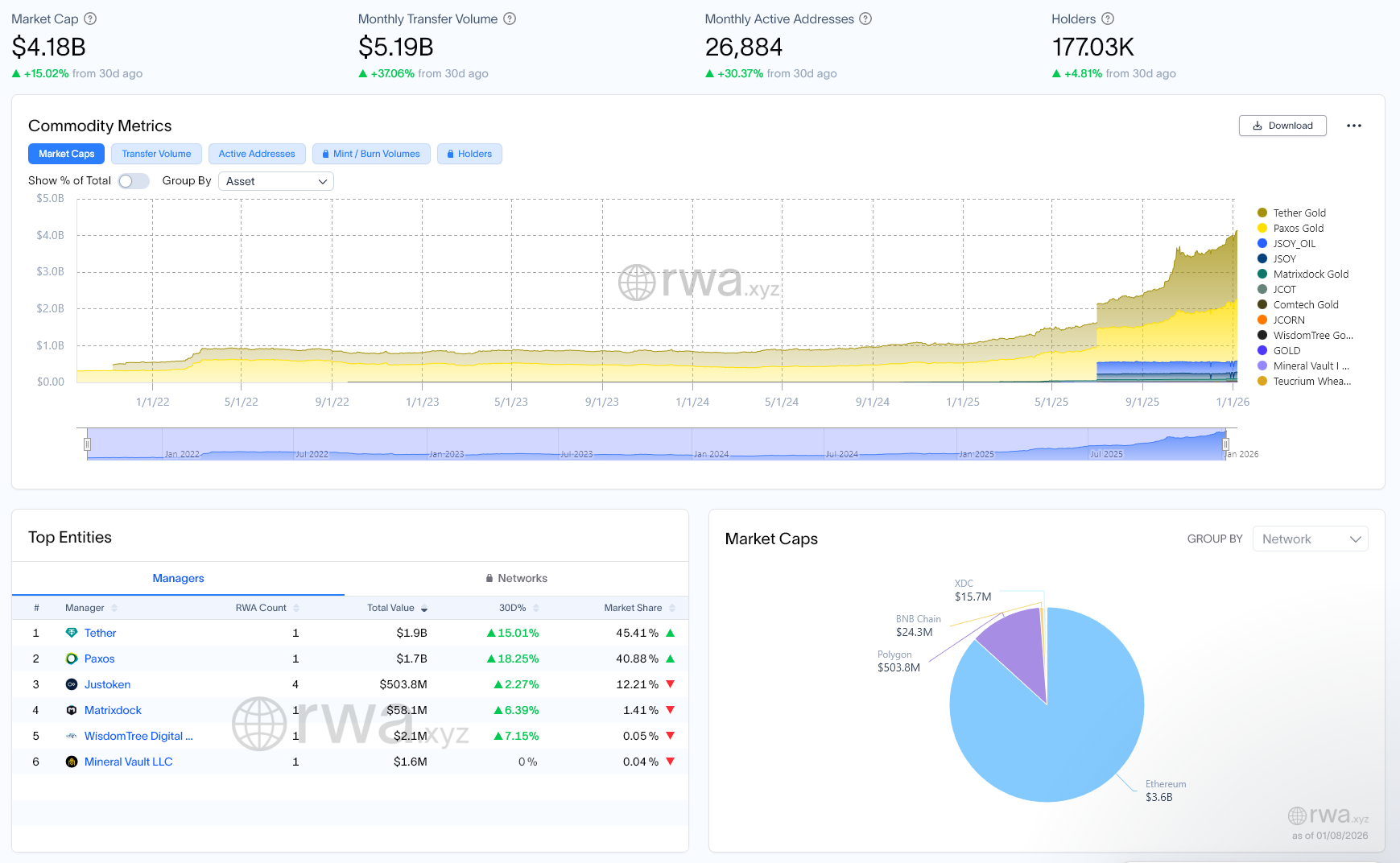
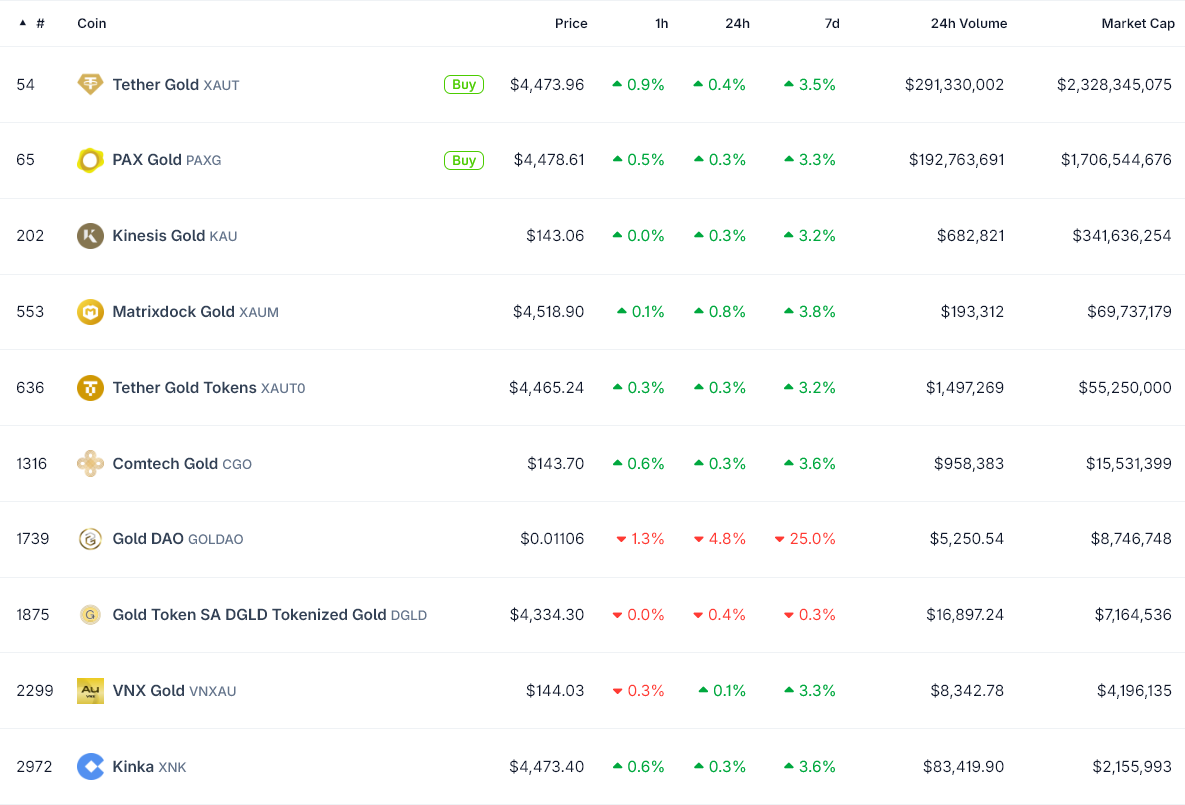
By 2026, the tokenized gold market has consolidated. A small number of issuers account for nearly all liquidity, integrations, and real-world usage.
Several early experiments have shut down or become illiquid, reinforcing the importance of issuer durability.
PAXG (Paxos Gold)
PAXG represents one fine troy ounce of physical gold stored in professional vaults. The issuer, Paxos, operates as a regulated trust company and emphasizes transparency and auditability. PAXG is widely listed on major centralized exchanges and integrated into DeFi lending protocols, making it the most commonly used gold token in crypto markets.
XAU₮ (Tether Gold)
XAU₮ represents one troy ounce of gold stored in Swiss vaults. Issued by entities associated with Tether, it has expanded across multiple blockchains to improve accessibility and portability. XAU₮ is widely used in crypto-native environments and maintains strong exchange liquidity alongside PAXG.
Other Active but Smaller Models
- KAU (Kinesis): Gold tokens denominated in grams, operating within a closed ecosystem that distributes platform fees to participants.
- CGO (ComTech Gold): A UAE-based, Shariah-compliant tokenized gold product with a regional focus.
- AWG (AurusGOLD): A 1-gram gold token distributed through bullion dealers, paired with an ecosystem-level fee-sharing structure.
These smaller models introduce alternative approaches but have significantly lower liquidity and fewer integrations than PAXG and XAU₮.
Comparing the Best Tokenized Gold Coins
|
Token + issuer |
Unit per token | Physical redemption? | Where it’s used most | Best for | Main drawback |
|
PAXG (Paxos) |
1 troy oz | Yes | Ethereum and major centralized exchanges | High-liquidity, compliance-oriented tokenized gold | Reliance on issuer and DeFi smart contract risk |
|
XAU₮ (Tether Gold) |
1 troy oz | Yes | Multi-chain crypto ecosystems and global exchanges | Portable, crypto-native gold exposure | Less formal regulatory oversight |
|
KAU (Kinesis) |
1 gram | Yes | Kinesis platform ecosystem | Gold with built-in fee distribution | Lower external liquidity |
|
CGO (ComTech Gold) |
1 gram | Yes | UAE and GCC region, XDC ecosystem | Shariah-compliant tokenized gold | Limited global adoption |
|
AWG (AurusGOLD) |
1 gram | Yes | Dealer networks and niche crypto venues | Small-denomination gold via bullion partners | Thin liquidity and ecosystem risk |
How to Earn Passive Income with Tokenized Gold Coins
Gold itself does not produce income. Tokenized gold can generate yield only when it is deployed into financial systems that pay for liquidity, collateral, or borrowing.
1. Earning Yield on Centralized Platforms
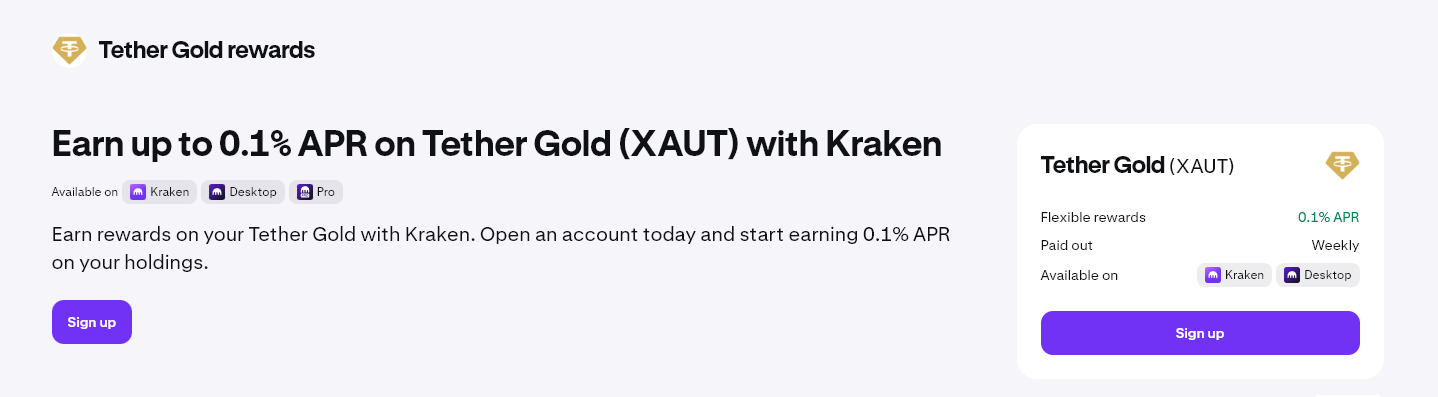
Some centralized platforms offer interest on tokenized gold deposits. The platform lends the gold to traders or institutions and shares a portion of the interest with depositors.
This approach is simple. Investors deposit tokens and earn yield without interacting with smart contracts directly. The tradeoff is counterparty risk. If the platform fails, assets may become inaccessible.
This method suits investors who value ease of use and accept custodial exposure in exchange for predictable income.
2. Lending Tokenized Gold in DeFi
Decentralized lending protocols allow users to supply tokenized gold and earn interest from borrowers. Major protocols have supported PAXG as a lendable or collateral asset.
Yields are usually low because demand to borrow gold is limited compared with stablecoins. However, the structure is transparent and non-custodial.
This approach suits investors who prefer self-custody and are comfortable with smart contract risk in exchange for modest returns.
3. Using Tokenized Gold as Collateral
Tokenized gold can be deposited as collateral to borrow stablecoins. Borrowed funds can then be used elsewhere to generate yield or provide liquidity.
This creates layered exposure and can increase returns, but it introduces liquidation risk if gold prices fall or borrowing costs rise. Conservative collateral ratios are essential.
This strategy is best suited to experienced users rather than beginners.
4. Providing Liquidity on Decentralized Exchanges
Gold tokens can be paired with stablecoins or other assets in automated market maker pools. Liquidity providers earn trading fees generated by swaps.
The main risk is impermanent loss. If gold moves sharply relative to the paired asset, fee income may not compensate for the imbalance.
This method works best when gold price volatility is relatively stable and the paired asset is not highly volatile.
5. Revenue-Sharing Gold Ecosystems
Some platforms embed yield at the ecosystem level rather than through DeFi lending. Kinesis, for example, distributes a portion of transaction fees to participants.
In this case, income depends on platform activity rather than gold market dynamics. Liquidity is usually lower, and returns are tied to adoption.
This approach suits investors willing to take ecosystem risk in exchange for a yield model not dependent on DeFi borrowing demand.
How to Pick the Right Strategy
A simple way to frame tokenized gold passive income is by “risk layers”:
- Low complexity: CeFi interest accounts (highest counterparty dependence).
- More transparent, more technical: DeFi lending (smart contract risk, usually lower yields).
- Most advanced: Collateralized borrowing and liquidity provision (adds liquidation/impermanent loss risk).
- Ecosystem bet: Revenue-sharing gold platforms (adds adoption and liquidity risk).
If your goal is credibility-driven passive income content, emphasize that tokenized gold yields rarely compete with high-risk farming.
The value lies in the fact that tokenized gold can generate a yield while still behaving like a gold exposure, which can be important in defensive portfolio construction.
Final Thoughts
Tokenized gold brings a historically static asset onto programmable financial rails. It allows gold to be transferred instantly, used as collateral, and deployed for income generation.
The realistic opportunity is not high yield. It is flexibility. Tokenized gold lets investors hold gold while selectively earning passive income through lending, liquidity provision, or structured use.
In 2026, that combination has made tokenized gold a credible component of crypto-focused passive income strategies, especially for investors prioritizing capital preservation over aggressive returns.



 Thank you for your feedback! We’re glad you found this article helpful.
 An error occurred while sending the form, please try again.
 We are sorry. You've already sent a message within the last 60 seconds. Please wait before sending another.
 Thank you for letting us know! Our team will review your feedback to help improve our content.
We're sorry you did not find what you were looking for. Please select the reason this article was not helpful.