


 4 min read
5 Blockchains To Earn Passive Crypto Income With $1,000 Investment



 AI Overview
What’s This?
An artificial intelligence tool created this summary, which was based on the text of the article and checked by an editor. Read more about how we use artificial intelligence in our journalism.Retail holders can earn passive crypto income by running validators on five low-cost PoS networks; each offers different APYs, hardware needs and technical complexity, letting users choose between direct validation or delegation.
- Low capital entry: Gnosis, Juno, Mina, Harmony and Casper allow validators to start with roughly $50–$1,000, offering APYs from ~7% to 30%.
- Know the trade-offs: Higher APY often requires more setup, server specs or command-line management; uptime, slashing and security affect net returns.
- Flexible strategies: Run a node to maximize yield or delegate to an established validator to earn passive rewards without operational overhead.
For those looking to earn passive income in crypto, becoming a validator can be a practical and sustainable option.
While some networks, such as Ethereum, have a high entry barrier to participation, several blockchain projects allow you to validate and earn rewards with as little as $1,000.
This guide looks at five legitimate blockchain networks where you can start validating without breaking the bank.

What is a validator?
A validator is a network participant who helps secure a blockchain by verifying transactions and creating new blocks. In return, validators earn staking rewards—usually paid in the network’s native token.
The amount of required capital, setup effort, and potential reward varies between networks.
Comparing low-cost validator networks
| Network | Min. Stake Required | Annual Reward (APY) | Hardware & Hosting | Setup Difficulty |
| Gnosis Chain | 1 GNO (~$100) | ~10–15% | Moderate (Eth2 client, modest server) | Easy to moderate |
| Harmony (ONE) | 10,000 ONE (~$100) | ~9–10% | 4–8 cores, 8GB+ RAM | Moderate |
| Juno (Cosmos) | ~1,000 JUNO (~$70) | ~20–30% | 4 cores, 16GB RAM | Moderate (Tendermint) |
| Mina Protocol | No minimum (~$50–$100) | ~7–12% | Low (can run on PC or light VM) | Moderate (OCaml-based) |
| Casper Network | No fixed min (top 100 by stake) | ~8–10% | Moderate server | Moderate |
 DON’T GET REKT
Curated drops, testnets and red flag alerts straight to your inbox ✌️
 You’re in. Thanks for joining our newsletter.

1. Gnosis Chain (GNO)
Minimum stake: 1 GNO (~$100)
Annual rewards: ~10–15% APY
Setup: Easy to moderate
Gnosis Chain is an Ethereum sidechain that migrated to a proof-of-stake system with minimal entry requirements. Validators only need to stake 1 GNO token, making it one of the most accessible networks.

You’ll run an execution client (for xDai) and a consensus client, similar to that of Ethereum 2.0. Tools like DAppNode make the setup simpler. Rewards come from both GNO issuance and transaction fees paid in xDai.
Gnosis is known for its stable, low-fee environment and has a growing ecosystem of dApps. With a low capital requirement and a steady rate of return, it’s ideal for beginners exploring validation opportunities.
2. Harmony (ONE)
Minimum stake: 10,000 ONE (~$100)
Annual rewards: ~9–10% APY
Setup: Moderate
Harmony uses a sharded proof-of-stake model and requires a self-bond of 10,000 ONE tokens. While this doesn’t guarantee entry into the validator set, it’s enough to compete if you attract delegators.
Hardware needs include a server with 4–8 CPU cores and 8GB RAM. Harmony’s community supports Raspberry Pi setups for those looking to run a node from home.
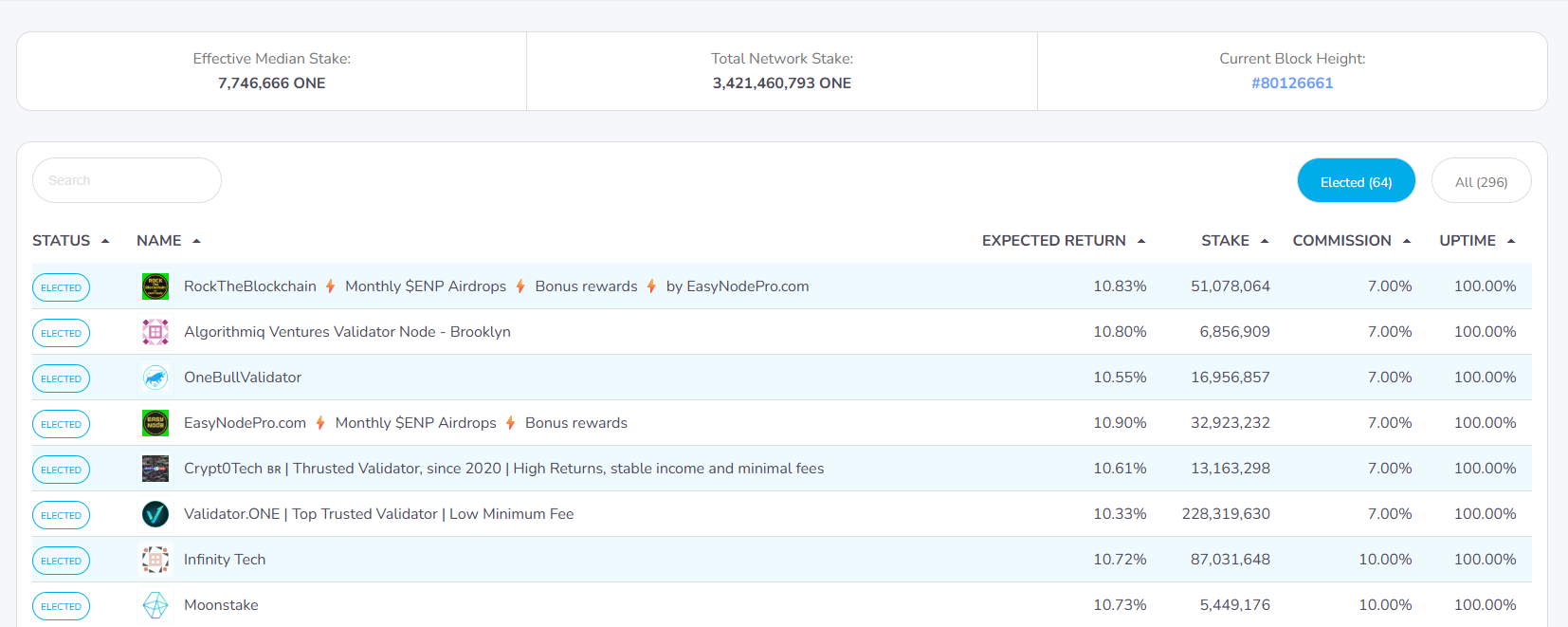
Despite recovering from a major bridge hack in 2022, Harmony remains active and offers a competitive reward for those helping secure the network.
3. Juno (Cosmos Ecosystem)
Minimum stake: ~1,000 JUNO (~$70)
Annual rewards: ~20–30% APY
Setup: Moderate (Tendermint-based)
Juno is a community-driven smart contract platform in the Cosmos ecosystem. Technically, there’s no minimum stake, but to be in the active validator set, you’ll need enough JUNO to rank among the top 125.
At current prices, this amount can be well under $100. The network offers high rewards—up to 30% APY—due to its inflationary token model. Setting up a validator account involves installing a Cosmos SDK node and managing keys via the command line.

Juno is suitable for validators looking for strong community engagement and a high-reward opportunity.
4. Mina Protocol
Minimum stake: No fixed minimum
Annual rewards: ~7–12% APY
Setup: Moderate
Mina is known for its lightweight blockchain architecture. With a chain size under 25 KB, validators can run nodes on low-resource hardware like basic laptops or cloud VMs.
There’s no slashing, and anyone with a small amount of MINA can validate and earn rewards. Mina uses a proof-of-stake model where rewards are proportional to the stake, and performance depends on uptime.
The project is active in zero-knowledge research and offers an accessible path to becoming a validator for those with limited capital.
5. Casper Network (CSPR)
Minimum stake: No fixed min; must rank in top 100 validators
Annual rewards: ~8–10% APY
Setup: Moderate
Casper uses an auction system to select the top 100 validators based on bonded stake. With enough delegations, you can enter the set even with less than $1,000 worth of CSPR.
Validators run Rust-based nodes with moderate specs. The network targets enterprise use cases and maintains consistent reward payouts via protocol inflation.

Casper continues to roll out updates focused on scalability and validator sustainability, including implementing a minimum commission fee.
Final thoughts
Becoming a validator is no longer limited to large investors or institutional players. These five networks require $1,000 or less. You can easily participate in blockchain security and earn passive income through staking.
Each project has its own setup requirements and reward mechanisms, so it’s important to assess your technical comfort level and long-term goals.
Whether you’re just starting out or want to expand your validator portfolio, these networks offer an accessible and practical way to passive crypto income.
An alternative: delegated staking
If running a validator feels too technical or time-consuming, delegated staking offers an easier alternative. Most proof-of-stake networks allow you to delegate your tokens to a validator of your choice.
While you won’t run the hardware yourself, you’ll still earn a share of the staking rewards, minus a small commission.
Delegation is ideal for passive holders who want to support network security and earn yield without the operational overhead.



 Thank you for your feedback! We’re glad you found this article helpful.
 An error occurred while sending the form, please try again.
 We are sorry. You've already sent a message within the last 60 seconds. Please wait before sending another.
 Thank you for letting us know! Our team will review your feedback to help improve our content.
We're sorry you did not find what you were looking for. Please select the reason this article was not helpful.