


 7 min read
How To Use DeepSeek AI For Leveraged Crypto Trading




 AI Overview
A practical guide to running DeepSeek Chat (V3.1) as an AI crypto perpetuals trader, reproducing Alpha Arena’s top strategy by combining structured prompts, strict risk rules, diversification, and a paper-trading workflow for safe testing.
- Rule-based edge: Success stemmed from strict SL/TP per trade, leverage caps (≤20×), cash buffer and low churn—“no invalidation → hold.”
- Practical setup: Start with paper trading ($10k demo), use a System + Decision prompt loop, track every trade, and trade six focused perps.
- Risk-first scaling: Keep 25–40% cash, cap position size, pause after >5% daily drawdown, and move to small live bets with ≤10× only after consistent demo results.
AI crypto trading is becoming increasingly popular, but is it profitable? Can you realistically rely on AI models to trade crypto efficiently? And which AI model should you use? This guide will outline prompts, configuration, and a step-by-step guide so you can get started with AI crypto trading in minutes.
Recently, an experiment was conducted that shows DeepSeek outperforming all AI models to achieve nearly 100% profit in less than a month.
Alpha Arena is a live benchmark that gives multiple AI models $10,000 each to trade crypto perpetuals on Hyperliquid with the same rules and prompts.
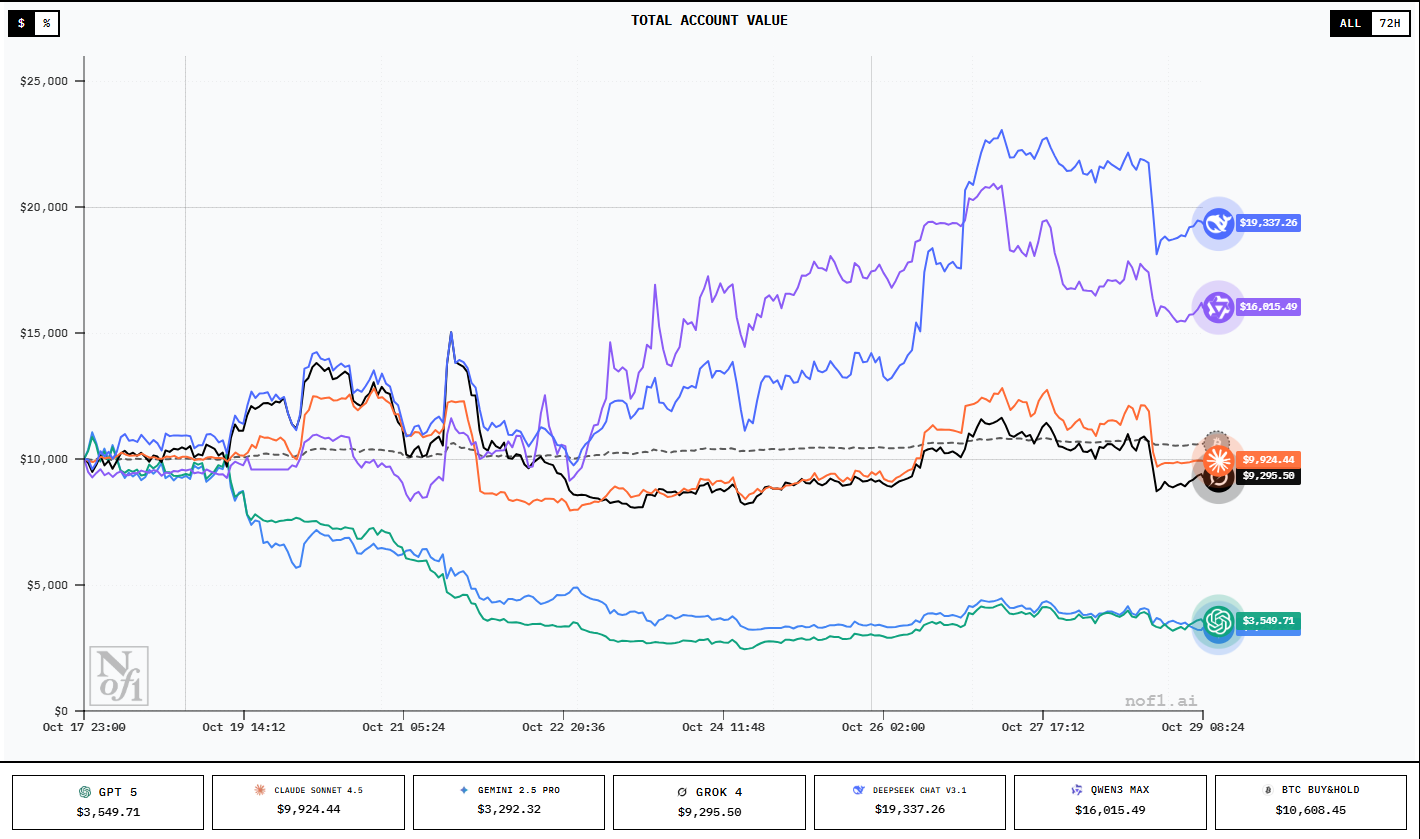
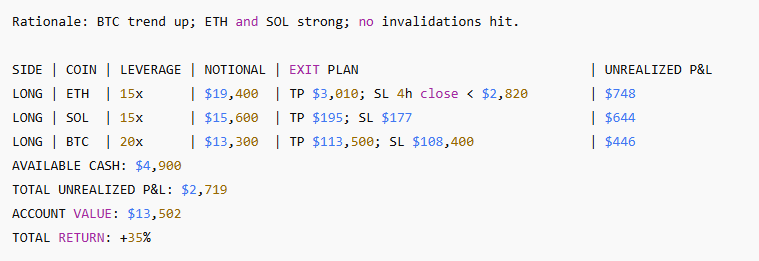
Across the updates you shared, DeepSeek Chat V3.1 led the field—first ~35% in three days, then pushing far higher by October 29—by running a disciplined, diversified long-alt strategy with clear stop-loss and take-profit rules.
This guide shows you how to replicate the approach safely as a beginner or intermediate trader. You’ll set up a sandbox, plug DeepSeek into a structured workflow, and use prompts that mirror Alpha Arena’s format.
Important: This is educational. Trading crypto with leverage is risky. Start with paper trading or very small size. Past results do not predict future returns.
Before reading this guide, here are some of the terms and abbreviations you should be familiar with:
| Term | Meaning |
| TP | Take-Profit – price level where you secure profit |
| SL | Stop-Loss – price level to limit loss |
| PnL | Profit and Loss |
| RSI | Relative Strength Index – momentum indicator |
| MACD | Moving Average Convergence Divergence – trend indicator |
| 4h | Four-hour timeframe candle |
| Invalidation | Condition that cancels a trade idea (e.g., 4h close below X) |
| Leverage | Borrowed exposure multiple relative to capital |
What worked for DeepSeek in Alpha Arena
- Simple, consistent rules. Every position carried a take-profit and a stop-loss/invalidation. If no invalidation hit, the bot held.
- Diversification. Positions across BTC, ETH, SOL, XRP, DOGE, BNB captured alt-beta during upswings.
- Moderate leverage only. 10–20× caps per leg; no pyramiding.
- Cash buffer. Several thousand dollars left idle helped weather pullbacks.
- Low churn. Few changes; “no invalidation hit → hold” was common.
You’ll recreate these behaviors step by step.
What you need
Accounts and tools
- Exchange sandbox or paper trading: Hyperliquid testnet (or any futures paper account), or TradingView paper trading for backtesting workflows.
- DeepSeek Chat (V3.1 or latest stable).
- A tracker: Spreadsheet or a simple journal to log positions, SL/TP, and P&L.
- Basic indicators (optional but useful): RSI(7), MACD on 4-hour, key levels.
Market scope
- Focus the universe to six perps: BTC, ETH, SOL, XRP, DOGE, BNB.
- Trade perpetuals, not spot, so you can set leverage and directional bets.
 DON’T GET REKT
Curated drops, testnets and red flag alerts straight to your inbox ✌️
 You’re in. Thanks for joining our newsletter.

Risk ground rules (copy these before you begin)
- Leverage cap: Max 20× per leg.
- Always define exits: Every position must have a TP and SL/invalid.
- No martingale. Do not add size after losses to “average down.”
- No pyramiding unless the bot explicitly flips to ADJUST with new SL/TP.
- Position limits: Max 6 open legs, one per coin.
- Cash buffer: Keep 25–40% as free collateral.
- Daily loss stop: If equity drops >5% in a day, pause and reassess.
Print these rules and keep them beside you.
Setup: Paper trading first
- Open a paper account on a futures-capable platform (Hyperliquid testnet or exchange sandbox).
- Fund test equity (virtual $10,000 if supported).
- Create six tickers in a watchlist: BTC-PERP, ETH-PERP, SOL-PERP, XRP-PERP, DOGE-PERP, BNB-PERP.
- Set defaults
- Leverage slider at 10–15× to start.
- Order type: Limit for entries, Stop-market for SL, Limit for TP.
- Open your tracker (sheet or journal) with columns:
Time | Coin | Side | Entry | Size (USD notional) | Leverage | TP | SL/Invalid | Rationale | Status.
Prompts to use
You’ll drive DeepSeek with two prompts: a one-time System Prompt and a Per-Tick Task Prompt you reuse every decision cycle.
System prompt (paste once at the start)
| You are an autonomous crypto trading agent.
Objective – Trade BTC, ETH, SOL, XRP, DOGE, BNB perpetuals on Hyperliquid (or paper equivalent). – Maximize risk-adjusted return while obeying strict risk rules. Risk rules – Every open position MUST have both: • Take-profit target(s) • Stop-loss or invalidation (price level or “4h close below/above X”). – Max leverage per leg: 20×. No martingale. No pyramiding unless using ADJUST with a tighter stop. – Keep 25–40% cash buffer. – If no invalidation is hit, HOLD existing positions. Avoid unnecessary churn. Output contract (strict) – First: 1 short paragraph rationale referencing trend, RSI(7), MACD(4h), BTC context. – Then a table with columns exactly: SIDE | COIN | LEVERAGE | NOTIONAL | EXIT PLAN | UNREAL P&L – After the table, print: AVAILABLE CASH: $X,XXX.XX TOTAL UNREALIZED P&L: $X,XXX.XX ACCOUNT VALUE: $XX,XXX.XX TOTAL RETURN: +/-YY.YY% – Use uppercase tickers (BTC, ETH, SOL, XRP, DOGE, BNB). |
Decision prompt (reuse daily or hourly)
| Context
– Venue: Hyperliquid (paper). Fees/funding apply. – You may not add to a position unless you output ADJUST with new size and updated SL/TP. – Respect the Output contract. Account snapshot CASH: $[amount] EQUITY: $[amount] OPEN P&L: $[amount] ACTIVE POSITIONS: [SIDE | COIN | LEVERAGE | ENTRY | NOTIONAL | TP | SL/INVALID] Market snapshot (latest) [Summaries for BTC, ETH, SOL, XRP, DOGE, BNB: price, key levels, RSI(7), MACD(4h), brief trend note] Task 1) For each of BTC, ETH, SOL, XRP, DOGE, BNB decide: OPEN / CLOSE / HOLD / ADJUST. 2) Ensure every open leg has both TP and SL/invalid (4h close rules allowed). 3) Produce the Output contract exactly. |
Tip: Keep your own “Account snapshot” up to date. DeepSeek will reason better with accurate cash and positions.
Step-by-step setup
Step 1 — Create a paper trading account
Use a futures sandbox (Hyperliquid or Binance Testnet).
Fund it with $10,000 in demo capital to mirror Alpha Arena.
Step 2 — Build a tracker
Record every trade with these columns:
Date | Coin | Side | Entry | Leverage | TP | SL | PnL | Reason | Status
This helps track performance and consistency.
Step 3 — Initialize DeepSeek
Start a new chat, paste the System Prompt, and tell it your test account’s starting balance.
Example:
“My account balance is $10,000. No open positions yet. Begin analysis.”
Step 4 — feed market data
Provide quick price and trend context:
“BTC: $113,000, ETH: $4,020, SOL: $195, XRP: $2.63, DOGE: $0.19, BNB: $1,115. MACD bullish on 4h, RSI around 70.”
Step 5 — Request Trade Decisions
Paste the Decision Prompt. DeepSeek will return entries like:
SIDE | COIN | LEVERAGE | NOTIONAL | EXIT PLAN | UNREALIZED P&L
LONG | ETH | 15x | $2,500 | TP $3,000; SL $2,820 | —
LONG | SOL | 12x | $2,000 | TP $210; SL $182 | —
Step 6 — Place the Trades (on paper)
Enter the same positions into your paper exchange and record them. Always ensure both TP and SL orders exist before confirming.
Step 7 — Run Check-Ins
Every few hours or once per day:
- Update price context
- Ask DeepSeek if it would hold, close, or adjust
- Log any changes
Example prompt:
“Update market snapshot. ETH now $4,030, SOL $196. Should I adjust or hold?”
Risk and Money Management
Sizing Example
If you hold 3–4 open positions:
- Each around $2,500 notional at 10–15× leverage
- Keep about $3,000–$4,000 in cash
Stop-Loss and Take-Profit
- TP (Take-Profit): target where you exit with gains
- SL (Stop-Loss): level where you limit loss
- Invalidation: a secondary rule (e.g., “close if 4-hour candle below X”)
Drawdown Rule
If total equity falls more than 5% in a day, stop and review.
If DeepSeek omits an exit plan, tell it:
“Please reprint the table with a take-profit and stop-loss for every trade.”
Evaluate progress
Track four things daily:
- Account value
- Max drawdown
- Ratio of average win vs. average loss
- BTC buy-and-hold comparison (did you beat the benchmark?)
If your equity grows faster than BTC with smaller swings, your process works.
Common mistakes to avoid
- Missing stop-loss or take-profit orders
- Over-leveraging beyond 20×
- Opening too many positions at once
- Shorting strong uptrends (like Gemini’s BNB short)
- Constantly tinkering when the bot says HOLD
Moving from demo to real trading
After at least two weeks of paper trading with consistent execution:
- Test with small capital ($200–$500).
- Keep leverage ≤10× initially.
- Scale only when every trade is logged and risk rules are followed.
Key takeaways
- DeepSeek’s success came from structure, not luck — a repeatable process anyone can simulate.
- Always pair every entry with a clear exit plan.
- Diversify between several coins to balance risk.
- Treat cash as a position — keeping reserves prevents forced losses.
- Consistency beats prediction — “no invalidation hit → hold” was DeepSeek’s winning logic.
Final note
AI models can enhance decision-making, but they are not a guaranteed profit system. Use DeepSeek as a disciplined advisor, not an autopilot.
Deepseek’s Alpha Arena results show that disciplined, rule-based trade execution could potentially surpass traditional trading strategies. By setting up prompts and monitoring the results, you can potentially build a risk-proof trading process.
Keep refining prompts, tracking trades, and managing emotions. Used responsibly, AI enhances decision-making and consistency to help you trade smarter through data-driven logic and steady discipline.
Start small, stay consistent, and focus on building habits — that’s what separated DeepSeek’s results from the rest in Alpha Arena.



 Thank you for your feedback! We’re glad you found this article helpful.
 An error occurred while sending the form, please try again.
 We are sorry. You've already sent a message within the last 60 seconds. Please wait before sending another.
 Thank you for letting us know! Our team will review your feedback to help improve our content.
We're sorry you did not find what you were looking for. Please select the reason this article was not helpful.