


 2 min read
Symbiotic Protocol Explained: Restaking Player Climbs The Ranks



 AI Overview
Symbiotic Protocol raised $29 million to expand a modular restaking framework that enables permissionless restaking of ERC‑20 assets across chains, driving rapid TVL growth and positioning itself as a multi‑asset security layer for dApps and institutional users.
- Modular, asset-agnostic security: Vaults, operators, resolvers and flexible collateral let projects plug in staking for any ERC‑20 without bespoke infrastructure.
- Rapid TVL momentum: Surpassed $877M (third in restaking) with a 14.2% weekly increase, outpacing some incumbents in recent performance.
- Strategic differentiation: Cross-chain, multi-asset support and developer-first composability offer a scalable alternative to ETH-only restaking leaders.
Symbiotic Protocol is quickly emerging as one of the most innovative players in the restaking sector.
With a fresh $29million in funding from top-tier investors, including Pantera Capital and Coinbase Ventures, the protocol is expanding its modular restaking framework that supports a broad range of ERC-20 assets, not just ETH derivatives.
This strategic raise puts Symbiotic in a strong position to scale its infrastructure and further cement its role in redefining how decentralized applications (dApps ) secure themselves across multiple blockchain ecosystems.
What is Symbiotic Protocol?
At its core, Symbiotic is building a universal coordination layer for staking and restaking across decentralized networks. Unlike conventional staking models that often confine participants to a single blockchain or a native asset like ETH, Symbiotic enables permissionless restaking of any ERC-20 asset across compatible chains.
The protocol is modular by design. Its architecture includes:
- Vaults that manage delegations
- Operators who run node infrastructure
- Resolvers responsible for dispute resolution and slashing
- And a collateral system flexible enough to accommodate assets beyond ETH derivatives.
This composability allows developers and protocols to plug into Symbiotic’s security layer without building custom solutions from scratch. It’s a developer-first platform tailored for the multi-chain future, aiming to lower the barrier to entry for projects that need robust, scalable security.
Current position and TVL growth
According to the latest data from DeFiLlama, Symbiotic has surpassed $877m in Total Value Locked (TVL), ranking it third among restaking platforms. It follows only EigenLayer, which leads the category with $7.9billion, and Babylon Protocol, which holds $4.6bn.
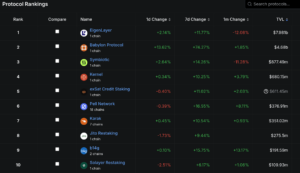
However, Symbiotic’s momentum is its most compelling metric. Over the past week, the protocol has recorded a 14.2% increase in TVL, outpacing EigenLayer on daily performance. This growth stands out in contrast to the broader restaking sector, where many protocols have seen a decline in TVL over the past month.
Such outperformance in a downtrend suggests that Symbiotic’s value proposition, flexibility, asset diversity, and modularity resonate with developers and institutional participants alike.
A fragmented yet growing restaking landscape
The restaking ecosystem is rapidly expanding, with EigenLayer maintaining dominance thanks to its ETH-native approach and early-mover advantage. Yet, Symbiotic is carving a unique path by supporting cross-asset and cross-chain functionality.
Other competitors like Kernel, Pell Network, and Jito Restaking are starting to gain traction but still lag significantly in TVL. Symbiotic’s early integrations with emerging chains and its support for a broader spectrum of staking assets could give it a lasting edge in a market that’s becoming increasingly diversified.
As the competition heats up, Symbiotic’s modular, open approach may be the key to unlocking new decentralized security forms while offering investors and builders a compelling alternative to ETH-only restaking models.



 Thank you for your feedback! We’re glad you found this article helpful.
 An error occurred while sending the form, please try again.
 We are sorry. You've already sent a message within the last 60 seconds. Please wait before sending another.
 Thank you for letting us know! Our team will review your feedback to help improve our content.
We're sorry you did not find what you were looking for. Please select the reason this article was not helpful.

 You’re in. Thanks for joining our newsletter.
