


 3 min read
Treasury Secretary Nom Opposes CBDCs During Senate Hearing


 AI Overview
Scott Bessent, Trump’s Treasury nominee, told the Senate he opposes a US central bank digital currency, arguing dollar holders already have ample secure investment options. His view could pause or reverse federal CBDC work even as other major economies speed up digital-currency programs.
- Potential policy shift: Bessent could halt or reverse federal CBDC research and rulemaking, reshaping the U.S. digital-asset agenda.
- Rationale & market view: Argues a US CBDC is unnecessary because dollar holders already access a wide set of secure assets, unlike some other countries.
- Geopolitical risk: As China and many G20 nations advance pilots and cross-border projects, U.S. retreat could cede payments influence and standards.
Scott Bessent, president-elect Trump’s Treasury Secretary nominee, yesterday expressed firm opposition to implementing a US Central Bank Digital Currency (CBDC) during his Senate confirmation hearing.
The American investor and hedge fund manager’s testimony before the Senate Finance Committee outright rejected the need for a digital dollar. He argued that CBDCs primarily serve nations lacking strong investment alternatives.
This potential policy reversal comes at a time when major economies like China have already deployed CBDCs. Here’s a closer look at his arguments against CBDCs.
Bessent sees no necessity for US CBDC
During Thursday’s Senate confirmation hearing, Bessent expressed his opposition to implementing a US CBDC. Speaking to the Senate Finance Committee, he said: “I see no reason for the US to have a central bank digital currency.” He explained that CBDCs primarily serve countries with limited investment options in their domestic markets.
Bessent elaborated on this view by contrasting the US financial ecosystem with that of other nations. He pointed to countries like Saudi Arabia and Singapore, which often accumulate foreign currencies but face limited investment options in those currencies’ domestic markets.
In contrast, Bessent stated that US dollar holders have access to “a variety of very secure US assets”, eliminating the need for a CBDC.
The Treasury Secretary nominee’s position is quite different from the current federal initiatives. Under the Biden administration, various agencies have been actively researching digital dollar possibilities following a March 2022 executive order for the “responsible development” of digital assets.
If confirmed when Trump takes office on 20 January, Bessent would be positioned to potentially halt or reverse these research projects.
When asked by Democrat Senator Ben Luján about anti-money laundering (AML) and whether Congress will have added transparency regarding suspicious activity reports at the Financial Crimes Enforcement Network (FinCEN), Bessent replied: “There is a sleeve of Treasury called TFI, terrorism finance, that deals with this within FinCEN. And I believe that we have to have a 2025 approach to – as you and I talked about – digital currencies and all branches of government. So yes.”
Global CBDC race continues without the US
The potential US withdrawal from CBDC development is quite different in comparison to the rising pace of digital currency projects worldwide. According to the data from Atlantic Council, every G20 nation is currently exploring CBDCs, with 19 countries in advanced stages of development. Of these, 13 nations, including major economies like Brazil, Japan, India, Australia, and Russia, have already entered the pilot phase.
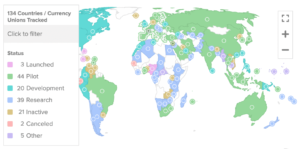
Three nations have fully implemented CBDCs, the Bahamas, Jamaica, and Nigeria, with the latter two reporting notable increases in digital currency adoption. Notably, China’s digital yuan program remains the world’s largest CBDC pilot, processing 7 trillion e-CNY ($986billion) in transactions across 17 provincial regions by June 2024. This is nearly a fourfold increase from the previous year’s 1.8 trillion yuan volume.
Cross-border CBDC projects have more than doubled since Russia’s invasion of Ukraine and the G7 sanctions. Meanwhile, the U.S. participates in Project Agorá, a wholesale CBDC initiative with six other central banks, even as domestic retail CBDC development faces political resistance.


 Thank you for your feedback! We’re glad you found this article helpful.
 An error occurred while sending the form, please try again.
 We are sorry. You've already sent a message within the last 60 seconds. Please wait before sending another.
 Thank you for letting us know! Our team will review your feedback to help improve our content.
We're sorry you did not find what you were looking for. Please select the reason this article was not helpful.

 You’re in. Thanks for joining our newsletter.
