


 4 min read
Wall Street Pepe ($WEPE): Meme Coin Mania Or Scam In Disguise?



 AI Overview
What’s This?
An artificial intelligence tool created this summary, which was based on the text of the article and checked by an editor. Read more about how we use artificial intelligence in our journalism.A forensic review of Wall Street Pepe ($WEPE) finds misrepresented tokenomics, shallow liquidity, anonymous operators, and concentrated whale control that enabled pump‑and‑dump dynamics and exposed presale investors to significant losses.
- Tokenomics & liquidity: Nearly full supply minted, tiny Uniswap lock (~4% of supply) and only ~$600k liquidity versus implied targets, creating extreme slippage risk.
- Control & market manipulation: Anonymous operators, reused scam patterns and a few wallets holding large stakes appear to coordinate pumps and timely dumps.
- Audit & investor risk: Token contract audited but presale mechanics were not; no vesting, opaque distribution and failed promises leave investors exposed.
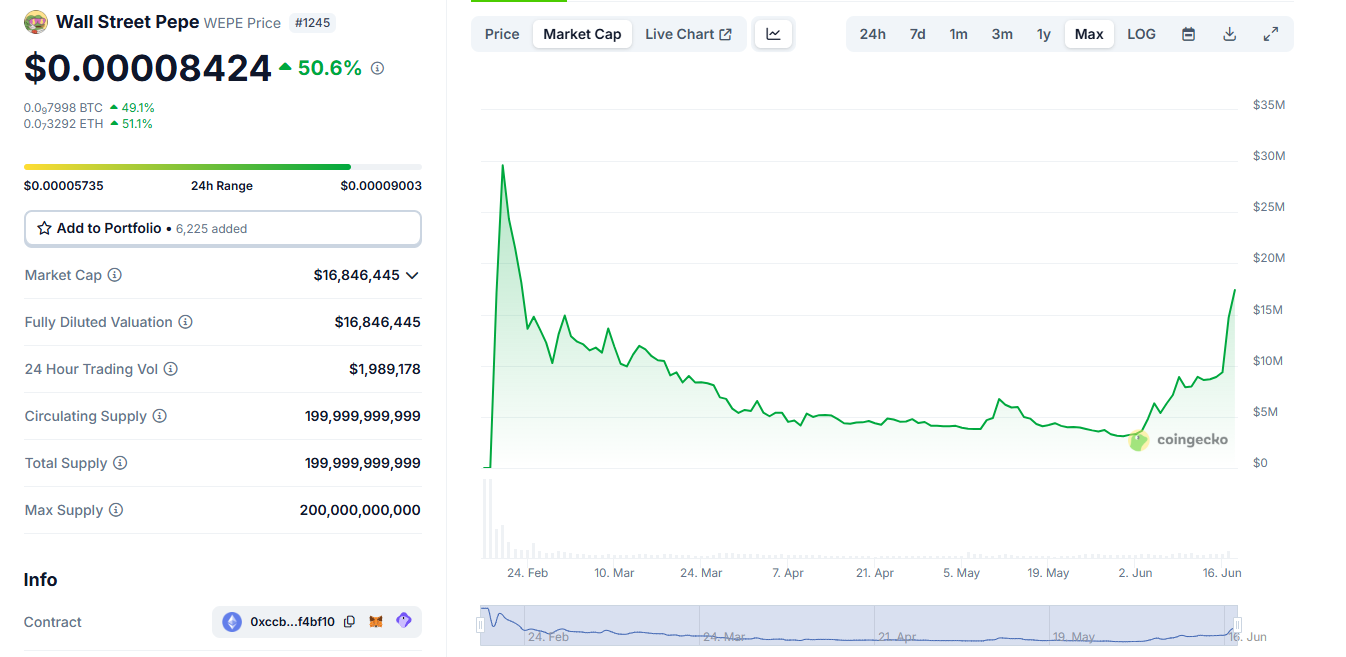
Wall Street Pepe ($WEPE) has caught the attention of meme coin traders again after a sharp price jump in mid-June 2025. With over $70million reportedly raised during its presale and social media buzzing, the token has delivered a volatile ride for speculators.
But is it a fun meme bet or a cleverly disguised rug pull? An in-depth look at its tokenomics, team structure, trading patterns, and on-chain behavior reveal troubling red flags.
Tokenomics: Oversold presale and misaligned allocations
$WEPE launched with a stated supply of 200 billion tokens, promising 73% to a multi-stage public presale. However, blockchain records show nearly the entire supply (~199.46 billion) was minted and distributed — far more than advertised.
While 15% was supposedly reserved for liquidity provisioning, only around 7.6 billion tokens (less than 4%) were ever locked in Uniswap, drastically underfunding its liquidity pool. This design created significant price fragility and allowed insiders to offload at scale.

The token contract has no mint function or fee mechanisms — meaning it can’t be arbitrarily inflated or weaponized. However, the actual distribution contradicted the whitepaper, and vesting mechanisms were non-existent. Nearly all tokens were unlocked and tradable from day one, inviting price manipulation.
Anonymous developers with questionable affiliations
$WEPE has no named founders, team members, or advisors. The issuer — ‘Wall Street Pepe Corp’ — was said to be under incorporation in the British Virgin Islands, but no formal entity documentation has been published.
The same wallet patterns, presale structure, and promotional tactics used in past alleged scams appear to be reused in $WEPE, raising credibility concerns. Despite this, the token gained initial momentum through heavy marketing and influencer campaigns.
Price performance: Classic pump and dump pattern
After its launch, $WEPE surged to an all-time high of ~$0.00033 in February 2025 before crashing over 95% in subsequent months.
It bottomed near $0.000015 by May, with modest rebounds since. Early investors reported massive losses, especially those who bought at later presale stages or on launch day.
Trading volume peaked during its listing window but declined rapidly. The price never returned to the presale highs, indicating immediate sell pressure and unsustainable token demand.
The brief June rally may reflect speculative recycling of capital, not organic growth.
Audit findings: Limited assurance
A Coinsult audit reviewed the token contract, confirming no hidden taxes, mint functions, or honeypot behavior. However, the presale contract was not audited, meaning the mechanism that handled $70m in investor funds went unchecked. This is a critical gap, given that multiple users reported failed or inflated transactions when buying tokens.
Although the token itself is sellable and doesn’t trap buyers, the process by which tokens were distributed lacked transparency. Without audit coverage of the sale mechanism, traders have no guarantee that funds were managed ethically or as disclosed.
Liquidity and exchange exposure
$WEPE is listed on Uniswap V3 and several Tier-2 exchanges including XT.COM, MEXC, and Gate.io. However, the liquidity backing these listings is shallow.
Uniswap holds ~$600,000 in paired liquidity, well below the whitepaper’s implied target of ~$4m. This creates dangerous slippage and makes the price highly vulnerable to even modest sell-offs.
No Tier-1 exchanges such as Binance or Coinbase have listed $WEPE. The coin’s speculative nature and lack of regulatory clarity likely limit its CEX exposure.
Whale control and on-chain manipulation
$WEPE has a highly concentrated ownership structure. A handful of wallets, including one tied to the presale contract, hold significant portions of supply (some over 4%). These addresses have been observed supporting the price during dips — only to sell large amounts during rallies.
Wallet activity strongly indicates orchestrated pumps. Despite thousands of small wallets holding $WEPE, a few insiders appear to dominate price action, allowing early actors to dump on new entrants.
Community control and marketing manipulation
The project’s Telegram and Discord groups are tightly moderated. Users have reported bans for posting negative feedback or discussing the token’s price decline. The project’s Twitter boasts over 30,000 followers, but analysts note many of these are likely bots or incentivized users from airdrop campaigns.
Rather than community-driven development, $WEPE appears to be a top-down marketing operation focused on hype.
Aggressive ad campaigns and influencer shills generated the early presale momentum — but engagement faded fast as price collapsed.

User complaints and scam warnings
Several users on Reddit, Coinbase forums, and Twitter allege that WEPE is part of a larger rug-pull network.
One user described the token as “100% a scam,” citing botched purchases and hidden fees. Another community audit claimed the staking feature (initially advertised at 32% APY for three years) was shut down within months.
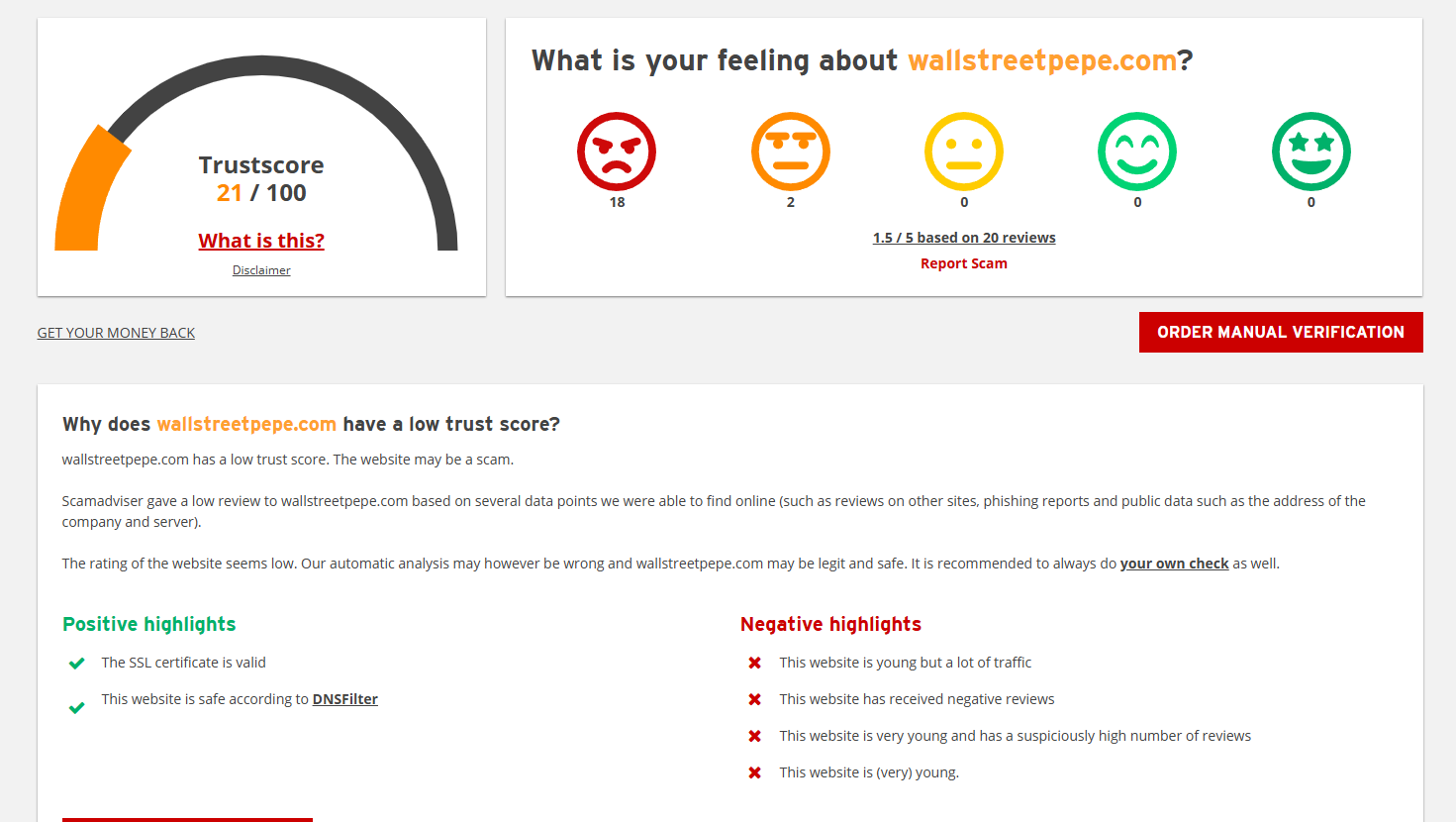
Investigators have connected $WEPE to previously failed tokens with similar branding and strategy. Combined with the anonymous team and lack of roadmap delivery, public sentiment has grown increasingly skeptical.
Conclusion: High risk, limited upside
Wall Street Pepe may not be a honeypot, but it fits the profile of a coordinated pump-and-dump . Between vague token allocation, anonymous operators, price collapse, and aggressive marketing, the evidence suggests a project built more on speculation than sustainability.
For traders, $WEPE remains an ultra-high-risk asset. Short-term speculation may be possible amid price swings, but long-term investment carries substantial risk of loss. Without transparency, roadmap execution, or meaningful liquidity backing, caution is advised.



 Thank you for your feedback! We’re glad you found this article helpful.
 An error occurred while sending the form, please try again.
 We are sorry. You've already sent a message within the last 60 seconds. Please wait before sending another.
 Thank you for letting us know! Our team will review your feedback to help improve our content.
We're sorry you did not find what you were looking for. Please select the reason this article was not helpful.