


 6 min read
USDC Yield Across Different Blockchains For Passive Income



 AI Overview
Comparison of where to earn USDC across chains and platforms, identifying lending, liquidity fees, and incentive programs as main APY sources and weighing higher returns against bridge, protocol, and custody risks.
- Primary APY sources: Borrower interest, DEX trading fees, and reward tokens— incentives can boost short-term yields but are often temporary.
- Risk–return trade-off: Solana and some L2s can reach double digits but carry higher chain and smart‑contract risk; Ethereum yields are lower but more secure.
- Practical steps: Prefer native USDC on established platforms, avoid bridged tokens if unsure, diversify across platforms, and monitor live APYs.
Circle’s USDC is one of the most widely used stablecoins in crypto. Since it is pegged 1:1 to the US dollar, many holders focus on USDC yield for passive income.
Today, blockchains and platforms provide several ways to potentially earn returns on USDC through lending, liquidity pools, and centralized programs.
This article explains the primary stablecoin APY sources, compares USDC yield across blockchains as of September 2025, and highlights key features that beginners should consider regarding cross-chain bridges and chain risk.

How to earn with USDC
Yields are not guaranteed, and they depend on the mechanics of each protocol or platform.
Lending protocols
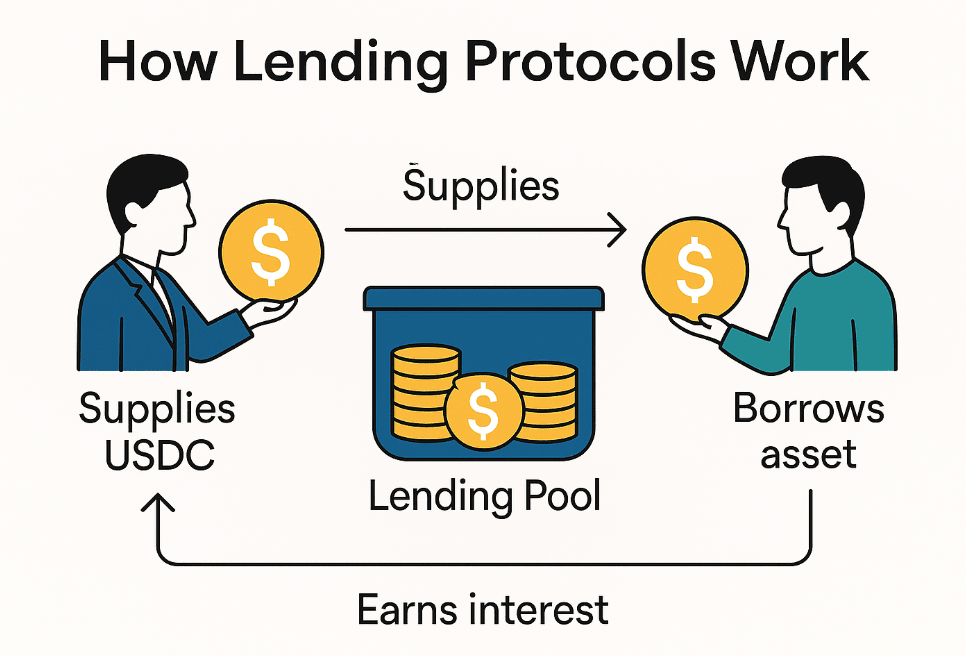
Protocols like Aave, Compound, Solend, and Benqi allow users to supply USDC into lending pools. Borrowers pay interest to use that liquidity, which becomes the depositor’s yield.
When utilization is high, USDC yield potentially rises; when liquidity outweighs borrowing demand, returns fall. Some lending markets also distribute incentive tokens that can temporarily boost returns.
Liquidity pools on dexes
On decentralized exchanges (DEXs) such as Curve, Uniswap, Orca, or Velodrome, users can provide USDC to liquidity pools. The stablecoin APY sources here are trading fees and, in some cases, reward tokens.
Pools with only stablecoins such as USDC and USDT reduce impermanent loss risk. While fees generally keep APYs in the low to mid-single digits, incentive programs may lift yields higher.
| Good to know: Impermanent loss happens when you provide liquidity to a pool with two different assets (for example, USDC and ETH) and their prices move apart.
When you withdraw your share, you may end up with more of the asset that dropped in value and less of the one that gained. This “loss” is called impermanent because if prices return to their original levels, the effect disappears. For stablecoin pairs (like USDC/USDT), impermanent loss is minimal since both tokens stay near $1. That’s why stablecoin pools are popular among beginners looking for yield without major price risk. |
Centralized and institutional programs
Centralized exchanges and custodians provide USDC yield by lending stablecoins to institutional clients or allocating them into short-term US Treasuries. Coinbase, for example, offers returns on USDC held directly in accounts. These programs remove DeFi complexity but introduce platform and custody risk.
USDC yield across major blockchains
Yields differ across chains because of utilization levels, liquidity incentives, and the role of bridges (native vs bridged USDC). Below is a comparison table of potential annualized APYs as of September 2025.
Blockchain / platform |
Potential APY range | Potential annual return on $1,000 | Main source of yield | Notes |
Ethereum (Aave v3) |
~3–5% | ~$30–$50 | Borrower interest | Stable but moderate yields. Compound v2 lower (~1–2%), Compound v3 ~3–4%. |
Base (Aave v3) |
~5–6% | ~$50–$60 | Borrower interest | Growing Coinbase-backed L2; high demand sustains higher APYs. |
Optimism (Aave v3) |
~4–5% (+ incentives) | ~$40–$50 (plus rewards) | Borrower interest + OP/VELO rewards | Velodrome stablecoin pools sometimes push returns higher. |
Arbitrum (Aave v3, Radiant) |
~4–5% (+ incentives) | ~$40–$50 (plus rewards) | Borrower interest + RDNT rewards | Incentives can increase total yield, but base APYs are closer to Ethereum. |
Avalanche (Aave v3) |
~4–5% | ~$40–$50 | Borrower interest | Native USDC supported. Benqi (bridged USDC.e) sometimes ~6%. |
Polygon (Aave v3) |
~4–5% | ~$40–$50 | Borrower interest | Comparable to Ethereum, with fewer new rewards. |
Solana (Solend, MarginFi, Kamino) |
~5–12% (variable) | ~$50–$120 | Borrower interest + trading fees + incentives | Can spike into double digits; depends heavily on demand and points programs. |
Ethereum (Curve 3pool) |
~1–3% | ~$10–$30 | Trading fees + CRV rewards | Large pool, diluted returns due to deep liquidity. |
Optimism (Velodrome pools) |
~5–8% | ~$50–$80 | Trading fees + VELO rewards | Incentivized pools provide competitive yields. |
Solana (Orca, Kamino) |
~2–10% | ~$20–$100 | Trading fees + managed strategies | Active liquidity management vaults can deliver higher APYs. |
CeFi (Coinbase USDC) |
~4–5% | ~$40–$50 | Institutional lending + T-bills | Simple for beginners, no on-chain steps. |
Other CeFi (Anchorage, etc.) |
~3–5% | ~$30–$50 | Institutional lending + treasuries | More relevant to institutional clients. |
Analysis of the most attractive options
Solana: High yields but higher chain risk
Solana often shows the highest potential USDC yield, sometimes reaching double digits when borrowing demand is intense or when points programs incentivize deposits.
However, high volatility and reliance on incentives make Solana less predictable. For beginners, Solana highlights the trade-off between high returns and chain risk — less battle-tested smart contracts and newer protocols yield potentially higher returns but carry more uncertainty.
Avalanche and Base: Mid-single digits with bridge considerations
Avalanche is unique because it has both native USDC and bridged USDC.e. Aave supports native USDC, while Benqi still uses USDC.e. Bridged assets can add extra chain risk since they depend on bridge security.
Nonetheless, both protocols offer around 5–6% APY. Coinbase layer-2 platform, known as Base, has quickly become a steady place to earn ~5% thanks to strong borrower demand.
Ethereum: Stability over maximum returns
Ethereum’s long track record and deep liquidity make it one of the most trusted environments for stablecoin APY sources. However, saturation keeps yields moderate, often ranging between 3–5%.
For users prioritizing security over high returns, Ethereum is a strong option with relatively lower chain risk.
Optimism and Arbitrum: Competitive with incentives
Optimism and Arbitrum mirror Ethereum’s base yields but offer additional incentive tokens that may push APYs higher.
These rewards can increase returns but require active management and carry the risk of token price declines. Still, both networks are considered relatively safer L2 environments compared to smaller chains.
Centralized options: Simplicity with platform risk
For those unwilling to use DeFi, Coinbase offers a yield of ~4–5% on USDC. While competitive, this yield introduces platform risk: users must trust Coinbase’s custody and operations. Compared to on-chain options, it removes bridge risk and smart contract exposure but requires relying on a centralized entity.
Tips for beginners
- Know the source: Always check whether yield comes from borrower interest, trading fees, or token incentives. High APYs often rely on incentives, which may not be sustainable in the long run.
- Account for bridges: On chains like Avalanche, decide whether to use native USDC or bridged USDC.e. Bridged stablecoins involve additional technical risk.
- Weigh chain risk: Ethereum is the most secure network, but pays less. Newer chains or L2s offer higher returns but may carry higher smart contract or liquidity risks.
- Diversify: Spread USDC across multiple platforms to reduce exposure to any single protocol or chain.
- Stay updated: Yields change frequently. Check protocol dashboards or aggregators like DeFiLlama to monitor current APYs.
Final thoughts
USDC yield opportunities vary widely across blockchains. Solana offers some of the highest potential returns but with more volatility and greater chain risk.
Avalanche and Base provide steady mid-single digits, while Ethereum remains the most reliable for conservative users.
Optimism and Arbitrum add incentive-driven opportunities, and CeFi platforms like Coinbase compete by offering simplicity and predictable returns.
For beginners, the best approach is to start with stable, transparent protocols, understand the differences between native and bridged USDC, and weigh the risks before exploring higher-yield chains.
With a clear view of the stablecoin APY sources and risks involved, USDC holders can make informed decisions about where to deploy their stablecoins.
-
01.
What is the best way to earn with USDC?
The best way to earn USDC yield is usually through established platforms like Aave on Ethereum or regulated options such as Coinbase’s USDC rewards. These rely on borrower interest or institutional lending tied to US Treasuries. While returns are moderate, they come from transparent stablecoin APY sources and carry a lower chain risk than newer or experimental platforms.
-
02.
How do bridges affect USDC yield opportunities?
Bridges create different versions of USDC, such as native USDC and bridged tokens like USDC.e on Avalanche. While both can generate yield, bridged assets add technical risk because they depend on the bridge’s security. Any vulnerability in the bridge, due to smart contracts or malicious validators, can lead to hacks. Cross-chain bridges are frequently targeted by exploiters. Higher yields on bridged USDC often reflect this extra chain risk, so beginners should understand the trade-off between convenience and safety.
-
03.
Why do USDC yields differ across chains?
Yields vary because each blockchain has different borrower demand, liquidity depth, and incentives. On Ethereum, oversupply often keeps yields lower, while chains like Solana or Base may show higher USDC yields due to growing activity or incentive-driven programs. Incentives and trading fees are also important stablecoin APY sources, but they can be temporary. Always consider how demand, incentives, and chain risk interact when comparing yields.



 Thank you for your feedback! We’re glad you found this article helpful.
 An error occurred while sending the form, please try again.
 We are sorry. You've already sent a message within the last 60 seconds. Please wait before sending another.
 Thank you for letting us know! Our team will review your feedback to help improve our content.
We're sorry you did not find what you were looking for. Please select the reason this article was not helpful.

 You’re in. Thanks for joining our newsletter.
